Asynchronous user interviews: how to interview users without scheduling a call
How to interview users without booking a call: four asynchronous formats, what each one loses, and when a live interview is still the better choice.
November 9, 2026
Godefroy
- An asynchronous user interview is answered on the participant's own time, from a link, with nobody from the team on the line.
- With recorded video questions, written questionnaires and diary studies, a vague answer usually stays vague unless someone from the team writes back, a day or more later.
- An AI-led voice interview is the only asynchronous format built to follow up on a vague answer straight away, but the AI hears only the voice.
- Keep a live call for exploratory research, for watching someone use a product and for conversations where the relationship matters.
- Read the answers as they arrive, then call back the three or four people whose answers surprised you.
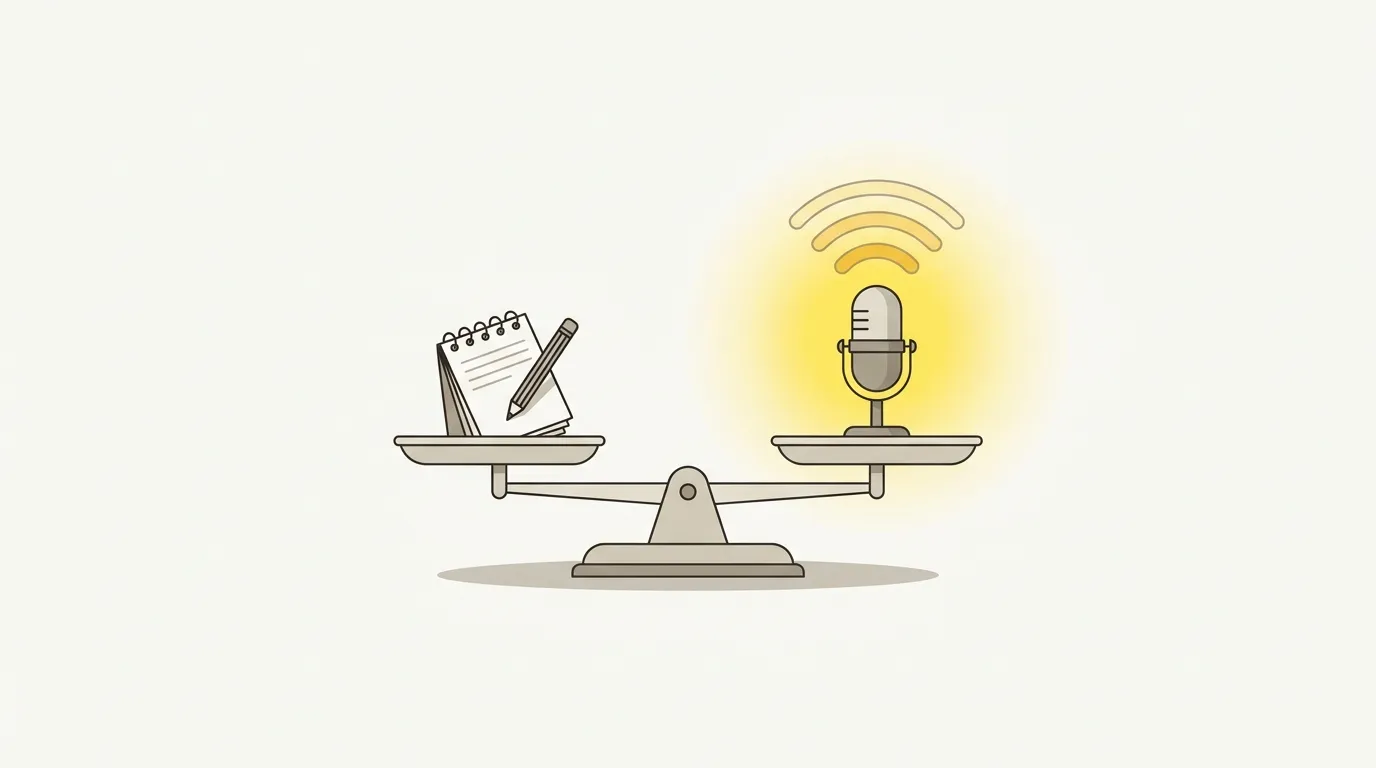
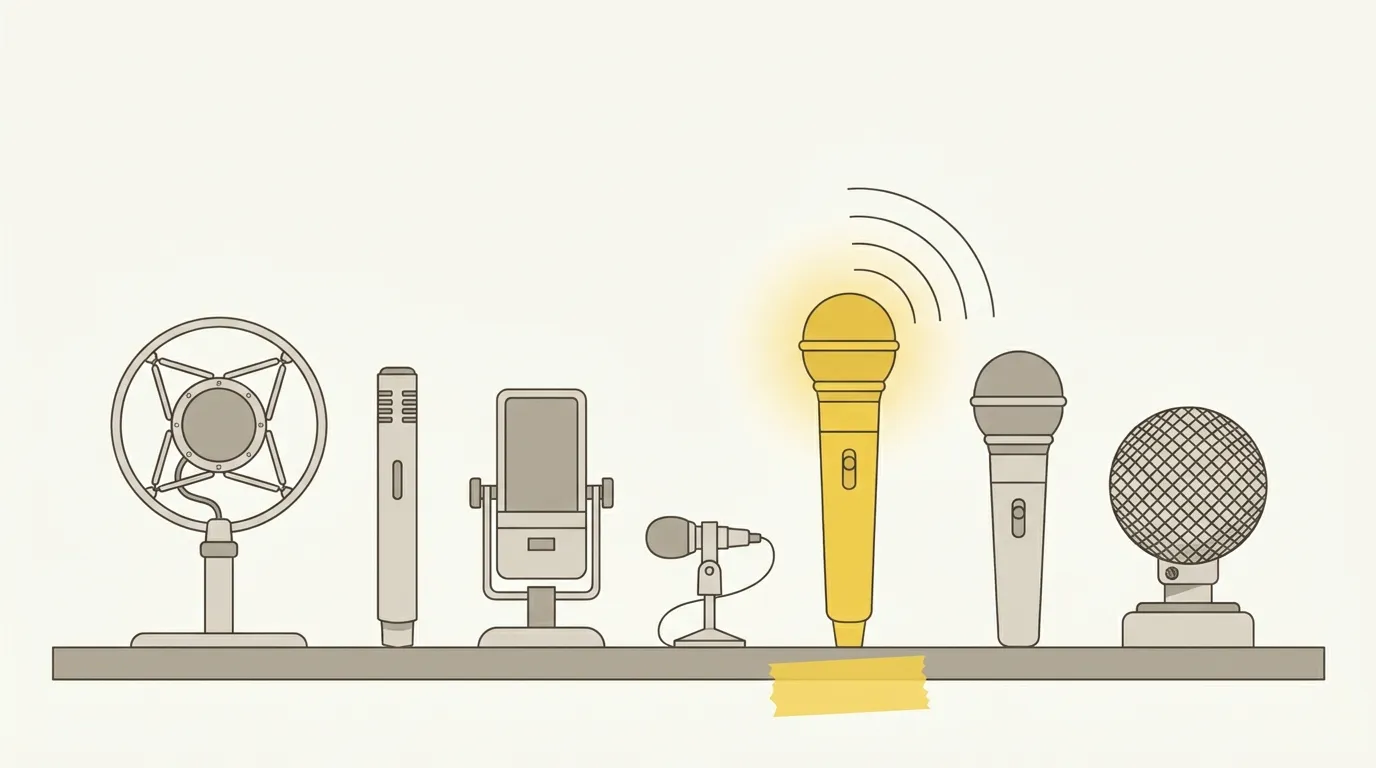
An asynchronous user interview is an interview that the participant answers on their own time, from a link, with nobody from the team on the line. You can run one without scheduling a single call, in any of four formats: recorded video questions, a written questionnaire, a diary study, or a voice interview led by an AI. The first three usually lose the follow-up in the moment: a vague answer stays vague until someone from the team writes back, if anyone does. That follow-up question is what separates an interview from a survey. The AI-led voice interview asks that follow-up straight away, but the AI only hears the voice. This page compares the four formats, says what each one loses, and lists the interviews where a live call still does better.
We build Raconte, which runs the fourth format, so we are not neutral. We say below where the other formats do better, and where a call does better than all four.
What an asynchronous user interview is
An asynchronous user interview separates the question from the answer in time. The team prepares its questions once, each participant answers when it suits them, and the team reads the answers afterwards. Nobody books a slot or sits in while the person answers. It stays an interview as long as the questions are open and ask people to describe their own experience in their own words.
In an unmoderated usability test, people complete tasks on a product while their screen is recorded, so the test shows what they do with an interface. The asynchronous interview collects what they lived through and why. A survey with closed questions shows how many people picked each answer, and rarely why.
Why teams drop the live call
A live interview costs more than its forty-five minutes. Someone has to find a slot in two calendars, send the invitation, handle the reschedule, run the call and write it up. Across time zones, the slot falls at seven in the morning for one of the two people. Teams that give up on weekly customer discovery interviews rarely give up because of the method. They give up because the logistics take up the week.
Asynchronous research removes the scheduling. The team writes the questions once and sends a link. Ten people or a hundred answer in the same week, in the evening, on their phone, from any time zone. People who would never accept a meeting answer too, like the customer who has no time for a call but will talk for ten minutes on the train.
The four asynchronous formats
Recorded video questions
The team records or writes a few questions, and the participant answers each one on camera, usually within a time limit. Recruiters call this a one-way video interview. Customer research teams use the same format through tools such as Typeform’s VideoAsk, where people answer by video, audio or text from their browser.
You see the face, you hear the tone, and each answer comes in one take. You lose the follow-up, since every participant gets the same questions whatever they said. Many people also dislike recording themselves. Researchers led by Ottilie Tilston at the University of Lausanne studied 27,809 job applicants across 33 companies and published their results in 2024. Applicants reacted more negatively to one-way video interviews than to traditional interviews. Their reactions improved when they had time to prepare and could re-record, and got worse as the number of questions grew. Those applicants had a job at stake, which a customer giving feedback does not. The practical lesson still holds: ask only a few questions and let people start again.
A written questionnaire or an email interview
The team sends a handful of open questions, by form or by email, and the person writes back. By email, the researcher can reply with a second round of questions. Lokman Meho, an information scientist then at Indiana University, reviewed the studies that had used the method and concluded in 2006 that email interviewing can in many cases replace face-to-face and phone interviews.
People have time to think. You also get their answers already written, with nothing to transcribe. You lose length and spontaneity, because people type much less than they say. Jan Karem Höhne, a survey methodologist, and his co-authors put the same open questions to just over a thousand smartphone users, half typing and half speaking. Typed answers averaged about 21 words, spoken answers about 55. Email does allow a follow-up, but each round adds a day or more of waiting, during which some people stop replying.
A diary study
Participants log entries over several days or weeks, each time the behaviour happens or at set intervals, in text, photos or short videos. Teams run diary studies on the phone with apps such as dscout and Indeemo. Kim Flaherty, a UX specialist at the Nielsen Norman Group, describes the diary study as a way to collect behaviours and experiences over time and in context. Her examples run from one to three weeks, depending on how often the behaviour occurs.
A diary study is the only format of the four where you can follow a habit as it forms, or a customer journey spread over several weeks. It is also the heaviest. Flaherty calls diary studies “fairly expensive and resource-intensive”, warns that more people drop out as the weeks go by, and recommends reading entries as they arrive to ask follow-up questions, then holding an interview at the end. Plan a diary study as a research project of its own, interview at the end included.
A voice interview led by an AI
The participant opens a link and talks. An AI asks the team’s questions one at a time and follows up when an answer stays vague or general, the way an interviewer would. The team gets the transcript and the audio afterwards. Outset, Listen Labs, UserCall and Raconte all build this kind of AI interviewer.
Of the four formats, this one alone is built to follow up straight away, with nobody from the team in the conversation. People also talk at length: on Raconte, 82% of invitees finish their interview, which lasts 16 minutes on average. The AI only hears the voice, though, so it sees no screen and no face. Its follow-ups are also shallower than an experienced researcher’s. It asks for the example or the episode it was told to look for, and rarely chases a thread that nobody planned. We went through the published studies on AI-moderated interviews compared with human moderators.
The four formats compared
Each format trades something away for not needing a call.
| Recorded video questions | Written questionnaire or email | Diary study | AI-led voice interview | |
|---|---|---|---|---|
| How people answer | On camera, one take per question | In writing | Text, photos or video, over days or weeks | By voice, in a conversation |
| Follow-up | None | By email, a day or more per round | The researcher writes back between entries | Straight away, on vague answers |
| Length of answers | Capped by the recording time | Short: about 21 words per typed answer (Höhne et al.) | Many short entries | Long: spoken answers run about two and a half times longer than typed ones (Höhne et al.) |
| Effort for the participant | Being on camera puts many people off | Typing every answer | Several entries over days or weeks | A few minutes of talking, on a phone or a computer |
| Effort for the team | Watching every video | Reading, then writing each follow-up round | Recruiting, reminders, daily reading, analysis | Writing the brief, then reading the transcripts |
| Observation | Face and tone | None | Photos and videos of the real setting | Voice only |
| Best for | A few standard questions you want to see people answer | Experts and people who like to think before answering | Habits and journeys that stretch over time | Discovery and feedback interviews with dozens of people |
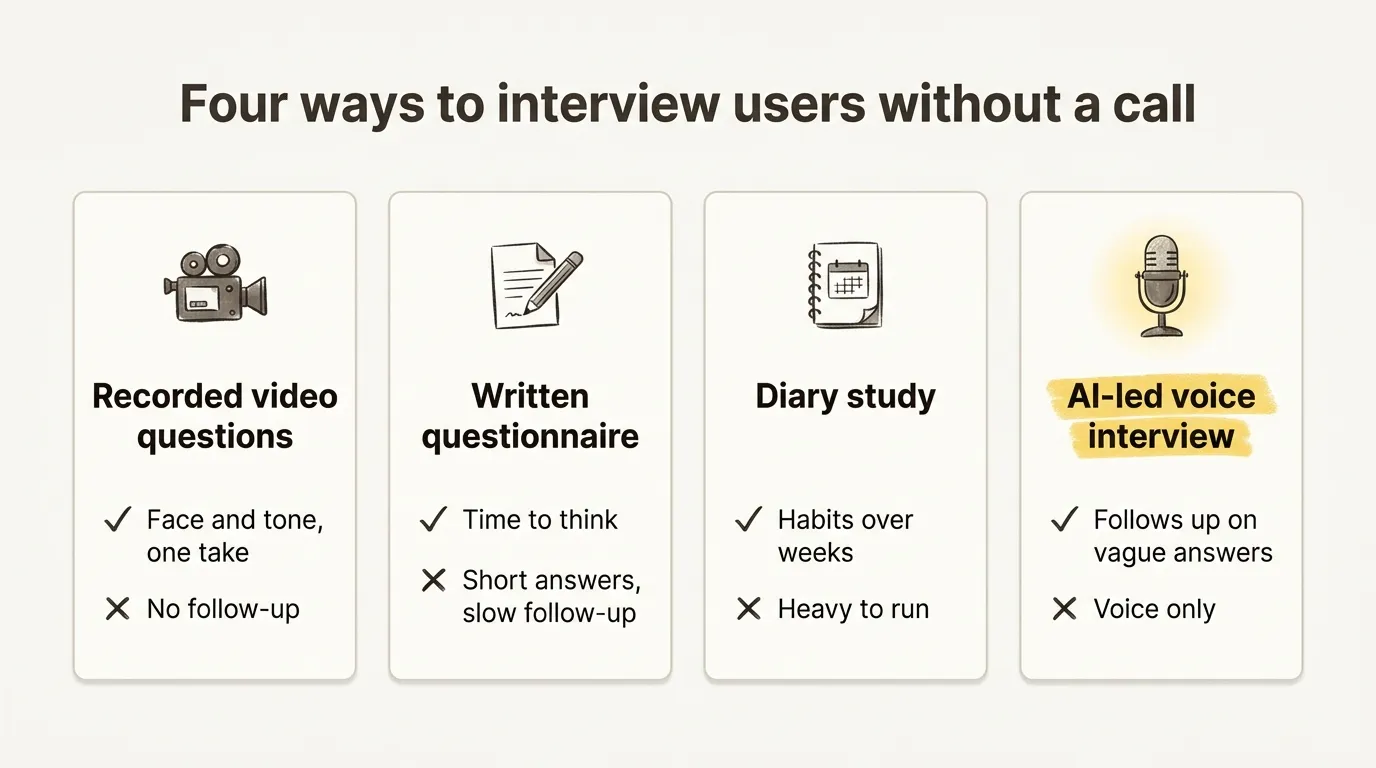
What an asynchronous interview loses: the follow-up
The follow-up is what separates an interview from a survey. When someone says “it was a bit complicated”, the interviewer asks what happened the last time, step by step. Amy Schade, then a UX specialist at the Nielsen Norman Group, described the limit of unmoderated tests in 2013: there is “no opportunity to ask detailed questions specific to the user’s actions”. Recorded video questions and written forms have the same limit.
You can make up for part of it in three ways:
- Write the follow-up into the question itself. Rather than “how do you plan your sprints?”, ask “tell me about the last time you planned a sprint: what did you open first, and what slowed you down?”
- Ask for one specific episode rather than a habit. People asked about “the last time” have to remember a real episode, so they tell a story rather than give an opinion. Rob Fitzpatrick, the author of The Mom Test, puts the rule this way: ask people about what they did, never about what they would do.
- Plan a second contact. Read the answers as they arrive, then call back the three or four people whose answers surprised you. Those few calls are worth the scheduling.
An AI-led voice interview asks the first follow-up on its own. Your callback can then focus on the threads the AI did not chase.
When a live call is still better
A live interview still does better whenever what matters happens during the conversation itself:
- In exploratory research on a problem you do not understand yet, the right questions only appear as people talk. An experienced researcher then drops the guide to follow them.
- To watch someone use a product, you need to see the screen as they use it, so you can ask on the spot why they hesitate or click.
- To design a solution with someone, you sketch or react to a prototype together.
- With a strategic account or a customer about to leave, the conversation is also part of the relationship.
- On a painful subject, trust builds as you talk. The interviewer also has to be able to slow down or stop.
For the rest, and above all when the same questions go to many people, an asynchronous format gets you more interviews for the same team time.
How to run an asynchronous user interview
- Write the guide as if you were going to run it live: the objective, five to eight open questions, and for each one what you want to hear (an episode, a figure, a workaround). An interview guide built for a live call can be reused almost as it is.
- Pick the format based on what you need to see, how long the behaviour lasts, and whether you need follow-ups.
- Test it on two or three people before sending it widely. Unclear questions show up in the first answers.
- Send the link with a deadline and a reason to answer: what you will do with the answers, how long it takes, and the incentive if there is one.
- Read the answers as they arrive rather than at the end, so you can fix a question that does not work.
- Call back the most surprising participants, live.
graph TD
  A["Write the guide: objective, 5 to 8 open questions"] --> B["Pick the format: video, written, diary or AI voice"]
  B --> C["Test it on 2 or 3 people"]
  C --> D["Send the link with a deadline"]
  D --> E["Read the answers as they arrive"]
  E --> F["Call back the 3 or 4 most surprising people, live"]
  F --> A
Tools for each format
For recorded video questions, VideoAsk by Typeform is the best-known tool outside recruiting. For the written format, any form builder works, such as Typeform or Tally, and so does plain email. Lyssna, a user research platform, generates AI follow-up questions on open answers inside its unmoderated studies, which partly makes up for the missing follow-up. Diary studies run on dedicated phone apps such as dscout and Indeemo.
For the AI-led voice interview, the tools to compare are Raconte, Outset, Listen Labs and UserCall. They differ a lot on price, languages and API access. We compared them in our ranking of user interview platforms where an AI runs the interview.
Running asynchronous interviews with Raconte
Raconte runs the AI-led voice format. You write a brief with your objective and your questions, then send each person their own link, or share one reusable link with a cap on responses and a closing date. Each person talks when it suits them, in English or French, with nothing to install. You get back the transcript, the audio, a summary and the sentiment of each answer. To compare dozens of interviews, connect Raconte to an AI assistant such as ChatGPT or Claude through the API or the MCP server, so the assistant can read the transcripts.
Every organisation gets 60 free interview minutes each month, with no card required. Past those minutes, you pay per active minute. Send your first asynchronous interview this week and read the answers as they come in.
Frequently asked questions
What is an asynchronous interview?
An asynchronous interview is an interview in which the questions and the answers happen at different times. The team prepares the questions once, each participant answers from a link whenever it suits them, and nobody from the team is present while they answer. It can take the form of recorded video questions, a written questionnaire, a diary study or a voice interview led by an AI.
Are asynchronous interviews as good as live interviews?
They are as good on known topics with clear questions, and weaker on exploratory research. Without a follow-up, a vague answer stays vague, which is the main weakness of recorded video and written formats. An AI-led voice interview follows up on vague answers but rarely chases an unexpected thread. A good split is to run most interviews asynchronously and keep a few live calls for the most surprising participants.
How can I run customer discovery interviews with dozens of customers without scheduling every call?
Write the discovery interview once, with questions about the last time each customer ran into the problem, and send it as a link that each customer answers when it suits them. An AI-led voice interview can follow up when an answer stays general and bring the person back to a specific episode. Read the transcripts each week, then call back the few customers whose answers surprised you.
What tools can I use to run asynchronous user interviews?
It depends on the format. VideoAsk handles recorded video questions, and Typeform, Tally or plain email work for written questionnaires. Diary studies run on phone apps such as dscout and Indeemo. For voice interviews led by an AI, Raconte, Outset, Listen Labs and UserCall run the conversation and follow up on the answers.
How long should an asynchronous interview be?
Keep a recorded video interview to a few questions: in a 2024 study of 27,809 job applicants, reactions to one-way video interviews got worse as the number of questions grew. On Raconte, an AI-led voice interview lasts 16 minutes on average. The diary studies the Nielsen Norman Group gives as examples run from one to three weeks, depending on how often the behaviour occurs.
Is an asynchronous interview the same as an unmoderated usability test?
No. An unmoderated usability test asks people to complete tasks on a product while their screen is recorded, so it shows what they do with an interface. An asynchronous interview asks open questions about what people lived through and why. The two often run on different tools and complement each other.