
The best user interview platforms in 2026, ranked by what they actually do
Most user interview platforms never ask a question. We compared 13 tools on who runs the interview, what it costs and whether you can call it from code.
August 1, 2026
Godefroy
Updated on October 12, 2026
- Of the twenty-five products we went through, about ten have an AI that conducts the interview itself. The rest recruit, schedule, observe or analyse.
- Four of the ten products whose AI conducts the interview gate that moderator behind an enterprise contract, a waitlist, a managed service or a panel commitment.
- Two marketing phrases cause most of the confusion: an "AI follow-up" on a survey answer and an "ask follow-up questions" assistant that queries your own data.
- Vendors that publish a price bill per session, per credit or per seat, so interview depth is rationed by quota rather than paid for as it is used.
- Close to half the AI interview products publish no price at all, so on much of this market you have to ask for the entry price in writing.
The label “user interview platform” covers products that mostly do not interview anyone. Some find participants and pay them. Some book a Zoom call for you. Some record the call and tag the transcript afterwards. A smaller group actually asks the questions.
That distinction decides which tool you need. The category vocabulary hides it well. We went through twenty-five products, read the pricing pages, the changelogs and the help centres, and sorted them by the job they really do. About ten have an AI that conducts the interview. Four of those ten only unlock it with an enterprise contract, a waitlist, a managed service or a panel commitment. The thirteen below are the ones worth your time.
Raconte publishes this article, and Raconte is one of the thirteen platforms below. We put ourselves first in the section on tools that run the interview, and the criteria that put us there are written out before the ranking so you can disagree with them. Every competitor entry describes that competitor on its own terms, with a link to its site so you can check.
Two traps caused most of our early confusion, and they will cause yours. Lyssna’s “AI follow-ups” generate probes on open answers inside an unmoderated study, with no live moderator anywhere. Userlytics, a usability testing platform, invites you to “ask follow-up questions”, which means you query an assistant about your own data. The assistant queries nobody. Both are useful features. Neither runs an interview.
How we compared them
We evaluated each platform on seven criteria.
- We look at who asks the questions: an AI agent that probes on its own, a human moderator, or nobody. This is the first filter and it eliminates most of the market.
- We record what it costs to start, because a published number beats a quote. Where a vendor publishes nothing, we say so rather than repeating a figure from a comparison site written by one of its rivals.
- We note how you buy it: you start on a card-free free tier, on a trial, or on a scoping call with sales.
- We check whether you can drive it from code. Some ship a documented REST API, webhooks or an MCP server. Some keep the API behind a minimum contract. Some have none.
- We list what it does beyond the interview: the product recruits, pays incentives, schedules, tests usability, analyses or stores.
- We check which languages it interviews in, French included, because most vendors publish a count without a list.
- We read what a vendor can show a security review: certifications, data residency and PII handling. This criterion separates the enterprise products from the self-serve ones.
The ranking is grouped by job rather than flattened into one list, because comparing a recruitment marketplace to a repository on the same scale produces nonsense. Inside the first group, we ordered by how quickly a team can start without talking to a salesperson and how much of the product is reachable from code. That axis suits a product team that already has people to talk to and wants to move this month. Rank on panel size, certifications or stimulus handling instead and the order changes, with Listen Labs, Outset and Strella moving to the top. Figures were read on each vendor’s own pages in August 2026. Where we could not find API documentation, we say so rather than asserting the API does not exist.
| Platform | Runs the interview | What it is for | Entry price | Public API |
|---|---|---|---|---|
| Raconte | Yes, voice | Async AI interviews | 60 free min/month, then $0.12/min | REST, MCP, webhooks |
| Listen Labs | Yes | AI interviews plus panel | Quote only | Not documented |
| Outset | Yes | Enterprise AI research | Quote only | Not documented |
| Strella | Yes | AI interviews with screen share | Quote only | None found |
| UserCall | Yes, voice | Async AI interviews | $89/month, 100 credits | MCP server |
| Versive | Yes, voice and text | AI interviews and surveys | $99/month, annual | Listed, undocumented |
| Whyser | Yes, voice | Async AI interviews | Free, 10 interviews/month | Business tier |
| User Interviews | No | Recruiting and research ops | $49/session | Yes, sales gated |
| Respondent | Yes, plus panel | Recruiting with AI moderation | $15/session | Yes, $20k minimum |
| UserTesting | No | Usability testing, enterprise scale | Quote only | Yes, public portal |
| Maze | Enterprise add-on | Continuous discovery suite | Free tier available | REST, webhooks, MCP beta |
| Dovetail | No | Customer intelligence | Free tier, then quote | Yes, REST, MCP, CLI |
| Looppanel | No | Interview analysis | $395/month | Enterprise only |
The AI runs the interview
These seven products put an agent in front of the participant. It asks, it listens to the answer, and it decides what to ask next.
1. Raconte
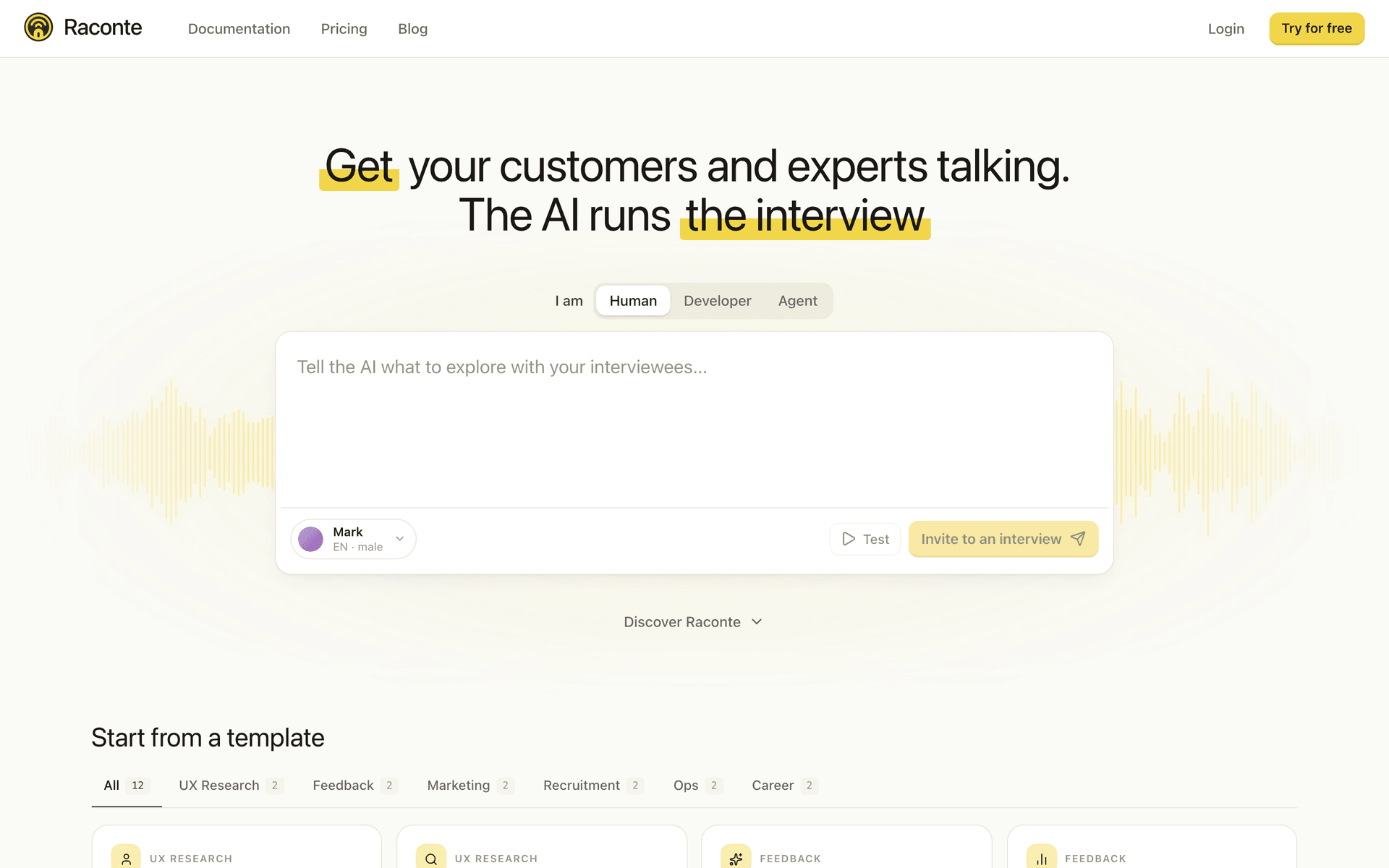
Raconte does one job: it runs the conversation. You write the interview as a prompt, then send it out as a link or by email, in bulk if you have a list. An AI agent holds a voice conversation with each person and follows up when an answer stays vague. Nobody books a slot and nobody installs anything. The transcript, per-message sentiment and a summary land a few seconds after the call ends.
The price is published. The first 60 interview minutes each month cost nothing and need no card, then it is $0.12 per minute of active speech, silences excluded, with top-ups from $12. The pricing page has the rest, and no step in that path goes through a salesperson.
For technical teams, the product is fully reachable from code, so an interview can be triggered by a product event instead of planned as a study. The OpenAPI spec is public at raconte.ai/openapi.json, @raconte/cli and @raconte/node-sdk are on npm, the MCP server exposes eight tools to any agent, and webhooks fire when an interview starts and ends.
The infrastructure is French: app, backend and database on Scaleway, and the AI providers behind the voice, the transcription and the text in France too, with every sub-processor named on the privacy page rather than described in the abstract.
The scope is deliberately narrow, and that is what makes it composable. Raconte runs the interview and stops there, with no participant panel, no prototype testing and no research repository, so it slots into the tools a team already has instead of asking them to move. The prompt is free-form, so the kind of interview is yours to decide: user research, customer feedback, exit interviews, or an agent collecting field signal on its own, and the API decides where the transcript goes next.
The voices are picked one by one for their intonation and their accent instead of being pulled wholesale from a synthesis catalogue, and the catalogue sits on a public endpoint, so you can listen to them before committing to anything.
2. Listen Labs
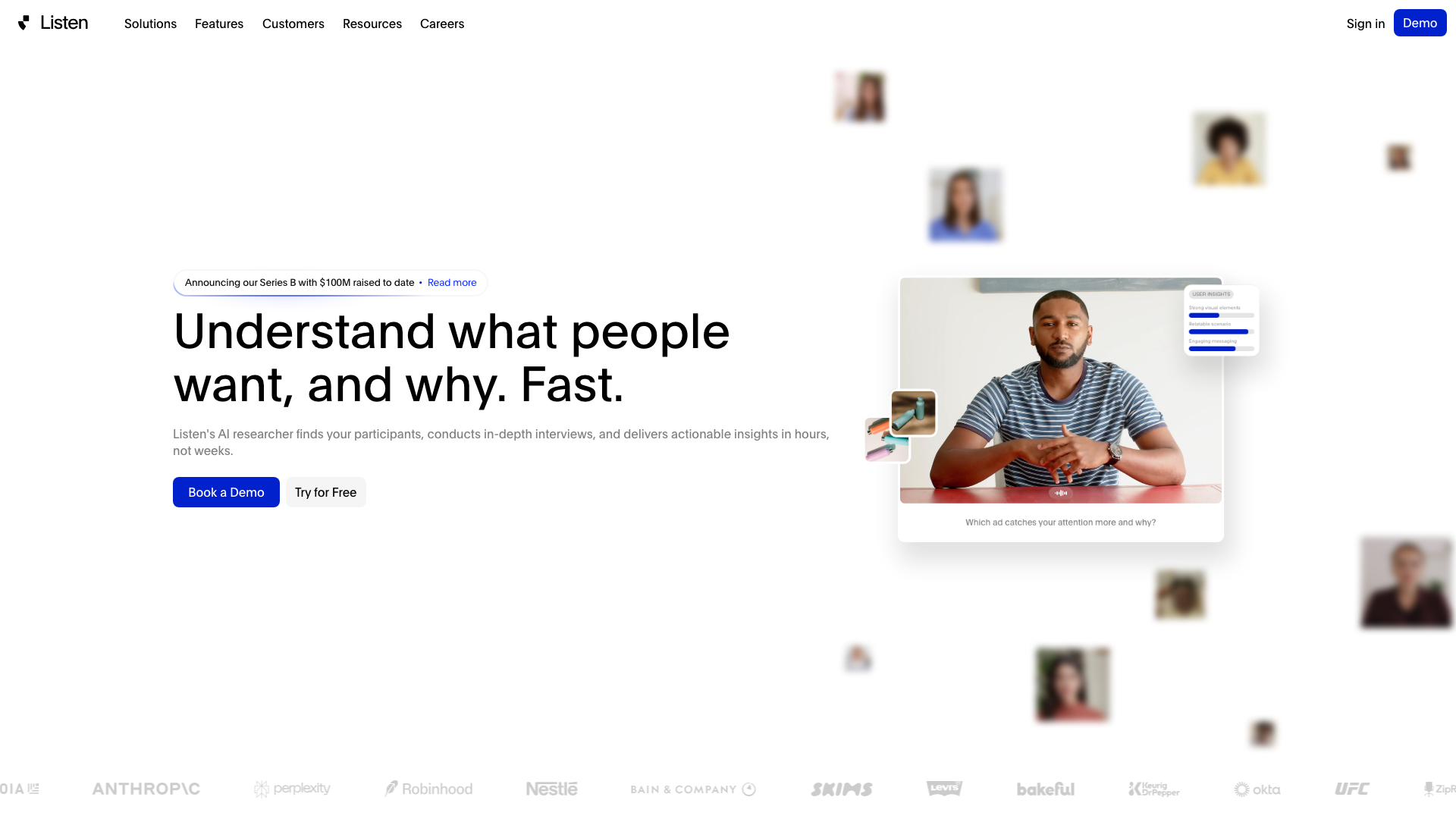
Listen Labs is the best funded pure play in this category. It raised a $69M Series B led by Ribbit Capital in January 2026 at a reported $500M valuation, bringing total funding to $100M, with Sequoia and Pear among earlier backers.
The product runs AI-led research end to end. The agent conducts the interview in video, audio or text, asks follow-up questions and works through the context of what it just heard. Listen Labs also recruits, from a network it puts at more than 30 million people, and you can bring your own participants or plug in an existing panel provider. It advertises more than 100 languages with automatic translation, and says more than a million people have been interviewed on it.
Pricing is quote only, with no figures anywhere on the site. The public documentation covers features rather than integration, and we could not find a REST reference, webhooks or an MCP server in it, so ask them directly if you need to trigger interviews from your own code. Microsoft, Anthropic, Sweetgreen and Perplexity appear as customers. If you are buying research capacity for a large organisation and want the panel in the same contract, this is the most complete vendor of the set.
3. Outset
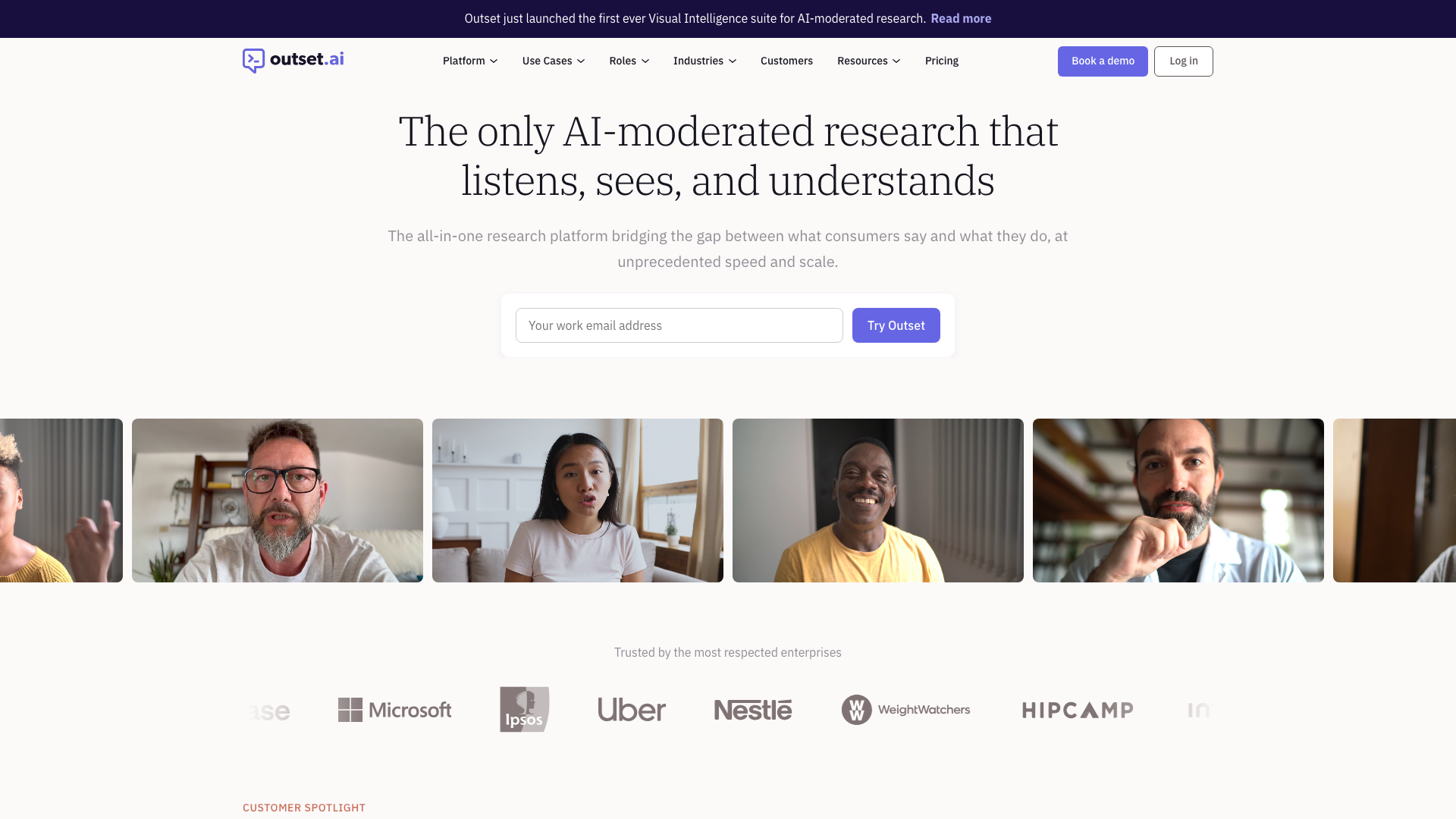
Outset raised a $17M Series A led by 8VC in June 2025, for $21M total, and sells AI-moderated research to enterprise insight teams. The agent runs hundreds of interviews at once in video, voice or text, and the pitch is built on multimodal understanding, bridging what people say and what they do.
Recruitment comes bundled if you want it, across 85 or more countries, or you send your own link. The platform ticks the enterprise checklist: SOC 2 Type II, GDPR, HIPAA, SSO and observer seats. HubSpot, Microsoft, Nestlé, Indeed and Glassdoor are named as customers.
Outset prices each engagement around the team, the research need and the support level, so there are no published numbers and the first step is a conversation. We found no public API documentation, and figures circulating in third-party buyer guides come mostly from companies competing with Outset, so we are leaving them out rather than repeating them here.
4. Strella
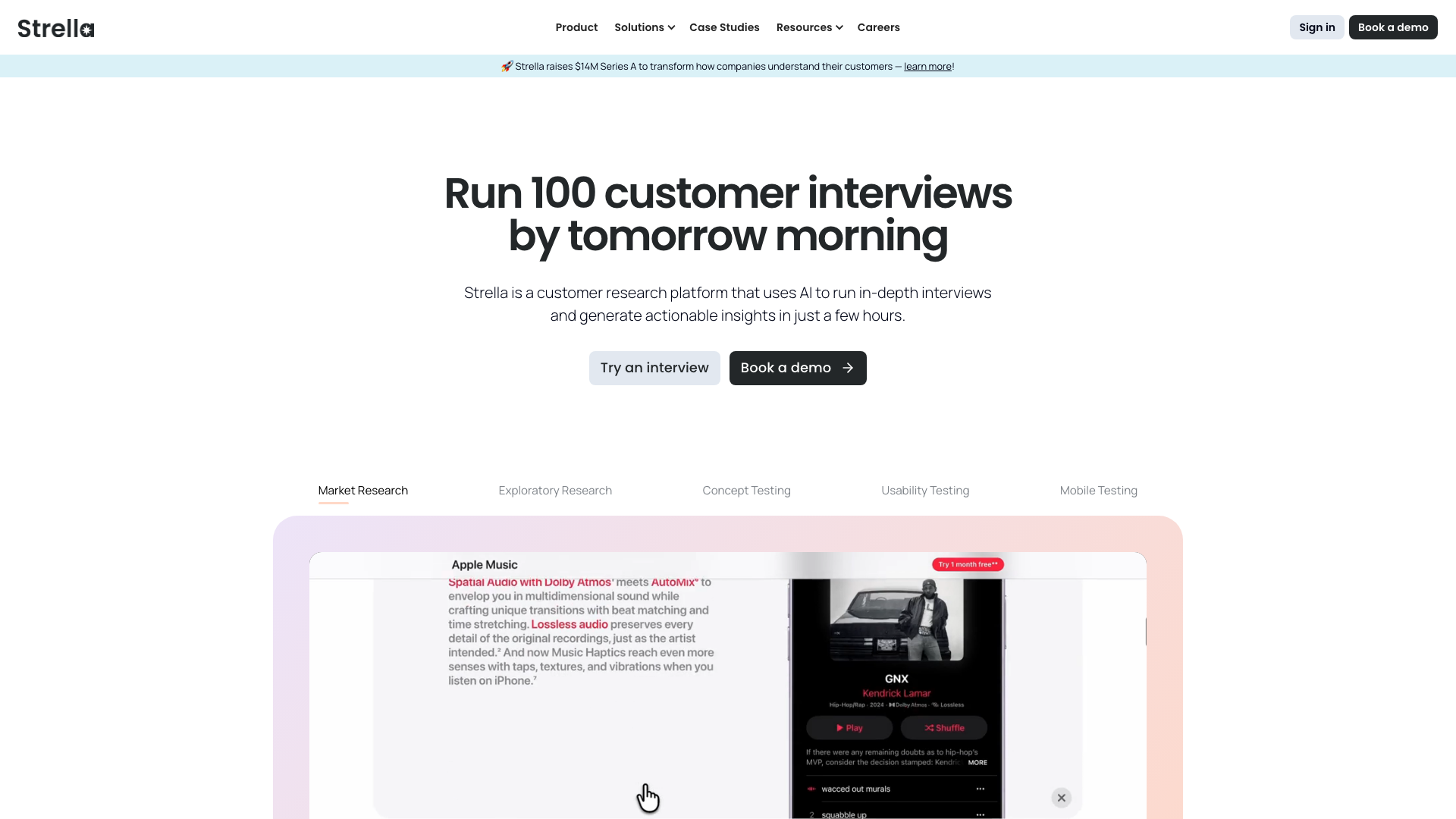
Strella was founded in 2023 in New York by Lydia Hylton and Priya Krishnan, and raised a $14M Series A led by Bessemer Venture Partners in October 2025, for $18M total.
Its AI moderator runs voice interviews that behave like a call, generating follow-ups in real time rather than walking a branching script, and it flags evasive or fraudulent respondents. Stimulus handling is where Strella differs. Participants can share their screen, and you can embed websites, prototypes, images, video or ad copy in the conversation. Researchers customise the moderator’s voice, language, speed and recording settings. Everything runs in the browser, asynchronously, on desktop or mobile. Strella recruits too, from its own panel and from third-party panels, and pays incentives within a few business days.
There is no pricing page, and we found no API, webhook or MCP surface documented publicly. Amazon, Duolingo, Chobani, Nubank and J.Crew are cited as customers, with published case studies including a claimed 24% revenue lift at Ritual from pricing research. One practical note: the site quotes two different language counts and two different panel sizes on different pages, so get both in writing before you commit.
5. UserCall
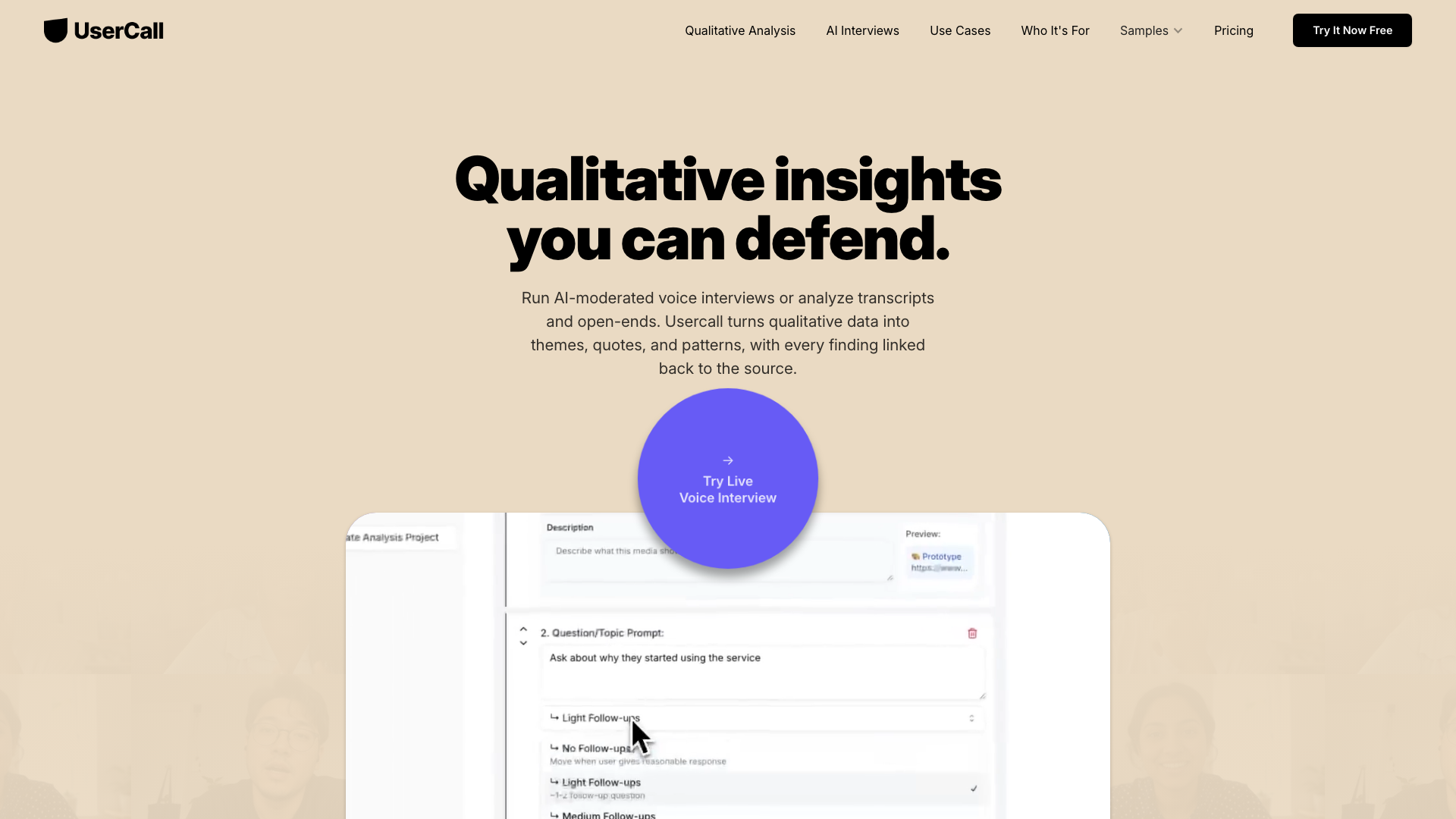
UserCall was founded in 2024 by Junu Joseph Yang, previously at IDEO, Frog and R/GA, and runs without disclosed funding. It is voice-first and self-serve, with its prices on the page.
The AI moderator holds voice interviews with adaptive probing, then hands you a thematic analysis where every finding links back to the quote it came from, which keeps the synthesis auditable. Voices and accents are customisable across more than 30 languages. Participants come from your own list or from a partner panel of more than four million people.
Pricing is credit-based and public: $89 a month for 100 credits, $199 for 300, $399 for 650, with a free trial at signup. Check what one credit buys before you compare that to a per-minute or per-session price, since the unit is not spelled out on the pricing page. The integrations point at PostHog, GA4, Mixpanel, Amplitude and Segment rather than at research tools, which tells you it is sold to product teams, and there is a public MCP server on GitHub. Electrolux, ClassDojo and Rice University are named as customers. French is absent from the visible language list, so ask them if you need it.
6. Versive
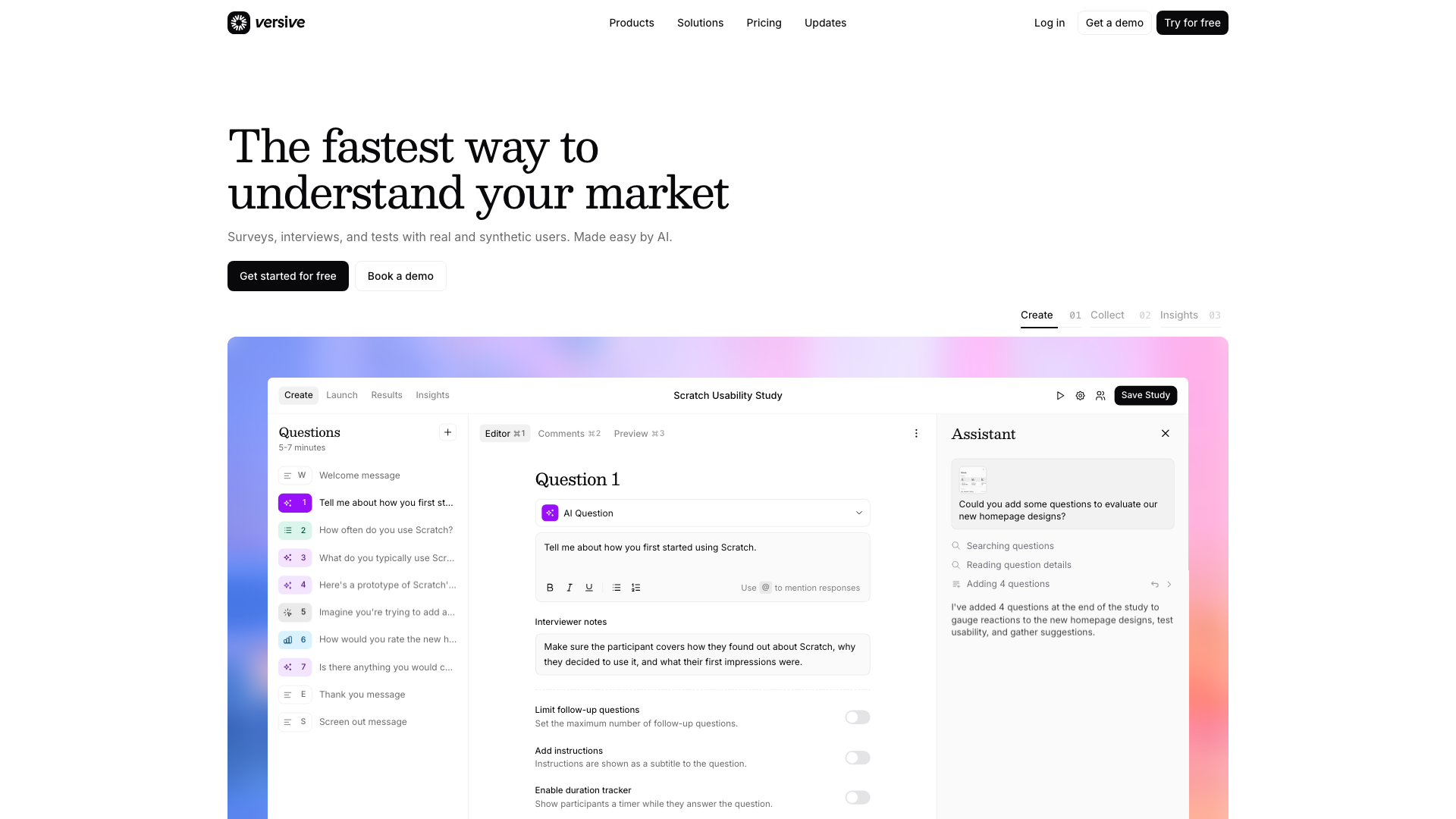
Versive came out of Y Combinator as Mirio and sells what it calls interview-quality results at survey speed, which is a real idea rather than a slogan. It treats the survey and the interview as one continuum instead of two separate methods, so a study can start as a questionnaire and deepen into a moderated conversation where an answer deserves it.
The AI moderator listens and probes in text or voice, and Versive also runs website and Figma task testing. It has synthetic personas alongside real participants, which is a methodological choice worth thinking about rather than a feature to take at face value, since a synthetic answer tells you about a model and not about a customer. Participants come from Versive’s panels, from your own list, or from a study embedded inside your product.
Prices are published, as they are at Raconte, UserCall and Whyser: $99 a month for Pro billed annually with 360 credits a year and two editor seats, $279 for Team with 1,200 credits and five seats, then Enterprise on quote, with a 14-day free trial. A developer API is listed among the product’s capabilities, though we could not verify how far it goes. Languages are described as multiple without a published count, and French is unconfirmed. IDEO, Udacity, 6sense, Gainsight and Personio are named as customers.
7. Whyser
Whyser is the youngest of the thirteen, founded in 2024 in San Francisco by Santi Ortega and Sergio Perdices, with no disclosed funding. Its AI voice agent, named Pia, adapts in real time, and the product records voice, video and screen, so it also handles Figma prototype tests.
The free tier is the most generous we found anywhere: ten interviews a month of up to fifteen minutes each, with no card. Pro and Business are quote only, and the Business tier is where API access and recruitment live. Whyser covers more than 40 languages and lists French explicitly, which several better-funded competitors do not.
Its recruitment works through an integration with the User Interviews API, so the panel comes from a partner rather than from Whyser itself. LG and N-iX are the named customers, which is thin next to Outset’s or Respondent’s customer lists, and expected for a company this young. If your study is small and you want to test whether AI interviews work for your subject before spending anything, this is the cheapest way to find out.
They find the people and handle the logistics
User Interviews leaves the questions to you, and Respondent asks them while billing each AI interview as one more session. Both supply the participants, the step that stops most studies before they start.
8. User Interviews
User Interviews was founded in Brooklyn in 2015 and has led recruiting since. UserTesting acquired it in January 2026. It continues to run as a standalone, tool-agnostic product, and its customer FAQ says nothing changes today for existing customers.
Two products sit under the name. Recruit sources participants from a panel of several million people, handling screeners, scheduling and incentive payouts worldwide. Research Hub is a participant CRM for your own users, with consent rules, quotas and governance. Research ops teams live in it daily.
It does not conduct the interview, and it does not even host the call: sessions run in Zoom, Meet or Teams. The clearest proof of that boundary is its 2025 partnership with Whyser, an AI interviewer, where User Interviews supplies panel, screening and incentives and the AI takes it from there. Pricing is unusually transparent for this market, at $49 per session for consumer participants and $98 for advanced B2B, dropping toward $20 at high volume, with incentives billed separately. Adobe, Spotify, Pinterest and Intuit are named customers.
9. Respondent
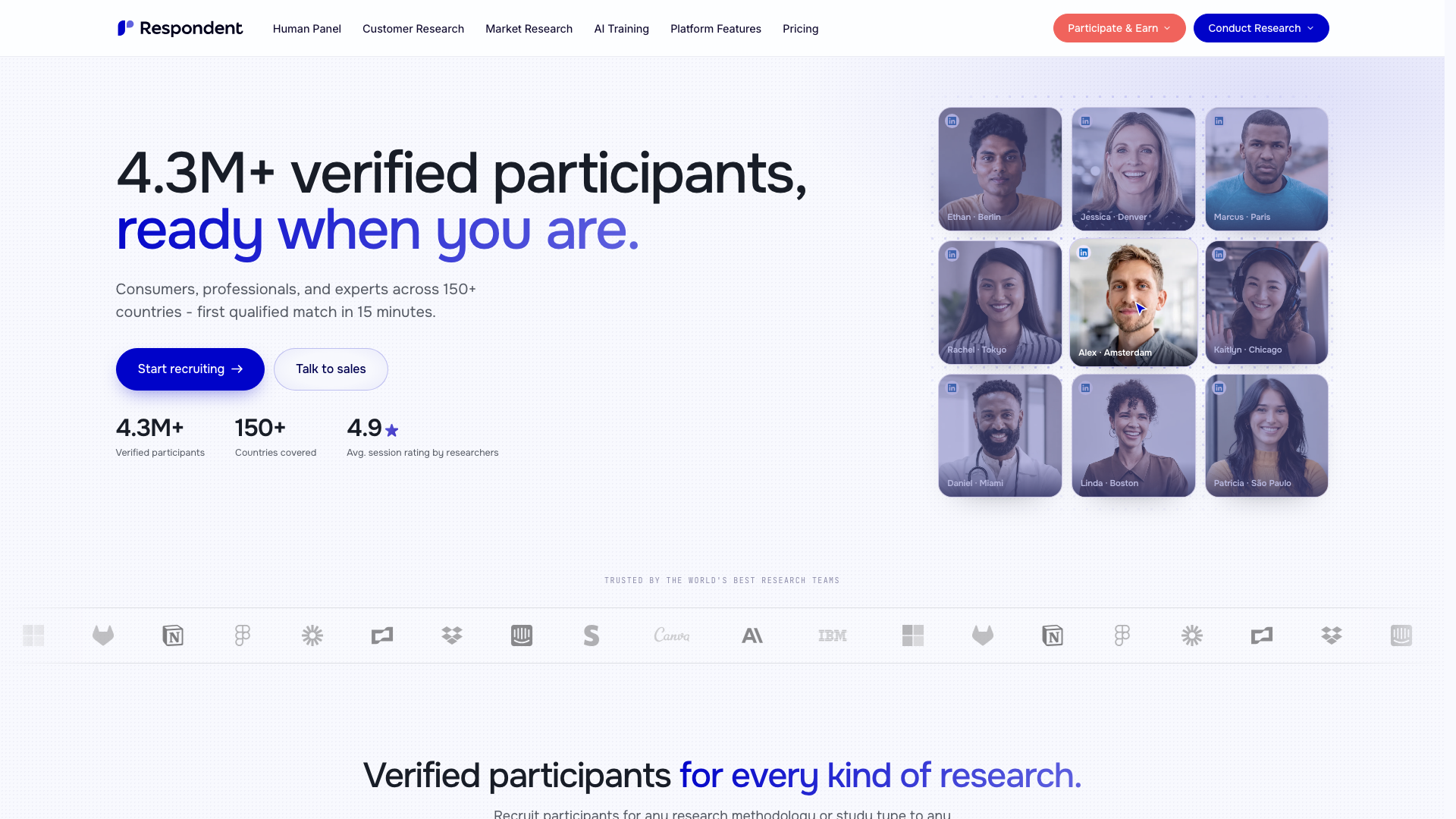
Respondent runs a marketplace of more than four million identity-verified participants across 150 or more countries, with four fraud checkpoints and a claimed fifteen minutes to a first qualified match. Recruiting hard-to-reach B2B profiles is what it is known for.
It has also crossed into AI moderation. Its AI Moderator, flagged as new, runs 30 to 50 conversations in parallel, with nothing to schedule, adapts its follow-ups across hundreds of interviews and returns themes, sentiment and quotes minutes after the last session. Recordings and transcripts come back as you would expect. You can mix AI-moderated and human-moderated sessions inside a single study, which few competitors allow.
Sessions cost $15 for consumer participants and $30 for B2B, with volume commitments taking that to $9 and $18, and AI interviews are charged as sessions drawn from the same recruitment funds. API access requires a commitment starting around $20,000, which puts programmatic use out of reach for a small team. IBM, Microsoft, Figma, Stripe, Anthropic and OpenAI appear as customers.
They watch what people do
UserTesting and Maze answer “can someone use this”, through observed behaviour rather than conversation. They are strong products, and they get bought for the wrong job often enough that it needs saying.
10. UserTesting
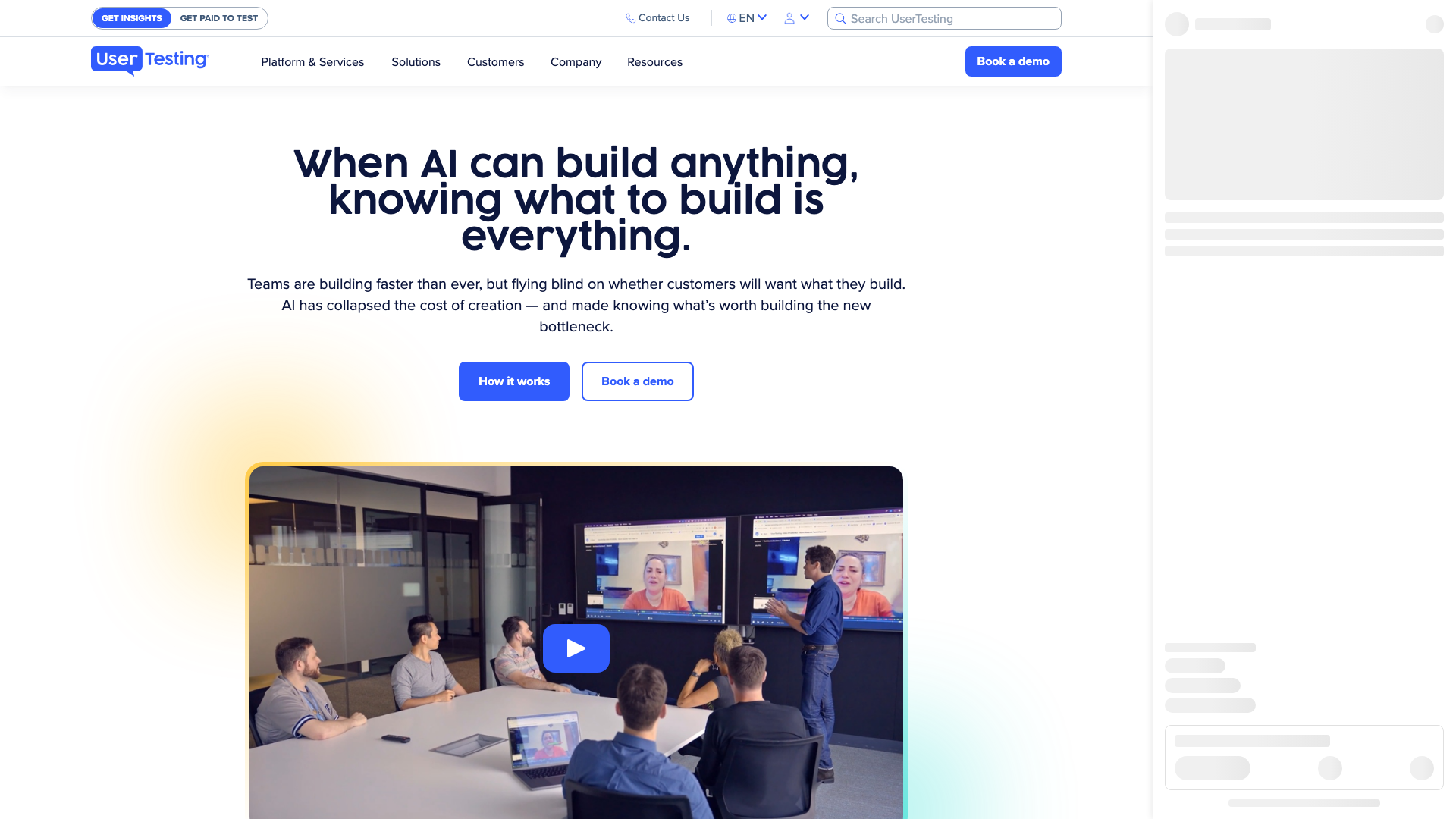
UserTesting has equipped enterprises since 2007. Thoma Bravo and Sunstone Partners took it private for around $1.3 billion in a deal closing in January 2023, it merged with UserZoom that April, and it acquired User Interviews in January 2026. Between them those moves consolidated a large share of the research tooling market under one owner.
The core method is human think-aloud. You write a task script, contributors from a panel of more than seven million people across 34 countries record themselves narrating while they use your site, app, prototype or ad, and you get video, transcript and AI-surfaced themes. Live Conversation adds scheduled moderated sessions with a human running them, QXscore benchmarks experience quality, and Insights Hub stores it all.
No AI conducts an interview at UserTesting. The 2026 releases added AI-generated test plans, AI summaries, a Figma plugin and an early-access MCP server, layers sitting on top of sessions a person recorded. Study languages are limited to English, Spanish, French and German. Pricing is quote only across all three tiers. Walmart, Microsoft and Wells Fargo publish results, including a 13% mobile revenue lift at Walmart.
11. Maze
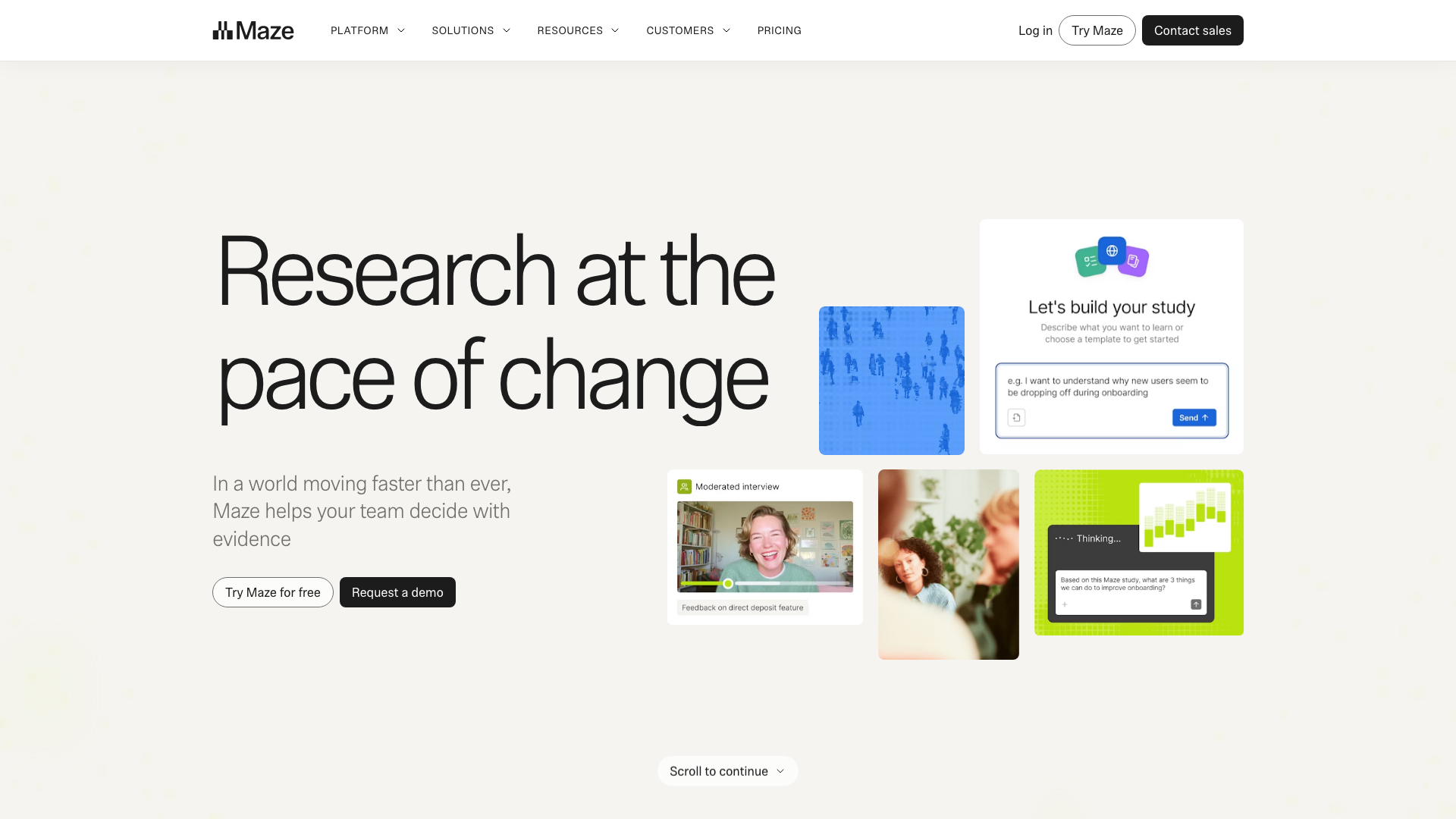
Maze is a continuous discovery suite built by a distributed team of more than 130 people across 35 countries, funded by a $40M Series B led by Felicis. It covers prototype testing on Figma, live website and mobile testing, surveys, card sorting, tree testing, five-second tests, in-product prompts and moderated interviews, with a panel of several million participants behind it.
Its AI Moderator is the most credible AI moderator inside a usability suite. It runs interviews asynchronously in voice or text across 19 languages, with configurable depth from roughly three minutes to eight, screeners, image stimuli and live UI states. There is also an AI Conversation Block that drops voice follow-ups inside an otherwise unmoderated study, a hybrid none of the pure interview tools offer. Maze ships a REST API, webhooks and an MCP server in beta.
AI-moderated studies are an enterprise-only add-on, so a self-serve buyer cannot purchase them. The free plan and the published paid tiers cover the rest of the suite. Atlassian, Volvo, Lowe’s and Lenovo are named customers.
They analyse what you already collected
Dovetail and Looppanel create no data. You buy them once the interviews have happened, and both pair naturally with an AI interviewer. We ranked fourteen qualitative data analysis tools in a separate article. Five of them expect you to arrive with the transcript, so check who does the transcription before you pick one.
12. Dovetail
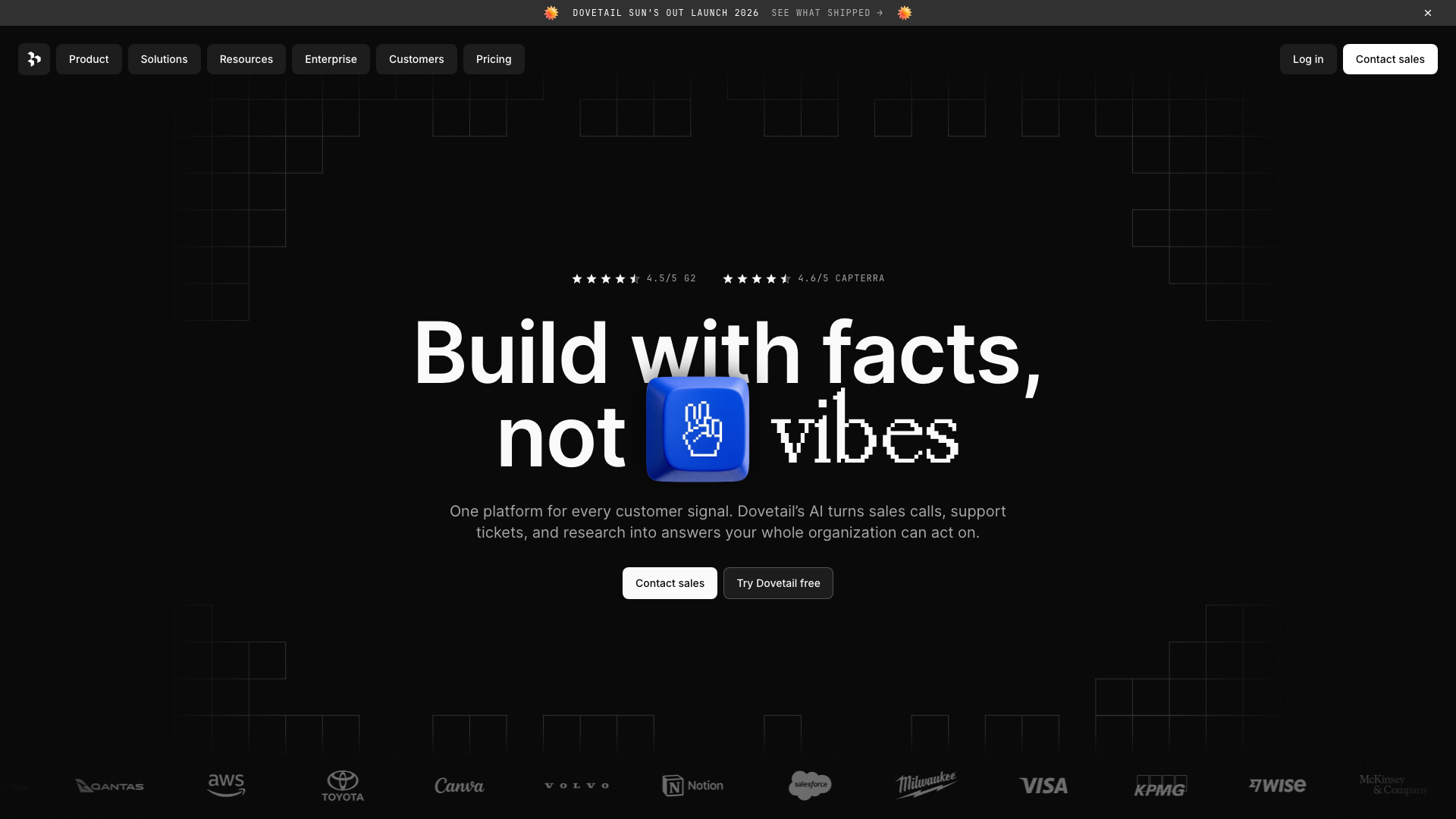
Dovetail started as the research repository everyone benchmarked against and repositioned in October 2025 as a customer intelligence platform. It ingests signals from 38 native integrations plus its API, MCP server and CLI, covering support tickets, calls, surveys and documents, then classifies, quantifies and makes them searchable. AI Channels sort feedback into product opportunities, AI Dashboards quantify qualitative data over time, and AI Chat answers with cited sources.
In July 2026 it launched AI agents and digital twins, personas built from real calls and tickets that you can hold a conversation with. It is a genuinely interesting bet and the opposite of interviewing a real participant. A twin can only know what your existing archive already contains.
Transcription covers 82 languages and translation 75, French included. Security runs to SOC 2 Type II, ISO 27001 and HIPAA with automatic PII redaction. Pricing shows two tiers now, a free plan with no card and an Enterprise quote, and aggregator sites still quote a mid-tier that Dovetail no longer lists. Atlassian, Canva, Qantas and Itaú Unibanco are named customers.
13. Looppanel
Looppanel is built by a small team in India and turns recorded calls into analysed research fast. Its bot joins Zoom, Meet or Teams through your calendar or a pasted link, transcribes, generates AI notes, tags by question or theme, cuts highlight reels in one click, and answers questions across the whole workspace with citations.
The bot records rather than interviews, which is deliberate: Looppanel sells analysis and says so. Customers publish numbers, with Miro, PandaDoc, Accenture, Thumbtack and Airtel named, and analysis time reported dropping from two weeks to two days.
Pro costs $395 a month or $4,200 a year, includes 30 transcription hours a month and requires a minimum of five editor seats, with extra editors at $75. There is no free plan. Transcription and translation cover more than 90 languages with French supported, and API access, SSO and PII redaction live in the Enterprise tier.
How to choose between them
Start by naming the step that is actually blocking you, because each group solves a different one.
If you cannot find people to talk to, buy recruitment. User Interviews and Respondent both do it well. User Interviews will not interview anyone for you, and Respondent bills its AI moderation as one more recruitment session. Budget the incentives on top, since every panel vendor here excludes them from the sticker price.
If you have the people and no time to hold the conversations, buy an AI interviewer. Above a certain size, where you want the panel, procurement, SSO and a support tier in one contract, Listen Labs, Outset and Strella are built for exactly that, and you will go through a scoping call to get a price. Below it, where you want to run something this week against your own users, four products publish a price and let you start without a call: Whyser is free for ten interviews a month, Raconte gives you 60 minutes a month with no card, UserCall starts at $89, Versive at $99, and each bills on a different unit, so compare on your actual volume rather than on the headline number. If French is a requirement, Raconte and Whyser both state it plainly and the others leave it open. If you only need people to answer a few written questions out loud, a voice survey tool that records each answer is enough.
If you need to know whether people can use your product rather than what they think of it, that is usability testing, and UserTesting, Maze, Lyssna and UXtweak are the products to look at. Check what their interview feature actually does before you buy one of them for interviews.
If interviews already happen and the bottleneck is making sense of them, buy analysis. Dovetail, Condens and Looppanel are strong and priced very differently, from €15 a month to $395.
Two more filters cut the list fast. Ask whether the interview language you need is genuinely supported, since counts get advertised without lists and French in particular is unconfirmed on several products. And ask whether you need to trigger interviews from your own systems, because a documented API changes what you can automate. Raconte, Dovetail, Maze and Voiceform document theirs publicly, Respondent puts one behind a commitment of around $20,000, and several well-funded AI interview products publish none at all.
We have an obvious interest in the build-or-buy trade, so here are the facts without the advice. Voice agent infrastructure like Phonic sells raw conversation at $0.14 a minute, or $0.12 on its $240 a month plan, with a full REST API, SDKs, an MCP server and webhooks. Building on it means writing the interviewer logic, the consent flow, the transcript storage, the sentiment scoring and the cross-interview aggregation yourself. Teams that want interviews embedded deep inside their own product routinely make that trade and are happy with it.
Wondering shut down in late 2025 despite a real product, a global panel and support for 50 languages, and directories still list it as live. Check that a tool is shipping before you build a research programme on it.
Frequently asked questions
What is a user interview platform?
A user interview platform is software that helps you talk to your users and turn those conversations into evidence. The label covers four different jobs: recruiting and paying participants, scheduling and hosting the sessions, conducting the interview itself, and analysing the transcripts afterwards. Most products do one or two of the four, so the first question to ask about any of them is which questions get asked, and by whom.
Is there an app for user interviews?
Yes: AI interview apps open in the browser from a link, with no video call to schedule, so the participant answers whenever they have a moment. Seven products in this comparison work that way: Raconte, Listen Labs, Outset, Strella, UserCall, Versive and Whyser. User Interviews and Looppanel depend on a separate call tool: User Interviews sessions take place in Zoom, Meet or Teams, while Looppanel’s bot joins calls in those same tools to record them. With Raconte, the participant talks for a few minutes without installing anything. You get the transcript a few seconds after the interview ends.
Who are the main competitors of User Interviews?
On recruitment specifically, Respondent, Askable and CleverX compete most directly, and Great Question bundles recruiting with a research repository. UserTesting acquired User Interviews in January 2026, so the two are now under one owner. Tools that run AI interviews, including Raconte, Listen Labs and Outset, solve a different step: User Interviews finds and pays the participants, while those products hold the conversation.
Can an AI really run a user interview?
Yes, and about ten products on the market do it today. The agent asks an opening question, reads the answer, and decides what to probe, so no two conversations follow the same path. It works well for volume and for stories people are willing to tell out loud. It works poorly where presence matters, such as an open conflict or a negotiation, because an AI reads neither an uncomfortable silence nor a facial expression. On whether people open up to a machine, Gale Lucas and colleagues at USC found in “It’s only a computer: Virtual humans increase willingness to disclose” (Computers in Human Behavior, 2014) that participants self-censored less when they believed no human was watching. That study used virtual humans rather than today’s voice agents, so treat it as a reason to test the format on your own subject rather than as proof.
How much does a user interview platform cost?
Prices split by what you are buying. Recruitment runs from $9 to $98 per session depending on volume, with participant incentives billed on top. Analysis tools range from about €15 a month to $395. AI interview products are the least transparent group, where roughly half publish nothing and start with a sales call. Among those that do publish, Whyser is free for ten interviews a month, UserCall starts at $89 a month, Versive at $99, and Raconte gives 60 free minutes a month then charges $0.12 per minute of active speech.
Do I still need to recruit participants?
Only if you are looking for strangers. When you want to talk to your own users, customers or employees, you already have the list and you need no panel at all. Buy recruitment when your research needs a profile you cannot reach, such as a specific job title in a market where you have no customers yet. Listen Labs, Outset, Strella and Respondent bundle a panel with the interviewing, while Raconte, UserCall and Whyser expect you to bring your own people or to plug in a panel separately.
Which user interview platforms support French?
Raconte interviews natively in French and English, and Whyser lists French among more than 40 languages. Dovetail, Condens and Looppanel all transcribe and translate French, and Condens hosts data in the EU. UserTesting supports French as one of four study languages. Several AI interview vendors advertise a language count without publishing the list, and French is unconfirmed on a number of them, so ask for it in writing before you commit to a French-speaking study.
Can I run user interviews through an API?
On a minority of platforms. Raconte, Dovetail, Maze and Voiceform document a public API, and Raconte, Dovetail, Maze, UserCall and Great Question also expose an MCP server so an AI agent can drive them directly. Respondent has an API behind a commitment starting around $20,000. Several of the best-funded AI interview products publish no API reference at all, so check the developer documentation rather than the feature list.
Is an AI interview as good as a human one?
It depends on what you are measuring. A skilled human researcher senses the mood, follows an unexpected thread and picks up on what someone avoids saying, and no AI does that yet. An AI holds the same quality of conversation with two hundred people in a week, keeps the same pace from first to last, asks the question as written, and needs nobody’s calendar. Run the human interviews when the subject is delicate or genuinely new, and the AI ones when you need the same story from a lot of people.
Is UX research being replaced by AI?
No: AI can run some of the interviews in a UX study, but a researcher still decides what the study needs to learn, chooses who to talk to, writes the interview guide the agent follows, and turns two hundred transcripts into a decision. Maria Rosala, a researcher at the UX consultancy Nielsen Norman Group, wrote in January 2026 that AI moderation complements human moderation. She finds it best suited to structured interviews and keeps discovery interviews, which call for judgement in the moment, for human moderators. What AI changes is the number of people one researcher can interview. A flaw in the study design now shows up in two hundred conversations, so getting the design right matters more than before. The synthesis takes longer too.
Where to start
Recruitment, interviewing, usability testing and analysis are four different purchases, and a product that is excellent at one of them will disappoint you at another. The comparison table is sorted on that basis.
If the blocked step is holding the conversations, and you have people to talk to already, that is what we built Raconte for. Write the interview once, share a link, and read the transcripts the next morning. The first 60 minutes each month cost nothing and need no card, and the pricing page covers what happens after that. If your questions still need shaping, our guide to writing an interview guide turns a research objective into something worth asking. The 45 open-ended questions grouped by goal give you the wordings to fill that guide with.

