
How to write an interview guide, with a full example to copy
The three interview families, a five-block structure, a complete guide you can copy, and the five question types that quietly ruin a study.
July 29, 2026
Godefroy
- An interview guide sets the objective, the themes and the follow-ups. It fits on two pages, which you follow as a map rather than as a script.
- Around a dozen interviews surface nearly every theme in one group, provided everyone got the same guide. Twelve improvised conversations leave you with twelve anecdotes.
- The structure that works has five blocks and follows a funnel: broad lived experience first, precise detail next, your hypotheses last.
- Five question types wreck a study on their own: closed, double-barreled, hypothetical, leading and too broad.
- A semi-structured guide converts into a prompt in about ten lines, and an AI can then run the interview for you, with no scheduling.
You booked eight interviews, prepared a list of questions, and came out with fifteen pages of notes that settle nothing. Every conversation went its own way. Two people talked at length about a topic the other six never mentioned, which leaves you unable to tell whether that is a signal or an accident of how you steered.
The problem is rarely the questions themselves. You had a list of questions where you needed an interview guide.
Greg Guest, a research methodologist, with the qualitative researchers Arwen Bunce and Laura Johnson, analysed sixty in-depth interviews to establish when new themes stop appearing. They found nearly all of them within the first twelve, with the broad strokes visible after six. Their protocol used the same guide from one person to the next. Without it, twelve interviews give you twelve conversations and nothing to cross-read.
What an interview guide is for
An interview guide is the document that structures a qualitative research interview. It sets the objective of the study, the themes to cover, one opening question per theme, and the follow-ups you plan to use. One or two pages is enough. You will also see it called an interview schedule in the UK and an interview protocol in the US.
The guide is a map. You know which places you have to pass through, and you pick the route based on what the person tells you. A guide read line by line during the conversation is a questionnaire in disguise, and it produces the same short answers a form would.
Three things change once it exists.
You can compare. With the same guide across ten interviews, you write “seven people out of ten got stuck at the same step”. After ten improvised conversations, the sentence shrinks to “someone mentioned this”.
You cover what you came for. A conversation that goes well drifts towards whatever excites the person in front of you. With nothing written down, you discover while rereading your notes that the central topic of the study got four minutes.
You listen. With the themes settled in advance, your attention goes to what is being said instead of to the next question. It is the most visible difference between someone’s first interview and their tenth.
Interview guide, interview schedule, interview protocol
The three names refer to the same kind of document. They differ on how strictly it fixes the questions, and on what it contains besides them. British social science textbooks, among them Social Research Methods by the sociologist Alan Bryman, keep “interview schedule” for the fixed list of questions of a structured interview and “interview guide” for the list of themes of a semi-structured one. In many UK universities, students still write “interview schedule” for any interview in a dissertation. In the United States, “interview protocol” is the usual word in academic research and in submissions to an institutional review board (IRB), the ethics committee that approves research involving people. The protocol covers the whole script: the introduction, the consent wording, the questions and the closing.
Whichever name your university or your team uses, the method and the template below apply.
The three interview families
Alain Blanchet and Anne Gotman, in L’enquête et ses méthodes : l’entretien, describe the research interview as a paradoxical exercise: producing discourse without stating the research questions behind it. How directive the guide should be is the first setting to fix, and you decide it before writing a single question.
| Structured | Semi-structured | Unstructured | |
|---|---|---|---|
| What the guide fixes | The questions and their order | The themes and one opening question each | A single starting prompt |
| Room for the person | Narrow, they answer inside your frame | They organise their story within each theme | Total, they decide what matters |
| Usual length | 15 to 30 minutes | 45 to 60 minutes | 60 to 90 minutes |
| When to use it | Many interviews to aggregate, familiar ground | Understanding why people do what they do | Opening up a topic you barely know |
| What you get back | Comparable answers, few surprises | Stories that compare with each other | Rich material, hard to cross-read |
Nearly all product research, UX research and customer feedback is semi-structured. Structured interviews fit when you already know what to ask and you want volume. Unstructured ones belong to the first exploration of a subject whose vocabulary you have not learned yet.
All three families assume the interview is the right method for what you want to know. An interview records what people say, while a diary study and a usability test record what they did. That difference rules out three of the six methods in our comparison of qualitative research methods.
The five-block structure
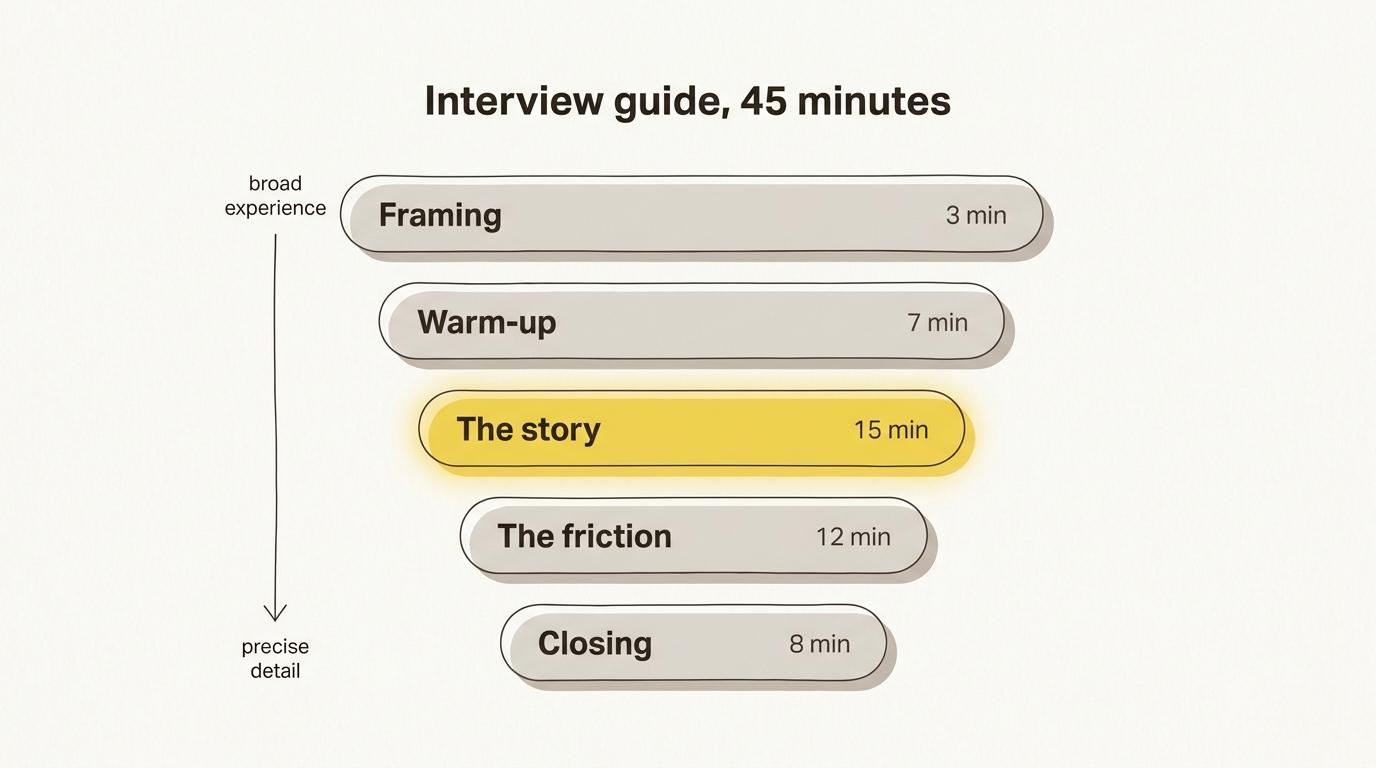
The order matters as much as the content, because it follows a funnel: broad lived experience first, precise detail next, your own hypotheses last.
| Block | Length | What you are after |
|---|---|---|
| Framing | 3 min | Who you are, what you are looking for, what happens to the answers, and consent to record |
| Warm-up | 7 min | The person’s context, role and typical day. Easy questions that settle them in |
| The story | 15 min | One past experience told in detail, start to finish, interrupted only to follow up |
| The friction | 12 min | Where things broke, the workarounds, what got abandoned along the way |
| Closing | 8 min | The projection, their one priority, and the open final question |
Two rules hold this structure together. The sensitive questions arrive after the twentieth minute, once trust is there. And your hypotheses stay out of the guide until the last block, otherwise you spend the interview hunting for their confirmation.
Give the story block room. It produces the material, and it is also the first thing time pressure crushes.
An interview guide template, with a full example
The template below follows the five blocks. Copy it, replace the parts in brackets, and keep the order.
INTERVIEW GUIDE: [study name]
Objective: [what you want to understand, in one sentence]Participants: [who, how many, how they were recruited]Length: 45 minutes, recorded with consent
1. Framing (3 min)   Who I am, what I am looking for, what happens to the answers.   "There is no right answer. May I record, so I can listen   instead of taking notes?"
2. Warm-up (7 min)   - Tell me about your role and your team.   - How did you handle [the topic] before you had [the tool or process]?
3. The story (15 min)   - Walk me through the last time you [did the thing you are studying].   - What happened right before? And right after?   - Who else got involved, and when?   Follow-ups: "what happened next", "[their last word]?",   "tell me about the last time that happened"
4. The friction (12 min)   - What was the worst moment with [the tool or process]?   - What do you do outside it, in a spreadsheet or by hand?   - What did you try once and then drop?
5. Closing (8 min)   - If you could change one thing tomorrow morning, what would it be?   - What should absolutely stay as it is?   - What should I have asked you that I did not?
For a dissertation or an ethics review, write the consent wording out in full in block 1, and note next to each block the research question it answers.
Here is the same template filled in for one specific study. The subject stays deliberately ordinary so the structure shows through: understanding why customers of an invoicing tool stop using it after three months.
Study objective
Identify the breaking points in the first three months of use, and separate what comes from the product from what comes from the customer’s own organisation. Eight to twelve 45-minute interviews, with customers whose usage dropped between month one and month three.
Block 1, framing (3 min)
Thanks for making the time. I work on how teams handle invoicing, and I want to understand what actually happens rather than assess how you use our tool. There is no right answer here. I record so I can stay in the conversation instead of taking notes. The recording stays internal, and nobody is quoted by name. Is that all right with you?
Block 2, warm-up (7 min)
- Describe your role and the size of your team.
- Who handles invoicing where you work, and since when?
- Tell me how this worked before you used any software for it.
Question 3 already puts memory to work on something concrete. It beats “what are your invoicing needs”, which invites a rehearsed answer.
Block 3, the story (15 min)
- Walk me through your last month-end, from the moment you sit down to the moment invoices go out.
- What happened right before? And right after?
- Who else got involved, and when?
- On that particular month-end, what took you the longest?
Planned follow-ups: “tell me what happened next”, “you said it was painful, painful how”, “and then what”. Stay on the last real episode rather than the usual routine, because people are bad at describing what they “usually” do.
Block 4, the friction (12 min)
- Over the last three months, what was the worst moment with the tool?
- What did you do at that point?
- Are there things you do outside the tool, in a spreadsheet or by hand?
- What did you try once and then drop?
- Who did you mention it to, and what happened?
Question 10 pays the most. A workaround that lasts is a problem the person has stopped reporting.
Block 5, closing (8 min)
- If you could change one thing tomorrow morning, what would it be?
- What should absolutely stay as it is?
- How would you describe this tool to someone in your network asking for advice?
- What should I have asked you that I did not?
Always keep question 16. It regularly opens a topic the guide ignored, and it costs fifteen seconds.
Sixteen questions for 45 minutes is the right density. A serious follow-up beats an extra question.
The question types that ruin an interview
Nielsen Norman Group has catalogued six recurring mistakes in interview question design. Five of them are enough to wreck a study, and all of them are fixed by rewriting the question.
| Question to avoid | What goes wrong | Rewrite |
|---|---|---|
| ”Do you have problems with invoicing?” | Closed, it invites yes or no and shuts the topic down | ”Walk me through your last month-end." |
| "How do you find the tool and the support?” | Double-barreled, people answer half and forget the rest | Ask the two questions one after the other |
| ”Would you use a feature that did X?” | Hypothetical, people predict their own future behaviour poorly | ”How do you do X today, and how long does it take you?" |
| "Did you stop because it was too slow?” | Leading, it hands over the expected answer | ”What happened the last time you opened the tool?" |
| "Tell me about your work habits.” | Too broad, the person cannot tell what you are after | ”Walk me through yesterday, hour by hour.” |
Rob Fitzpatrick made the hypothetical the central rule of The Mom Test: people happily answer “would you buy a product that did X”, and their answer is worth nothing, because they want to please you and they overrate their future enthusiasm. The past is not up for negotiation. Ask how they do it today, what it costs them, and what they tried before. Founders who check that a problem exists before building anything rely on the same rule in customer discovery interviews.
Leading questions are sneakier, because they usually arrive dressed as a helpful paraphrase. Nielsen Norman Group points out that phrasings built on “because” plant your hypothesis in the person’s head, and they tend to adopt it from there. You hear your own idea come back as an echo and you write down a confirmation.
Our bank of 45 open-ended questions takes each of these five apart and gives the rewrite, grouped by what you are trying to learn.
Following up without steering
When you conduct a qualitative interview, most of the skill is in the follow-ups. The guide lists the ones you plan, such as “what happened next” or the person’s last word repeated as a question. During the conversation, you can also wait three seconds in silence, or ask for one specific episode when an answer stays general. Keep the answer you expect out of every follow-up, since the person tends to take the wording you offer.
From guide to prompt: handing the interview to an AI
A good interview guide converts into a prompt almost as is. That is what made this work automatable, and it is why we built Raconte. You write the interview once, send a link, and the AI runs the voice conversation and follows up whenever an answer stays vague.
The invoicing guide becomes this:
You are running a 45-minute interview with a customer of an invoicing tool whose usage has dropped over the past three months. Your goal is to understand the breaking points in their usage, and to separate what comes from the product from what comes from their own organisation. Start by introducing yourself, make clear you are not assessing them and that there is no right answer. Cover, in order, their role and team, a detailed walkthrough of their last month-end, the worst moments they had with the tool, the workarounds they use outside it, and what they would change first. Always ask about real, dated episodes rather than general habits. Never ask a hypothetical question about what they would do if the product changed. Follow up whenever an answer stays at the level of opinion. Finish by asking what question you should have asked.
That move to a prompt produces three effects. The guide is identical from one person to the next, so the answers stay comparable. The follow-ups come from an AI with no hypothesis to defend, which mechanically solves the leading-question problem. And scheduling disappears, which is what kills a good share of interviews before they happen: people open the link whenever it suits them, evenings included.
The format has clear limits. An AI reads neither an uncomfortable silence nor a look, so a subject that needs presence, an open conflict or a negotiation, calls for a human interviewer. And if you want one factual data point from two hundred people, a form stays faster for everyone. AI-run voice interviews hold the middle ground, where you want stories at volume, without scheduling.
You get the full transcript, per-message sentiment and a summary a few seconds after the call ends. The getting started guide has you send your first interview in a few minutes.
Where to start
Write the study objective in one sentence, list three to five themes, then one opening question per theme with two planned follow-ups underneath each. Test the guide on one person, cut whatever went unused, and keep that version for the whole series. That is the point where interviews become comparable.
If you apply the same method to people leaving your company, our bank of 30 exit interview questions uses this structure on an HR topic. To run those conversations without booking each one, see the tools built for exit interviews.
Once the guide is written and what you lack is something to run it on, our ranking of user interview platforms compares what each one actually does. When you have the transcripts, we take one real interview extract through the six phases of thematic analysis, from the first codes to a theme you can defend.
And if volume rather than method is what blocks you, the first 60 interview minutes each month are free, no card required. The pricing page covers what comes after.
Frequently asked questions
What is an interview guide?
An interview guide is the document that structures a research interview. It sets the study objective, the themes to cover, one opening question per theme and the planned follow-ups. It fits on one or two pages, and you consult it as a map during the conversation rather than reading it line by line.
What is the difference between an interview guide and a questionnaire?
A questionnaire is administered identically, with closed questions asked in the same order to everyone, and it produces numbers. An interview guide is navigated: the themes are fixed, the wording and the order adapt to what the person says, and it produces stories. The first tells you how many, the second tells you why.
How do you build a semi-structured interview guide?
Start by writing the study objective in one sentence. Break it into three to five themes, then write one broad opening question per theme and two follow-ups underneath each. Order the themes as a funnel, from general experience towards precise detail, and put the sensitive topics after the twentieth minute. Test it on one person before running the series.
What is the difference between an interview guide, an interview schedule and an interview protocol?
All three name the document that structures a research interview. British textbooks often keep “interview schedule” for the fixed questions of a structured interview and “interview guide” for the themes of a semi-structured one. “Interview protocol” is the American term, and it adds the introduction, the consent wording and the closing to the questions. The five-block structure applies to all three.
How many questions should an interview guide have?
Plan twelve to twenty questions for a 45-minute interview, with follow-ups on top. Beyond that the guide turns into a questionnaire and you recite instead of listening. Fifteen questions with real follow-ups beat thirty rushed ones.
How many interviews do you need?
Guest, Bunce and Johnson found nearly every theme within the first twelve interviews of their study, with the broad strokes visible after six. Twelve is a solid marker for a homogeneous population. Count eight to twelve interviews per segment if you are studying very different profiles.
How do you write an interview guide for a thesis?
The structure is the same as in a company, with two additions examiners expect. Tie each theme of the guide explicitly to a research question or a hypothesis, and attach the full guide as an appendix along with the analysis grid you used. Examiners also expect you to state how participants were recruited and how consent was obtained.
Should you record the interview?
Yes, and ask for consent during the framing block. Taking notes while someone talks damages your listening and makes you miss follow-ups. A recording also lets you go back to an exact wording during analysis, which no set of notes preserves faithfully.


