
20 customer testimonial questions that get specific answers
Copy 20 customer testimonial questions, from the customer’s situation before your product to a specific result, a useful quote and permission to publish.
October 30, 2026
Godefroy
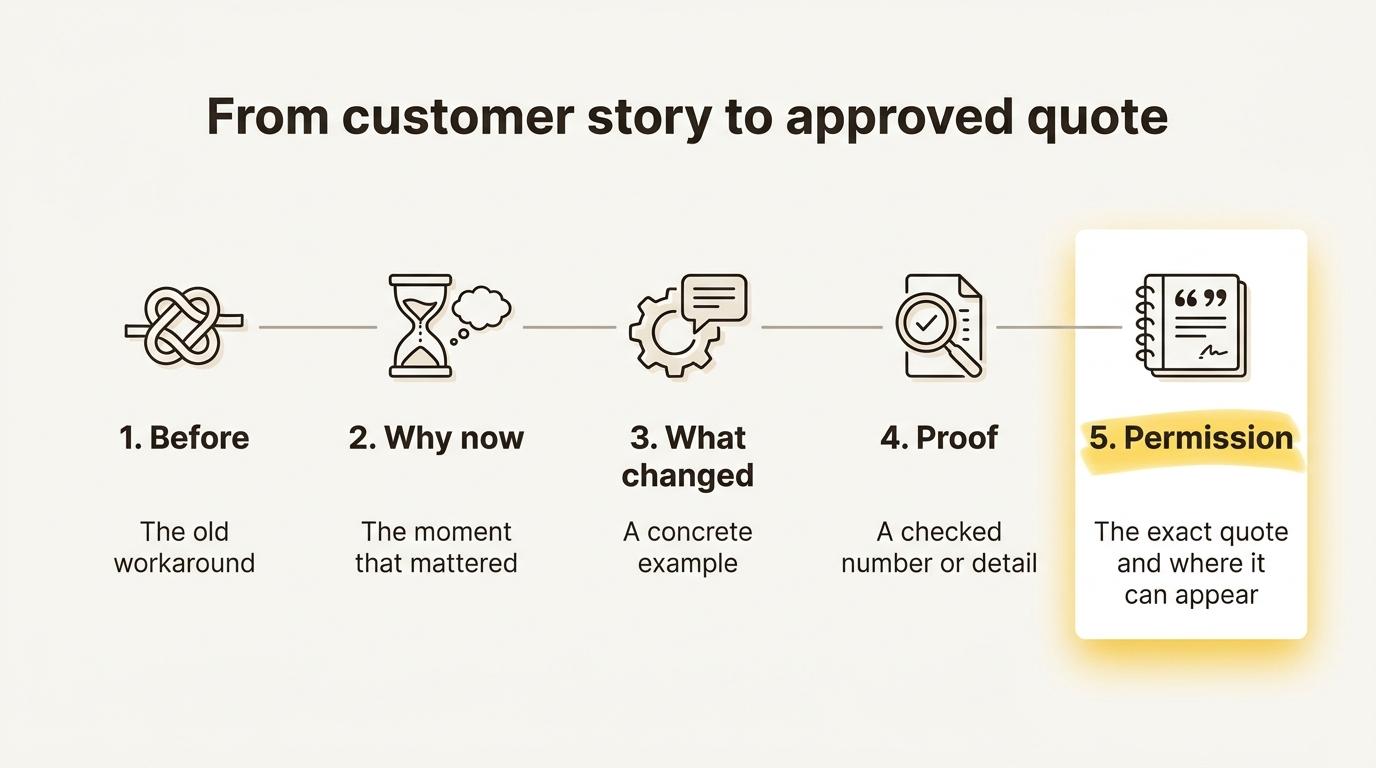
- A useful testimonial tells a customer’s story in their own words: what they needed, what changed and what they can point to now.
- Ask about one moment at a time. Follow “That was great” with a question about what happened, rather than asking the customer to praise you again.
- A testimonial is not a case study. Add context, a timeline and verified results when the story needs to explain a larger project.
- Before publishing, send the exact quote and attribution for approval, agree where it can appear and keep a record of the customer’s permission.
- A written form is quick, video shows a face, and a voice interview can capture a longer answer without asking someone to film themselves.
A customer says, “We love it.” Your marketing team needs a sentence that tells a future buyer why it matters. The gap usually comes from the questions: ask for praise and you get praise, ask about a real decision or change and you get a story. These 20 customer testimonial questions help B2B marketing teams and founders collect specific, accurate answers, then turn an approved quote into a testimonial or a fuller case study.
What makes a customer testimonial useful?
A useful testimonial helps a potential customer recognise a problem, understand what changed and decide whether the experience applies to them. It does that with a concrete detail, not a string of compliments. “The team was helpful” tells little. “We stopped rebuilding the monthly report by hand, so our account managers can use the meeting to discuss the numbers” gives a reader something to picture.
A short testimonial usually needs four ingredients:
- A recognisable starting point. What was the customer trying to do, and what got in the way?
- A reason for changing. What made them look for another approach, and what nearly stopped them?
- A concrete change. What can they do now, or what happened differently?
- A clear fit. Which teams or situations would benefit, in the customer’s view?
A number can strengthen the story when the customer can explain where it came from. It is not a required ingredient. A clear example from a real working day is more useful than an impressive estimate nobody checked.
The article’s sample answers below are fictional examples, not customer claims. Replace them with what your own customer says, and keep the difference clear in any draft.
20 customer testimonial questions to copy
Choose the questions that fit the customer and the page you are making. A short testimonial needs only a few. A case study interview can use a wider set, with pauses to explore an answer. Do not read all 20 in a row.
1. The customer’s situation before
Start with the customer’s work, not your product. That gives readers a situation they may recognise.
- What were you trying to get done when you started looking for a solution? This gives the story a purpose in the customer’s terms.
- How did you handle that before? The answer may name a workaround, an older tool or a manual step.
- What was the hardest part of that approach? Ask for the task or moment that caused the trouble, rather than a general rating.
- Can you remember a specific time when that problem got in the way? A recent example is easier to understand than a broad claim about the whole year.
- Who else on your team felt the effect? This helps readers understand whether the change mattered to one person, a team or a wider process.
2. The moment they decided to change
The buying decision makes the story useful to readers who are weighing their own options.
- What happened that made you look for a different approach? Listen for a trigger such as a new project, a missed deadline or a process that no longer fit.
- What other options did you consider? Let the customer decide whether to name another provider. Do not put a competitor’s name in their mouth.
- What mattered most when you chose us? This can surface the reason that mattered to the customer, which may differ from your own pitch.
- What gave you pause before you decided? A real concern can help a future buyer assess the same risk.
- What helped you feel ready to try it? This follows the hesitation without turning the interview into a request for praise.
3. What changed after they started
Ask for one change at a time. Keep the customer’s answer grounded in an example, a comparison or a piece of evidence.
- What changed in the way you do that work? This invites the customer to describe the difference in their own terms.
- What can you do now that was difficult before? The answer often gives a clearer quote than “we are more efficient.”
- Can you walk me through the last time you noticed that change? A specific occasion helps you check what the customer means.
- What did your team notice first? This can add a second perspective, if the customer has heard it directly from colleagues.
- Has anything changed in a number you already track? Ask which metric, what period it covers and where the figure comes from. If the customer cannot check it, leave the number out.
4. A recommendation that helps the next buyer
Close by letting the customer describe the fit. Their answer should help readers decide, not tell every reader to buy.
- Who would you recommend this to, and what would make it a good fit for them? Ask for a role, team or situation rather than “everyone.”
- What would you tell a colleague who is considering it? This often brings out the customer’s plain-language summary.
- What should someone know before they start? The answer can include a useful limitation or condition.
- What is one part of the experience you would want to keep? Ask what the customer values, without asking them to rank features they may not use.
- Is there anything about your experience that I have not asked and you want people to know? Leave room for the point your question list missed.
Follow-up questions that turn a vague answer into a useful quote
When a customer says “It was great,” resist the urge to suggest what they might mean. Ask for the detail behind the reaction. Keep the follow-up neutral, and let the customer correct your understanding.
| If the customer says… | Ask… | What it helps clarify |
|---|---|---|
| “It was great.” | “What happened that made it feel great?” | A moment, action or result |
| “It saved us time.” | “Which task took less time, and how did you notice?” | The work that changed and the basis for the claim |
| “The team adopted it quickly.” | “Who started using it first, and what did they do with it?” | The people and behaviour behind “adoption” |
| “The support was excellent.” | “Can you describe one interaction that stood out?” | What the support team actually did |
| “We recommend it.” | “Who do you think would get the most from it?” | The situation where the recommendation applies |
From a short testimonial to a customer case study
A testimonial is usually one concise customer statement. A case study gives the statement context: who the customer is, what challenge they faced, how they chose and used the product, what changed and what evidence supports the result. Use the longer format when a buyer needs to understand a process or compare a decision, not simply read a recommendation.
For a case study interview, add questions such as:
- What does your team do, and who does it serve?
- What was happening before the project began?
- What did you try before this approach, and what did you learn?
- What did the decision process involve, and who took part?
- What happened during implementation? Which parts went as expected and which did not?
- What changed over the next three to six months? Which records or measures can support that account?
- What would you do differently if you started again?
- Which exact statements, figures, names and images can we include publicly?
Choose a period that gives the customer enough experience to describe a real change. Confirm the baseline and end date, and mention other factors that may have contributed.
For a longer conversation, use a customer interview guide with a clear opening, a small number of themes and neutral follow-ups. A voice of the customer program can also show how a customer story fits alongside support tickets, surveys and other feedback.
How to ask a customer for a testimonial
Choose a recent moment when the customer has something concrete to say: they completed a project, reached a milestone or described a result you can discuss. Start with a personal request that explains why you are asking and what you want to create. Make declining easy.
Subject: Could we share your experience with [product]?
Hi [name],
You mentioned [specific experience the customer actually described]. Would you be open to answering a few questions about what changed? We are preparing [the page or campaign where the story may appear]. It is completely fine to decline. Before we publish anything, we will send you the exact wording and attribution to review.
If you are interested, you can reply here or use [interview link].
Thanks, [name]
Replace every bracket with a true detail before sending. If the customer replies, agree on the format, the deadline and who else needs to approve the story. A customer contact may not have authority to approve their employer’s name, logo, figures or internal details.
Form, email, call, video or voice interview?
Choose the format by the material you need and what the customer is comfortable sharing. A short form can be enough for a simple quote. A call gives you room to follow up, but it takes a shared calendar slot. Video shows the customer’s face and voice, which can matter on a sales page, and asks them to appear on camera. An asynchronous voice interview captures spoken answers without a live appointment or a filmed face.
| Format | Works well when | What you need to plan for |
|---|---|---|
| Email or form | The customer has one clear point to share and prefers writing | Short answers may leave no room for follow-up |
| Live call | The story has several parts or needs careful follow-up | Find a time that works for both people and take notes or record with permission |
| Video | The customer is comfortable on camera and a visible face matters | Camera comfort, recording consent, editing and final review |
| Asynchronous voice interview | You want spoken answers and a follow-up without scheduling a call | Check the transcript against the audio, and agree on the quote and its use separately |
There is no universal response-rate winner. It depends on the relationship, the audience, the request and the effort involved. Pick a method the customer can answer comfortably. If you need a customer feedback survey before inviting someone to share a longer story, use a form designed for one feedback moment. To compare tools for spoken answers, see these voice survey tools. If a face is central to the asset, choose video rather than describing a voice-only recording as video proof.
Get permission and approve the exact wording
Treat publication as a separate step from collecting an answer. Tell the customer where you plan to use the quote, how you will identify them and whether you want to use a photo, logo, audio clip or video. Ask for approval of the exact quote and attribution before publication. Keep the approved version and the permission record together.
The UK Advertising Standards Authority says marketers should hold evidence that a testimonial is genuine and permission to feature it. The US Federal Trade Commission’s endorsement guides say a testimonial must reflect the endorser’s experience, and that editing must not distort the meaning. Check the guidance that applies to your campaign. Keep the customer’s meaning, verify factual claims and publish only what they have approved.
A quote does not prove that a result is typical. Verify a specific saving or increase, and explain the period and conditions. A genuine testimonial can still mislead if the business cannot support its factual claims.
Collect a customer story by voice with Raconte
Raconte includes two marketing interview templates. “3-question customer testimonial” asks about the situation before, what changed and who the customer would recommend the product to. “Customer case study” asks for the context, problem, solution, results over three to six months and a quote. Adjust either prompt to fit the customer and the story you can publish.
The customer receives a link and can answer when they have time. Raconte runs the interview by voice. The team can review the transcript and audio, plus a summary and sentiment for each message. The interview gathers material, but it does not grant publication permission or verify a business metric. Send the proposed wording and attribution to the customer for approval.
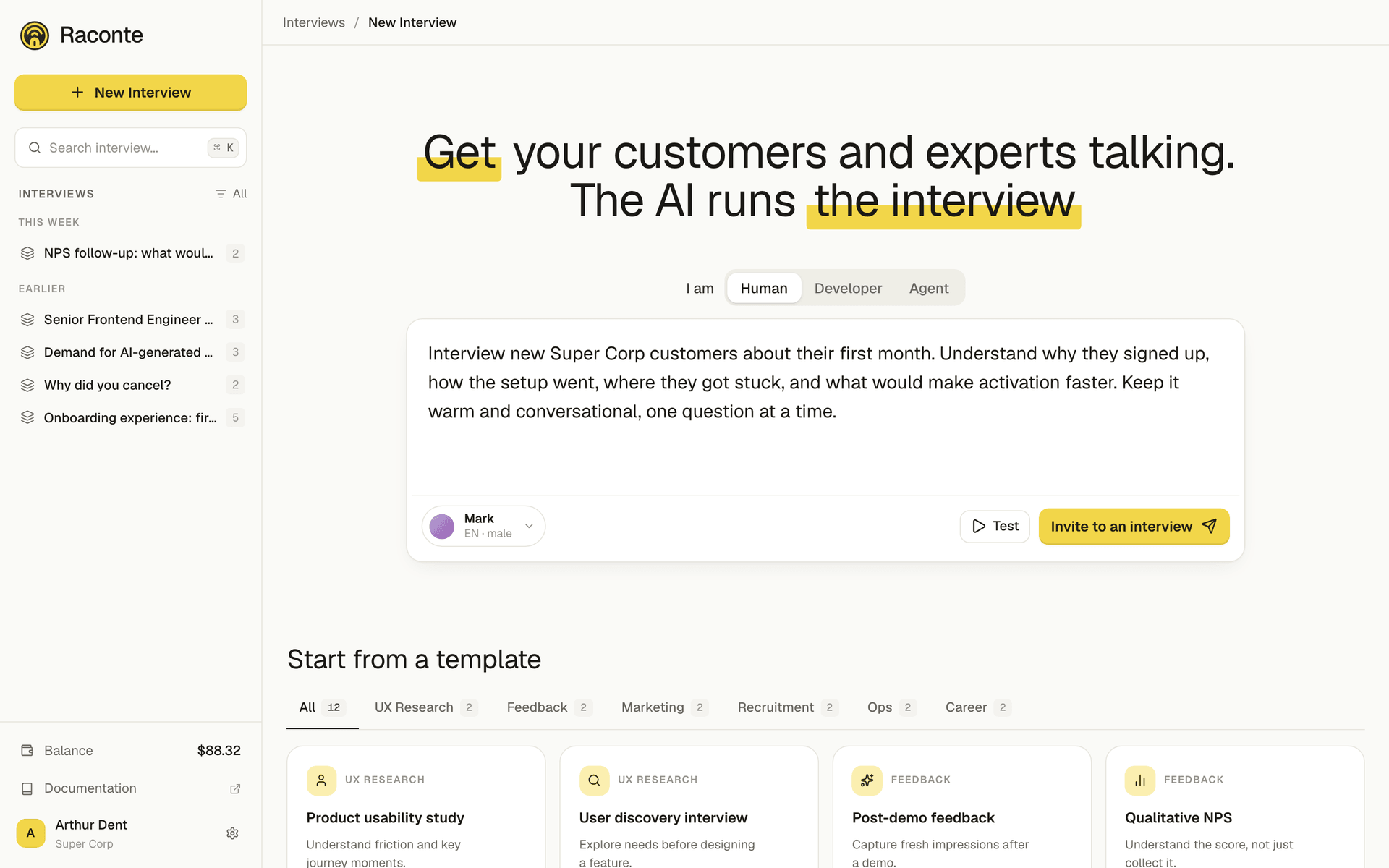
If a short voice interview fits the project, create a free Raconte account and start from the customer testimonial template. The first 60 interview minutes each month are free, and pricing follows the minutes of active speech.
graph TD
  A[Choose a recent customer milestone] --> B[Ask neutral questions about before and after]
  B --> C[Check examples and any measurable result]
  C --> D[Draft the quote with accurate attribution]
  D --> E[Send the exact wording for approval]
  E --> F{Did the customer approve it?}
  F -->|Yes| G[Publish only in the agreed places]
  F -->|Changes requested| D
Frequently asked questions
What are good questions to ask for a customer testimonial?
Ask what the customer was trying to do, how they handled it before, what changed, what example shows the difference and who would benefit from the same approach. Follow a broad answer with a neutral request for a specific moment or detail.
How many questions should a testimonial interview have?
A short testimonial can use three core questions: what the situation was before, what changed and who the customer would recommend the product to. Add only the follow-ups needed to understand a particular answer. A case study needs more context about the decision, implementation, timeline and evidence.
Should customer testimonials be video?
Use video when a face and a visible speaking style matter to the page and the customer is comfortable being filmed. Use text or voice when the story matters more than a filmed appearance, or when the customer prefers not to be on camera.
How do I get permission to publish a testimonial?
Explain where the quote may appear and how the customer will be identified. Send the exact wording and attribution for approval, and keep a record of the customer’s permission. Ask separately about any company name, logo, image, audio or video you want to use.
Start with the story, not the quote
A strong testimonial starts with a customer’s experience, not a sentence your marketing team wants them to say. Ask about the work before the product, the decision and one change the customer can describe. Check every number, preserve the customer’s meaning and get approval for the exact quote and its use. When you need to collect those answers without finding a shared call slot, Raconte lets you run a voice interview from a link.


