
24 dichotomous question examples grouped by purpose
Twenty-four dichotomous questions to copy: screeners, facts, beliefs, forced choices. One verb in a question moved the result by 21 points.
September 1, 2026
Godefroy
- A dichotomous question offers exactly two answer options and nothing between them. It measures cleanly when the two options exclude each other and cover every case, which is true of a fact and rarely true of an opinion. A forced choice is the exception, because there you narrow the field on purpose.
- Yes or no records what someone did. An opinion needs a scale, which keeps the degree that two options throw away.
- Split a sample in two. Ask one half whether the United States should forbid public speeches against democracy and 54% say yes. Ask the other half whether it should allow them and 75% say no. One verb moves the result by 21 points.
- A dichotomous question is the cheapest screener in a survey, because it decides which questions someone sees next at the cost of one tap.
- A two-option question returns a percentage and no reason, so pair the questions you care about with a way for people to answer in their own words.
After shipping a new export, one team asked a single question about it: “Did you have any difficulty setting it up?” 94% said no. The team closed the subject. Support spent that whole week on that export, though.
In fact nobody lied, but the question was the wrong one. A yes or no makes each person decide whether what they went through counts as a difficulty. Someone who got there on the third attempt says no, because they got there. The people who kept support busy are part of that 94%. The team believed that number described the setup. It measures how bad the setup has to get before someone calls it difficult. A two-option question produces a percentage, and that is all.
The format is still the fastest thing you can put in a form, as long as you keep it for the right subjects. You will find 24 dichotomous questions to copy, grouped by purpose, and the two conditions that decide whether two options are enough. The full bank of closed questions covers the seven other formats.
What a dichotomous question is
A dichotomous question offers exactly two answer options and nothing between them: yes or no, true or false, done or not done, this one or that one. The person picks one of the two, so every answer arrives in your spreadsheet as a 1 or a 0 and the analysis is a percentage.
The two conditions that make the format valid both look obvious enough that nobody checks them. The options have to exclude each other. “Do you use the tool on mobile or on desktop?” breaks that condition for everyone who uses both. The options also have to cover every case. “Do you pay monthly or yearly?” breaks that one for everyone who has never paid, and those people still pick an option, because the form makes them.
A third option changes the format. Yes, no or don’t know is a single choice with three options. A five-point agreement scale is a rating scale. People call both dichotomous in conversation. Neither behaves like one. The people who have not made up their minds take the “don’t know” when it is there, and take the midpoint when the questionnaire offers a scale instead. Both answers mean something other than a straight yes or no.
Four purposes, six questions each
One group will do. Pick the one that matches what you want to find out: screening, checking a fact, testing a belief, or forcing a choice.
Screeners, to decide who answers the rest
- Have you bought anything from us in the last six months?
- Do you manage a team?
- Have you opened the reporting section at least once?
- Are you the person who set up this account?
- Did you attend Tuesday’s session?
- Do you pay for a tool of this kind today?
Put these first. A screener costs one tap and decides which questions someone sees next, so write it without leaving room for interpretation. State the condition so the person can check it rather than estimate it. “Have you opened the reporting section at least once?” is checkable. “Do you use reporting regularly?” is not, because each respondent decides what regularly means on their own.
Facts about what someone did
- Did you finish setting up your account?
- Did you contact support about this problem?
- Did you read the notes for the last release?
- Have you invited anyone else into your workspace?
- Did you export a report in the last 30 days?
- Was your problem solved on the first contact? (asked only of the people who answered yes to question 8)
Two options really do cover every case when the question is about an event, because it either happened or it did not. Your own database usually holds the same fact, so you can check the answers against it. Watch for the question that asks about two facts at once. “Did you contact support and get an answer?” collects one answer for two events. A no then leaves you unable to say which half failed.
True or false, for what people believe about your product
- True or false: your data is deleted when you close your account.
- True or false: you can change plan in the middle of a month.
- True or false: an invited teammate uses up one of your seats.
- True or false: an export includes the items you archived.
- True or false: an unused credit carries over to the next month.
- True or false: two people can edit the same document at once.
Six questions like these at the end of onboarding reveal what people believe about your product, which is the one thing a usage log never shows. Every false answer points at the page that needs to explain the rule better. People guess when they do not know, so a question that comes back near 50% is worth nothing to you. The correct answer also has to be indisputable, or you are scoring your own wording.
Forced choice between two named options
- If you could only have one, would you take faster exports or more export formats?
- Would you rather pay per seat or per usage?
- Would you rather get a weekly digest or a notification as things happen?
- Which matters more to your team next quarter, cutting the setup time or cutting the cost?
- Would you keep the current workflow, or trade it for one that removes a step and takes a week to learn?
- Would you rather see the summary first or the full transcript first?
A forced choice narrows the field on purpose, so the rule about covering every case does not apply here. You are making people pick one of two things you control, and “neither” is the answer you refuse to accept. That refusal is the whole point of the format. Faster exports and more export formats both come back around 4 on a five-point scale. A choice between the two produces a split you can act on. The split leaves out how far apart the two options are for each person, since someone who barely prefers faster exports and someone who would fight for them tick the same box. Ask a few of the people who picked the losing option why they did, before anyone writes code.
A sample dichotomous questionnaire
Send these eight questions a month after someone signs up. Every one of them returns a percentage. Branch question 2 into two paths, which costs nothing to set up.
- Are you the person who set up this account? (yes, no)
- Have you invited anyone else into the workspace? (yes goes to question 3, no goes to question 4)
- Did the person you invited finish their setup? (yes, no)
- Have you connected the account to another tool? (yes, no)
- Did anything block you during setup? (yes, no)
- True or false: an export includes the items you archived.
- Would you rather have faster exports or more export formats?
- Would you take a 10-minute call about your setup? (yes, no)
The 10-minute call recruits the people you will ask why. The other seven questions show you who to ask.
Writing the question and its two answer options
- Ask about one fact per question. Two verbs in a question produce one answer for two events.
- Name both options in the question when they are not plainly yes and no. “Would you rather pay per seat or per usage?” tells the person where the two ends are. “How do you prefer to pay?” leaves them guessing, so the answers come back as sentences you cannot count.
- Give the two options the same weight. “Was the setup straightforward, or did you run into trouble?” and “was the setup straightforward, or not?” collect different answers, because “did you run into trouble” names a real experience and “or not” names nothing.
- Decide what someone who cannot answer is supposed to do. Either you force a pick, or you add an explicit “not applicable” and it stops being a dichotomous question.
The verb moves the answer more than the opinion does
Donald Rugg, a survey researcher writing in Public Opinion Quarterly in 1941, split a sample in two and asked each half the same question with one word changed. One half was asked whether the United States should forbid public speeches against democracy, and 54% said yes, forbid. The other half got the same question worded with allow, and 75% said no, do not allow. The two questions are logically the same question, and yet the two results sit 21 points apart.
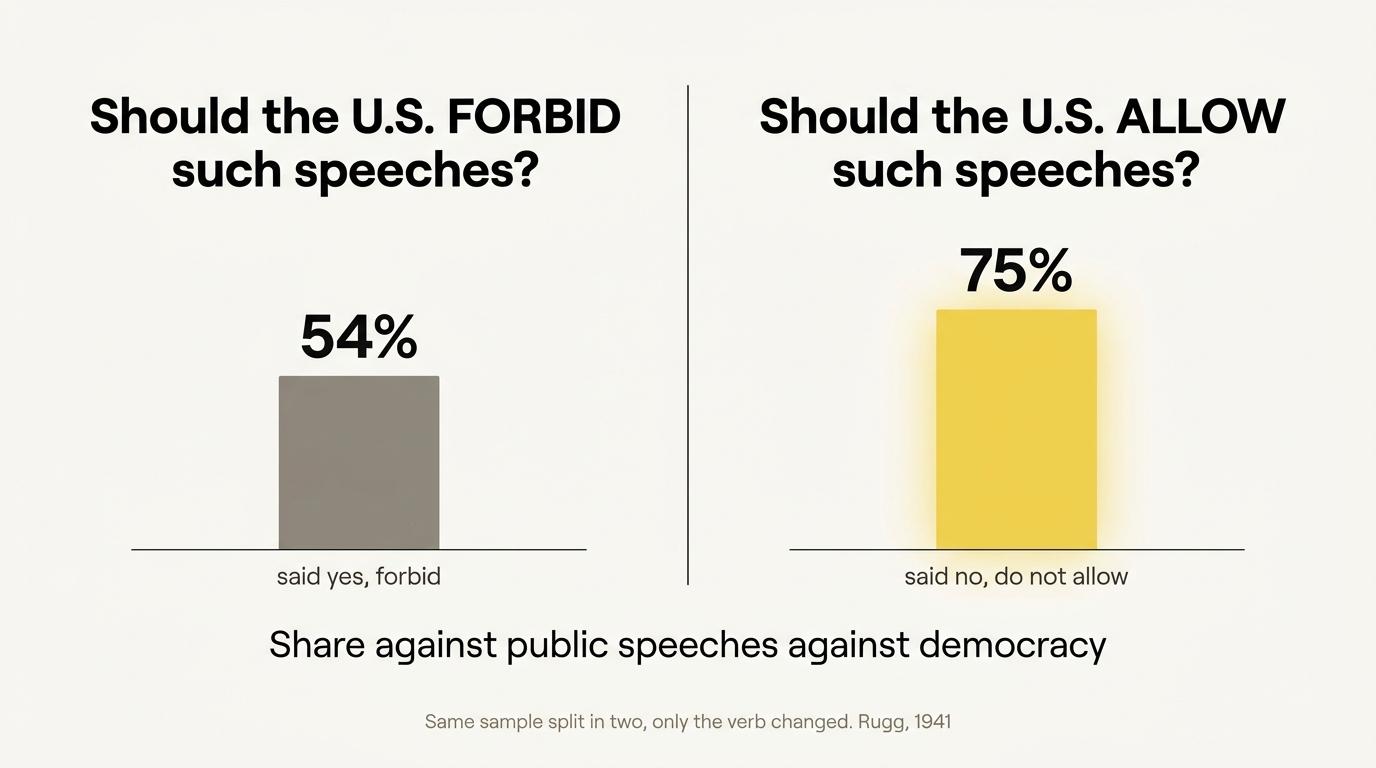
Both wordings measure the same underlying attitude. Bregje Holleman, a linguist at Utrecht University, ran ten experiments and traced the difference to the moment the person matches what they think to one of the two words on offer. Someone with a moderate opinion finds “yes, forbid” and “yes, allow” too strong for what they actually think, and takes the no in both cases. Each option has a weight of its own. The same thing happens with any pair where one side sounds harsher than the other.
The acquiescence bias behind a yes or no
Two options on an opinion give you an agree/disagree question under another name, a format that produces the best documented bias in survey research. People say yes. Survey methodologists call that acquiescence. Jon Krosnick and Stanley Presser, in the standard chapter on questionnaire design in the Handbook of Survey Research, recommend dropping yes/no questions for opinions altogether. They summarise ten studies where 52% of people agreed with an assertion while only 42% disagreed with its opposite. Seven studies in the same chapter show an average of 22% of people agreeing both with a statement and with its reversal. Krosnick and Presser put the pull towards yes at around 10 points, more than most of the differences a survey is designed to detect.
What to ask when two options fall short
| The answer you need | Format to use instead | What two options miss |
|---|---|---|
| How strongly someone holds a position | Rating scale, five points, midpoint kept | A mild yes and an emphatic yes land in the same cell |
| Which category someone belongs to | Single choice, every case listed | Anyone outside your two options picks the nearest one |
| Several answers true at the same time | Multiple choice | The second true answer has nowhere to go |
| A quantity | A number, over a dated window | ”Often” means a different number to each person |
| Why the answer is what it is | An open question, or an interview | Everything, since a percentage does not say why |
The interview that follows the form
As we saw, a two-option question gives you a number and never the reason for it. A reassuring number hides as much as a bad one.
To get at that reason, talk to a handful of respondents, starting with the ones who reassured you. Teams skip that step because a conversation costs a slot in two calendars and someone to take notes.
We built Raconte to remove that cost. You write the brief once and send a link. The person talks for a few minutes when it suits them, the AI follows up whenever an answer stays vague, and you get the transcript, the audio, a summary and per-message sentiment as soon as the call ends.
Keep the dichotomous questions, and end the form by asking whether the person would take a 10-minute call. Send the link to everyone who said yes, with a brief built from what happened and what should have been different. The 45 open-ended questions are grouped by research goal if you want a starting point for that brief. The customer feedback form templates, one per moment of the relationship, all end on that permission question.
A voice interview misses the look on someone’s face. On a sensitive subject, that is reason enough to send a human interviewer. And when a percentage really is all you need, the form on its own is faster for everyone. The first 60 interview minutes each month are free with no card. The pricing page covers what happens after that.
Frequently asked questions
What is an example of a dichotomous question?
“Did you finish setting up your account?” is a dichotomous question. It offers two answer options, yes and no, they exclude each other, and together they cover every respondent. “True or false: an export includes the items you archived” is another one, with true and false as the pair.
Can you give me 10 examples of close-ended questions?
Have you bought anything from us in the last six months? Do you manage a team? Did you finish setting up your account? Did you contact support about this problem? Which plan are you on today? Which of these features have you used in the last month? How many times did you use the tool last week? How would you rate the speed of the tool, from 1 to 5? How easy was it to learn, from 1 to 5? Rank these five features from most to least useful. The four yes/no questions are dichotomous. The plan, the feature list, the count, the two ratings and the ranking use the other closed formats.
What words do closed-ended questions begin with?
Closed questions usually open with an auxiliary or a modal verb: did, do, does, have, has, is, are, was, were, can, will, would. A question starting that way asks for a yes or a no. The other closed formats open on “which”, “how many”, “how often” or “how would you rate”, which ask for an option, a count or a value. Open questions start with “why”, “how” or “what happened”, which ask for a sentence.
What are some good examples of closed-ended interview questions?
In an interview, closed questions are checkpoints between the open ones: “Did you contact support about this?”, “Was that before or after the migration?”, “Do you still use it every week?”. Each one settles a fact in a second and gives you something concrete to follow up on. Keep them scarce, because an interview that runs on closed questions returns a form that cost you an hour.
How do you formulate a dichotomous question with its answer options?
Put one fact in the question, then name the two options explicitly. “Did you complete the setup yourself?” comes with yes and no. “Did you set the account up yourself, or did someone else set it up for you?” comes with two options that cover every account. Check that no respondent fits both options and that none is left outside the pair, then decide in advance what someone who cannot answer is meant to do, because forcing a pick and adding a “not applicable” produce different data.
What is the difference between a dichotomous question and a multiple choice question?
A dichotomous question offers two options and accepts one answer. A multiple choice question offers a longer list and accepts one answer or several, depending on how you set it up. The results read differently too. A dichotomous question gives you a percentage you can track over time, a multiple choice question gives you coverage and combinations.
Is a Likert scale a dichotomous question?
No. A Likert scale offers five or seven ordered positions, from strong disagreement to strong agreement, so it records how far someone leans rather than which side they are on. A dichotomous question records the side only. If you collapse a Likert scale into two options after the fact, you throw away the degree you paid to collect.
When should you avoid a dichotomous question?
Avoid it whenever the answer has degrees. Satisfaction, difficulty, agreement and intent all sit on a range, and two options compress that range into a percentage that moves with your wording rather than with the opinion. Krosnick and Presser recommend dropping yes/no questions for opinions entirely, because people lean towards yes by roughly 10 points. Keep the format for facts, screeners and forced choices.


