
45 open-ended questions for qualitative research, grouped by goal
A bank of 45 open-ended questions grouped by research goal, the reason each one is phrased the way it is, and the four ways a question closes back up.
August 22, 2026
Godefroy
- A question is open when it cannot be answered with yes, no, or a number. The grammar matters less than whether the person has to reconstruct something to answer.
- Pick the two research goals that match your study and leave the rest. A question bank used whole produces an interview nobody finishes.
- Four phrasings close a question back up: the disguised yes-no, the leading question, the stacked question and the hypothetical.
- The first answer sets the scene. The follow-up brings back the information. During the conversation, let a silence run three seconds before you fill it, and keep the answer you expect out of your follow-ups.
- A form loses most of what these questions go looking for. Out loud they get about 55 words against 21 typed, and a vague answer gets a follow-up on the spot.
You asked twelve people the same question and you got twelve one-line answers. “It’s fine.” “It works well enough.” “I have no real issues.” The question starts with “how”, it invites a story, and it still produced a checkbox.
The phrasing is only half of the problem. An open question is a question the person cannot answer without going back and reconstructing something they lived through, and most questions that look open ask for a summary instead. “How do you find the onboarding” asks for a verdict. “Take me back to your first week, what did you do first” asks for a sequence, and a sequence has details in it.
This is a bank of questions you can copy, grouped by what you are trying to learn. The interview guide covers the structure that holds them together, so this page stays on the questions themselves.
Choose the method before you write a single question. Our comparison of qualitative research methods gives the question each one answers and how many people it takes.
What makes a question open
A closed question hands the person a set of answers and asks them to pick one. An open question hands them the floor. The practical test takes two seconds: try to answer your own question with yes, no, or a number. If it works, the question is closed.
| Closed | Open | |
|---|---|---|
| Typical opening | ”Do you”, “Did you”, “Was it”, “How often" | "Walk me through”, “Tell me about”, “What happened when” |
| What you get | A position on a scale you chose | A sequence of events with details you did not anticipate |
| Length of the answer | Two words | Two minutes |
| What it is good for | Counting, segmenting, screening | Understanding why people do what they do |
| Failure mode | You only learn what you thought to ask | Hard to aggregate across many people |
Both have a job. Nielsen Norman Group makes the split cleanly in its comparison of open and closed questions: closed questions establish facts, “what is your job title”, “have you used it before”, and they stop the conversation there, which is exactly what you want at the start of a session. Open questions carry the study, and the closed ones have a bank of their own, 40 examples grouped by format. Keep yes or no questions for facts, since an opinion comes in degrees and needs a scale. Whether your study as a whole should rely on qualitative or quantitative research depends on the decision it has to inform.
The trap sits in between, in the question that opens with an open word and closes on a verdict. “What do you think of the new dashboard” is grammatically open and produces “yeah, it’s good”. Nothing in it requires the person to go and look at a memory.
Nine goals, five questions each
Pick the two goals your study is about and take their ten questions, then add two closing ones. A dozen questions with real follow-ups beat forty-five recited in order.
Discovery, before you know where the problem is
- Walk me through the last time you had to do this.
- What were you doing right before that? What did you do right after?
- Who else got involved, and at what point?
- Tell me about a time this went badly.
- What did you try before you settled on how you do it now?
All five point at one dated episode. People describe what they “usually” do by reconstructing an average that never happened, and the average has no details in it. The same questions work as a weekly routine in customer discovery.
The current workflow and its workarounds
- Take me through how you do this today, step by step.
- What do you end up doing outside the tool, in a spreadsheet or on paper?
- Which part of it do you push to the end of the day?
- What did you set up yourself to make this bearable?
- Where do you have to go and ask someone else?
Asking what people do outside the tool pays the most of the five. A workaround that is still in place six months later is a problem the person stopped reporting.
Onboarding and the first weeks
- Take me back to your first week with it. What did you do first?
- What did you expect to happen that did not?
- Where did you get stuck long enough to think about giving up?
- Who did you ask when you got stuck? What came back?
- What made you keep going?
Satisfaction, past the score
- Tell me about the last time you dealt with us.
- What is the one thing that would have made it better?
- When did you last recommend us, or decide not to? What was going on?
- What do you say when someone asks you what we do?
- What do you tell colleagues to watch out for?
A score tells you the level. The cause takes a conversation, and these five questions are that conversation. The limits of a satisfaction survey go into what a number out of ten hides.
Churn and the moment of the decision
- When did you first start thinking about stopping?
- Walk me through the day you decided.
- What were you already doing instead by then?
- Who did you talk to about it before you left?
- What would have had to change, and how soon?
Pricing and perceived value
- How did you work out what this was worth to you?
- What did you compare it against?
- Tell me about the conversation where the budget got approved.
- What happened the last time the price came up internally?
- What got cut the last time your budget dropped?
Rob Fitzpatrick built The Mom Test around the gap these pricing questions try to close. People answer “would you pay forty euros a month for this” generously and truthfully, because they are describing a version of themselves who does not have to pay. Ask what they already bought, what they compared, and who signed.
Feature and concept feedback
- Describe the last time you needed something the tool could not do.
- What did you do instead?
- What did that gap cost you the last time it came up?
- Who else on your team runs into the same thing?
- What would you stop doing if this existed?
Asking what someone would drop separates interest from appetite. “Would you use it” measures politeness. “What would you drop for it” measures a budget, an hour in the week, or a habit. Question 35 is a hypothetical, and it earns its place because the person answers it with something they already own.
When someone leaves the company
- Tell me about the week you decided you were going to look elsewhere.
- What kept you here for as long as it did?
- Describe the best month you had here, and the worst one.
- What did you raise at the time? What came of it?
- What did you stop bothering to mention after a while?
The question about what people stopped mentioning hurts, and it pays. Our bank of 30 exit interview questions covers the full structure for a departure, including who should be in the room.
Closing questions
- If you could change one thing by tomorrow morning, what would it be?
- What should absolutely stay as it is?
- What have I not asked you about?
- Who else should I be talking to about this?
- What made you say yes to this conversation?
Question 41 is the second hypothetical worth keeping, after question 35. A hypothetical works as a ranking rather than a prediction once the person has enough of their own material to pick from, and by the closing block they do. Keep “what have I not asked you about” in every guide too. It regularly opens a topic you did not plan for, and it costs fifteen seconds.
Four ways an open question closes back up
Most bad questions in a guide were written as open questions and drifted. Rewriting them takes a minute each.
| The question as written | What the person hears | The rewrite |
|---|---|---|
| ”Do you find the export easy to use?” | Say yes and we move on | ”Walk me through the last export you ran." |
| "Was it frustrating that it took so long?” | You want me to say it was frustrating | ”What was going on while you waited?" |
| "How was onboarding, and did support help?” | Answer the last bit | Ask the two questions one after the other |
| ”Would you use a version that did X?” | Be encouraging | ”How do you handle X today?” |
The leading question is the hardest one to catch on a reread, because it usually arrives dressed as a helpful paraphrase. Elizabeth Loftus and John Palmer put a number on how much damage one word does: they showed five groups of students the same film of a car accident and asked how fast the cars were going when they smashed, collided, bumped, hit or contacted each other. The average answer went from 31.8 miles per hour on “contacted” to 40.8 on “smashed”. Same film, one verb changed, nine miles per hour of difference.
Nobody in your study is lying to you. They are answering the question you actually asked, and your hypothesis was inside it.
”Why” makes people justify themselves
“Why did you stop using it” reads like the most open question you can ask. It is also the one that changes the register of the conversation, because people hear it as a request for a defensible reason. They give you a tidy one, and the tidy reason is rarely the real sequence.
Indi Young builds her deep listening method around replacing that word. Instead of asking for a justification, hand back what they said and wait: “because…”, “and then…”, “what was going through your mind there”. The person continues their own sentence rather than building a case, and what comes out is the thinking as it happened rather than the version rehearsed for you.
Keep “why” for the things people have genuinely thought about, a deliberate decision or a rule they follow on purpose. Drop it everywhere else.
Following up is where the answer arrives
The questions in a guide are the openings. The follow-up goes and gets what the first answer left out, and a vague answer gets handled while the person is still talking rather than while rereading the transcript on Thursday.
Steve Portigal makes silence the first move in Interviewing Users, and it is the one beginners skip. An answer stops, the pause feels long, you fill it. Wait three seconds and the person picks their own answer back up, and the sentence they add is the one they had not planned to say.
graph TD
  A["The answer just stopped"] --> B{"Story or opinion?"}
  B -->|"An opinion"| C["Ask for the last real episode"]
  B -->|"A story"| D{"Anything still vague?"}
  D -->|"A word you do not understand"| E["Repeat the word as a question"]
  D -->|"A jump in the timeline"| F["Ask what happened next"]
  D -->|"Nothing"| G["Wait three seconds"]
  G --> H["They usually keep going"]
Phrase your follow-ups without slipping the answer into them. “That must have been annoying” and “so basically it’s a speed problem” save half a minute and cost you the data, because the person will take the wording you offered rather than find their own. Repeat their word as a question, ask what happened next, or wait in silence: the wording stays theirs. All three follow-ups appear in an annotated qualitative interview example, where a vague “it was fine” becomes the reason someone cancelled a meal-kit subscription: nobody in their household cooks from a recipe three evenings a week.
The same questions fail in writing
Send these 45 questions as a form and most of them come back empty. The Pew Research Center measured 18% nonresponse on an open-ended question against 1% to 2% on a closed one, on a paid panel used to answering them.
The answers you do get are short, and there is a measurement for that too. Jan Karem Höhne, Konstantin Gavras and Joshua Claassen put the same open questions to just over a thousand people in a smartphone survey, half typing and half speaking, and compared the length of text and voice answers. Typed answers averaged around 21 words. Spoken answers to the same questions averaged around 55. Their reading is that speaking runs closer to how people actually think, and that typing gives the respondent time to trim. You can collect spoken answers like these with one of the twelve voice survey tools we compared.
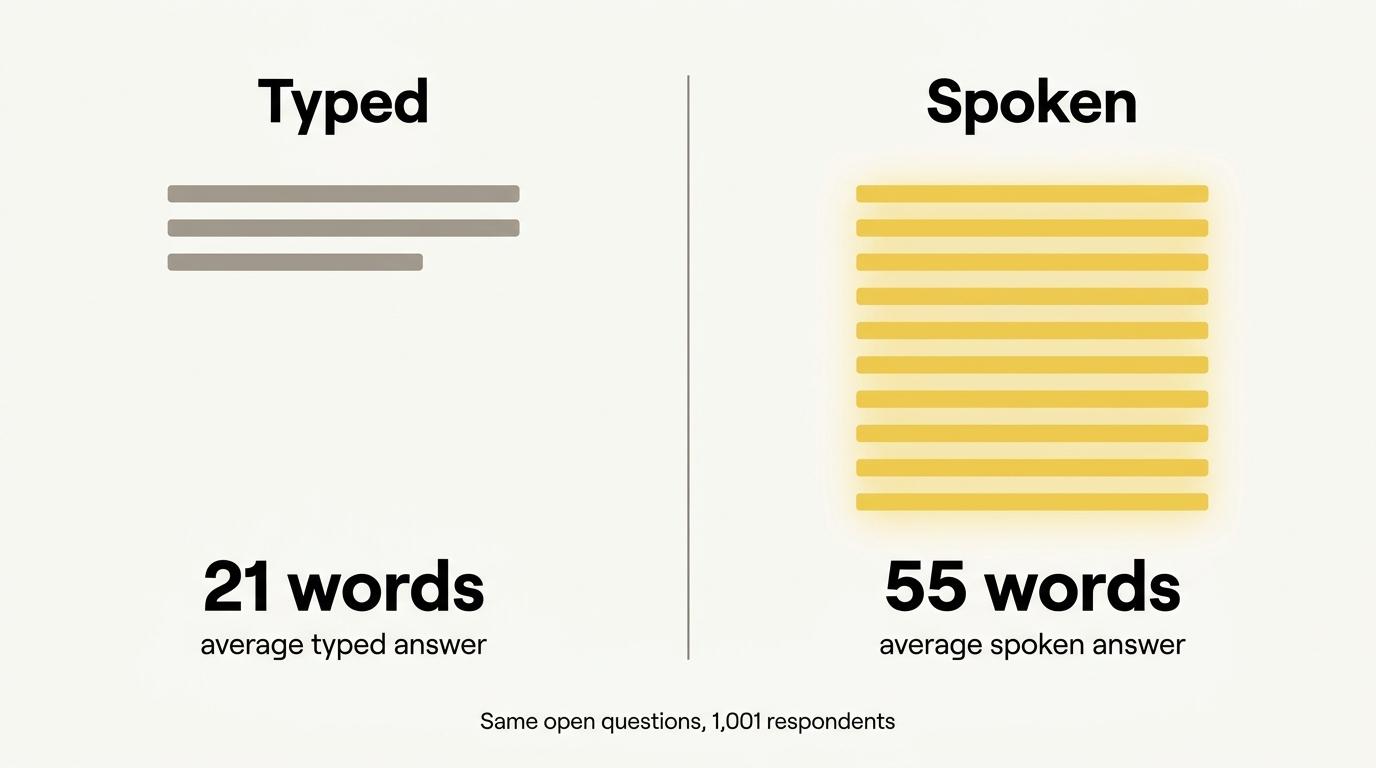
Follow-ups explain the rest of the gap. In writing, “too expensive” ends the exchange and nobody ever learns what it was measured against. In a conversation, the next question arrives a second later. You will rarely get more than “too expensive” from any form builder, since Typeform, Tally and Google Forms all collect typed answers.
Handing the follow-ups to an AI
The reason teams run six interviews a year and send surveys to five thousand people is the cost of a conversation: a slot to book, an interviewer who is free, and someone taking notes. That is the cost we set out to remove with Raconte. You write the questions once as a brief, send a link, and the AI runs the voice conversation.
Most of the rules in this article are built into how it interviews. It asks one question at a time, never two in the same message, so the stacked question cannot happen even when your brief lists five questions in a row. It follows up whenever an answer stays vague or incomplete, and moves on once the answer is precise enough. And it tracks what the person already told you, so it skips a question they answered in passing three minutes earlier instead of asking it again in different words.
For the questions it writes itself, the same instructions apply: ask for a real episode rather than a verdict, keep the expected answer out of the wording, and reach for “what happened next” rather than “why”. Your own questions are asked exactly as you wrote them, because a closed question in a brief is usually a deliberate screener.
The follow-ups also come from a model with no hypothesis to defend. When you have spent three weeks convinced that the slow export is what drives people away, you nudge the person towards saying it without noticing. The AI has nothing riding on the answer. If the real problem is somewhere else, that is what comes back.
The format has real limits. An AI reads neither an uncomfortable silence nor a face, so an open conflict, a negotiation or a subject that needs presence still calls for a human interviewer. And if all you want is one factual data point from two hundred people, a form is faster for everybody.
You get the transcript, the audio, a summary and per-message sentiment within seconds of each conversation. The getting started guide walks through sending a first interview, and the first 60 interview minutes each month are free with no card. The pricing page covers what happens after that.
Where to start
Take the guide you already have and answer each of its questions yourself with a yes, a no or a number. Every question you can answer that way is closed, and the rewrite is almost always the same move: swap the verdict for an episode. “How do you find X” becomes “walk me through the last time you did X”.
Then take the two goals your study is about, keep their ten questions, add “if you could change one thing” and “what have I not asked you about”, and run that guide on one person before the series. Whatever went unused on that first conversation comes out of the guide.
Open questions produce material nobody can count. That is the point of asking them, and it is also why you need a method to read it. Thematic analysis is the usual one, and we run its six phases on one real interview extract. To read a large batch of answers, you can choose among the fourteen tools for qualitative data analysis we compared on price and on whether they transcribe your recordings.
Frequently asked questions
What is an open-ended question in qualitative research?
An open-ended question is a question the person cannot answer with yes, no or a number. It hands them the floor and lets them decide what matters and how much detail to give. In qualitative research it is the main instrument, because the point of the study is to find out what you did not think to ask about.
What is the difference between an open-ended and a closed question?
A closed question offers a limited set of answers and asks the person to pick one, which produces something you can count. An open question asks them to reconstruct an experience, which produces a story you can read against other stories. The test is to try answering your own question with yes, no or a number. If it works, the question is closed.
What is a good qualitative research question?
Four things make a question good. It asks about one thing, it points at a real episode rather than a habit, it leaves the answer entirely to the person, and it keeps your hypothesis out of the wording. “Walk me through the last export you ran” does all four. “Was the export frustrating?” misses three of them, and the rewrite costs one sentence.
How many open-ended questions should an interview have?
Plan twelve to twenty questions for a 45-minute interview, with follow-ups on top of that. Beyond twenty you recite instead of listening, and the conversation turns into a spoken questionnaire. Twelve well-chosen questions with real follow-ups produce more than thirty asked in a row.
Why should you avoid asking 'why' in an interview?
“Why” is heard as a request for a justification, so people answer with a defensible reason rather than the actual sequence of events. Replacing it with “and then”, “because…” or “what was going through your mind there” keeps the person describing what happened. Keep “why” for genuinely deliberate decisions.
Do open-ended questions work in a survey?
They work badly. The Pew Research Center measures 18% nonresponse on an open-ended question against 1% to 2% on a closed one, and the answers that come back run around 21 words. The same questions asked out loud get around 55 words, because speaking runs closer to how people think while typing gives them time to trim.
How do you follow up on a vague answer?
Four moves cover almost everything. Wait three seconds and let the person restart on their own. Repeat their last word as a question, “complicated?”. Ask for an episode, “tell me about the last time that happened”. Or simply ask what happened next. Avoid any follow-up that already contains the answer you expect.
Can an AI ask open-ended questions properly?
Yes, it handles the mechanical part of the job. An AI interviewer asks one question at a time, follows up as soon as an answer stays vague, and has no hypothesis it is hoping to confirm, which removes most leading questions. What it cannot do is read a silence or a face, so a sensitive or conflictual subject still calls for a human.


