
How to transcribe an interview, with an annotated transcript example
An interview transcript annotated mark by mark, the same extract cleaned up, the four ways to transcribe compared on time and cost, and when AI is enough.
October 3, 2026
Godefroy
- Decide how much detail the transcript records before you start typing, based on the analysis you plan: a thematic analysis needs the words, conversation analysis needs the pauses and the overlaps.
- A cleaned-up transcript is easier to read but loses evidence: hesitations, laughter, interruptions, and sometimes the mark showing a word was inaudible, replaced by the transcriber's guess.
- Typing a transcript by hand takes at least three hours per hour of talk, and up to ten when you record pauses and overlaps.
- Automatic transcription is good enough for a thematic analysis of clear audio, provided someone checks it against the recording once. Conversation analysis, legal use and hard recordings still need a human transcriber.
- Mark what you cannot hear instead of filling it in. A guessed word reads exactly like a heard one, so nobody can tell them apart afterwards.
To transcribe an interview properly, decide first how much of the speech the transcript has to keep, then write down every word with the speakers separated and a timestamp at each turn, mark what you cannot hear instead of guessing it, and check the result against the recording. Most interview transcripts for research are “clean verbatim”: every word, minus the ums. The trouble is that a clean-up sometimes removes the very parts that answer your research question.
This page starts with an example transcript: one extract in full verbatim with every notation mark explained, then the same extract cleaned up, so you can see what goes missing. You then get the four ways to produce a transcript, with their real time and cost, and the cases where automatic transcription is enough.
An interview transcript example, annotated
An interview transcript is the written record of a conversation, with each turn attributed to a speaker, timestamped, and set down in the words that were said. We wrote this extract for the page, as an example of a research interview about why freelancers stop using their invoicing software. It is transcribed in full verbatim, with the light notation most qualitative researchers use.
Interview 07 · freelance designer · 2026-09-18 · audio 00:41:12Transcribed by: M.L. · Level: full verbatim · Names replaced by [brackets]
[00:12:04] I: So you said you stopped sending invoices from the app. When was the last time you used it?[00:12:09] P: Um (.) March? I think March. I had (.) I had this client, a big one, and I wa- I wanted the invoice to go out the same day because they pay on the first.[00:12:21] I: Mm-hm.[00:12:22] P: And the PDF came out with the old VAT number. ((laughs)) Which is (.) yeah. Which is funny NOW.[00:12:29] I: What did you do [then?][00:12:30] P:                [I just] did it in Word. (2.5) I did it in Word that night and I never really went back.[00:12:38] I: You said you never really went back. What would have had to happen for you to go back?[00:12:43] P: Honestly? (1.5) If someone had told me it was fixed. Nobody (inaudible 00:12:47) so I assumed it wasn't.[00:12:51] I: Who would that someone have been?[00:12:53] P: I don't know. The app? [Accountant] maybe. Someone.
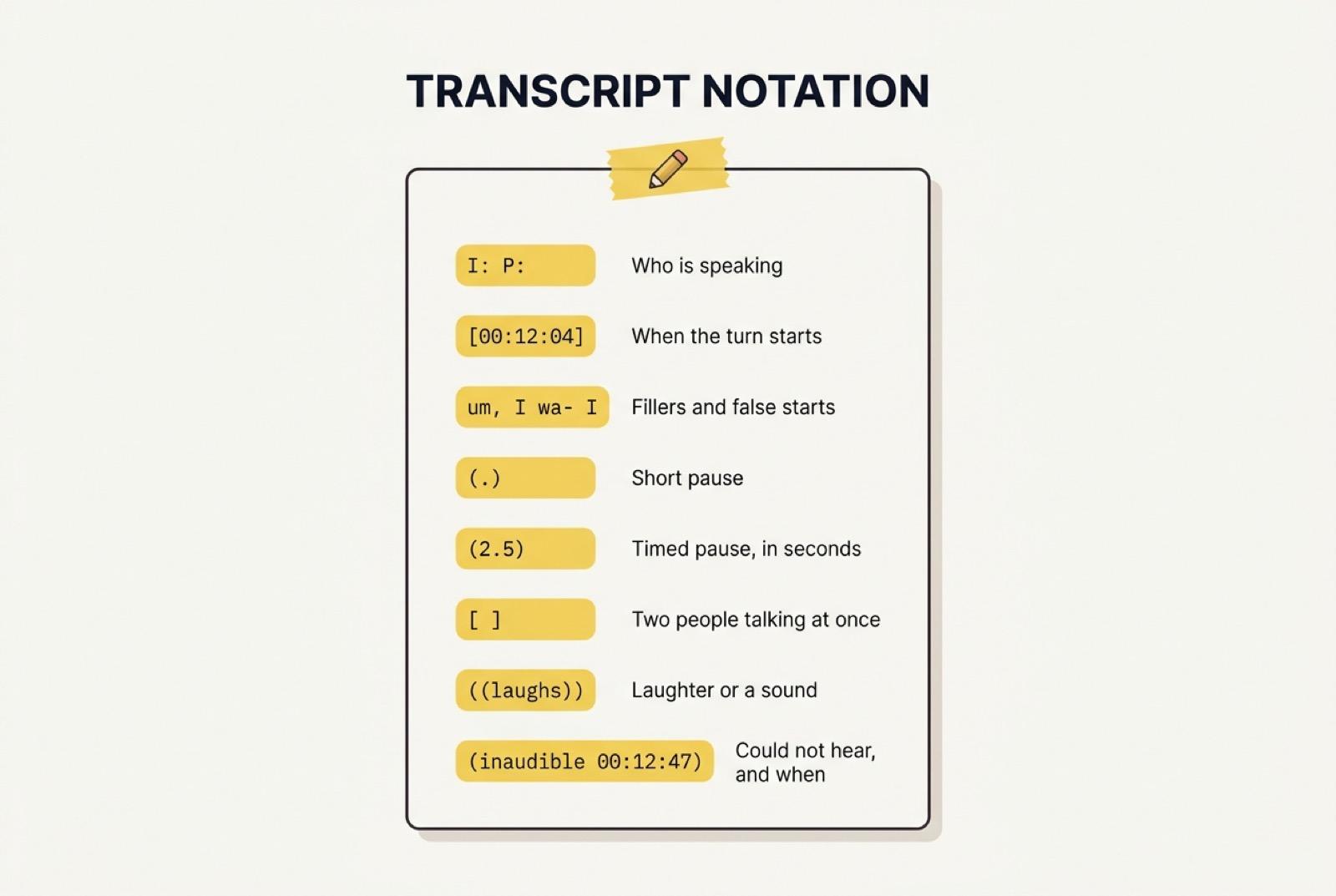
Each mark records something the plain words would lose.
| Mark in the extract | What it records | What the analyst learns from it |
|---|---|---|
| Header: interview number, date, length, transcriber, level | Where the text comes from | Lets you trace any quote back to its recording and know how much detail to expect |
I: and P: | Who is speaking | Separates the participant’s words from the interviewer’s, which is the first thing coding relies on |
[00:12:04] | When the turn starts | Takes you straight to the audio when a passage needs listening to again |
Um, I wa- I wanted | Fillers and false starts | The participant is reconstructing the memory as they speak rather than reciting a prepared answer |
(.) | A pause too short to time | Hesitation, here around the date and around the client |
(2.5), (1.5) | A pause, in seconds | The longest silence comes right before “I did it in Word that night and I never really went back”, the sentence where the participant says they left the app |
((laughs)) and NOW | Laughter, and a word said louder | The participant laughs off a moment that embarrassed them at the time |
[then?] / [I just] | Two people talking at once | The participant cut in before the question ended, so the answer was ready |
Mm-hm. | A backchannel from the interviewer | The interviewer kept the participant talking without steering them |
(inaudible 00:12:47) | A word nobody could hear, with its time | Shows the reader that something is missing, and where to listen for it |
[Accountant] | A name replaced at transcription | The person stays anonymous and the role stays readable |
| The echo question at 00:12:38 | The interviewer reusing the participant’s words | Shows the follow-up was built on the answer rather than read from the guide |
Verbatim or clean verbatim: what the cleaned version loses
Here is the same extract after a standard clean-up, the version many transcription services deliver by default and many teams produce when they tidy an automatic transcript.
I: When was the last time you used the app to send invoices?P: In March. I had a big client and wanted the invoice to go out the same day, because they pay on the first. The PDF came out with the old VAT number.I: What did you do then?P: I did it in Word that night, and I never went back.I: What would have had to happen for you to go back?P: If someone had told me it was fixed. Nobody did, so I assumed it wasn't.I: Who would that someone have been?P: I don't know. The app, or my accountant maybe.It is easier to read and quote, but it has lost at least four things.
- The hesitations, and the 2.5-second silence before “I did it in Word that night”. The cleaned version states the decision flatly, where the recording shows somebody reluctant to say it.
- The laugh and the stress on “now”, which showed the embarrassment.
- The word “really” in “never really went back”, which leaves the door open. A product team reads “never went back” as a lost customer, and “never really went back” as one who could return.
- The inaudible passage. Whoever cleaned it wrote “Nobody did”, which is a plausible guess. Nothing on the page flags it, so it reads exactly like a heard word.
Daniel Oliver, Julianne Serovich and Tina Mason, three researchers writing in the sociology journal Social Forces, named the two approaches in a 2005 paper on interview transcription. A naturalized transcript keeps every utterance in as much detail as possible. In a denaturalized one, the transcriber corrects the grammar, removes the noise and standardises the accents, so the text records what was said rather than how. Which one is right depends on the analysis you plan.
| Level | What it keeps | What it drops | Use it for |
|---|---|---|---|
| Clean verbatim (denaturalized) | Every meaningful word, speakers, timestamps | Fillers, false starts, pauses, laughter, overlaps | Content and thematic analysis, quotes in a report |
| Full verbatim (naturalized) | Everything above, plus fillers, false starts, pauses, laughter and overlaps marked simply | The length of short pauses, pitch, breath | Interviews where how something is said matters: sensitive topics, hesitant decisions, discourse analysis |
| Jefferson notation | Everything above, plus every pause timed to the tenth of a second, pitch, stress, speed, breath, latching | Nothing that can be heard, in principle | Conversation analysis, where the turn-taking itself is the object of study |
We recommend transcribing in full verbatim with the light notation of the freelancer extract, and cleaning it later for quotes. You can cut a recorded filler in a second when a quote goes into a slide, while a pause nobody wrote down means listening to the recording again, if you still have it.
Transcription conventions and what each one records
A transcription convention is an agreed mark for what the plain words cannot show: who is speaking and when, a pause, an overlap, a word cut off or said louder, a laugh, a word nobody heard or only guessed, a name taken out. Researchers who need full detail use the system built in the 1960s and 1970s by Gail Jefferson, a sociologist who developed conversation analysis with its founder Harvey Sacks. Alexa Hepburn and Galina Bolden, two conversation analysts, set out the full Jefferson notation in their chapter of the Handbook of Conversation Analysis. Most interview studies need only a handful of its marks.
| Convention | Meaning | Example |
|---|---|---|
I: / P: or names | Speaker turn | P: I did it in Word. |
[hh:mm:ss] | Timestamp at the start of a turn | [00:12:30] |
(.) | Pause under about two tenths of a second | I had (.) I had this client |
(2.5) | Timed pause, in seconds | I did it in Word. (2.5) I did |
[ ] | Start and end of overlapping talk, aligned across the two lines | [then?] / [I just] |
- | Word cut off | I wa- I wanted |
((laughs)), ((sighs)) | A sound or an action, described | ((laughs)) |
CAPITALS | Said noticeably louder | funny NOW |
(inaudible hh:mm:ss) | Could not be heard, with the time | (inaudible 00:12:47) |
(word?) | Best guess, flagged as a guess | (Tuesday?) |
[Role] | A name replaced for anonymity | [Accountant] |
Three habits keep a set of conventions usable across a whole study.
- Write the conventions on one page before the first transcript, and give that page to everyone who transcribes. Two transcribers with different habits produce two datasets.
- Put a header on every transcript: interview number, date, length, transcriber, level of detail. A transcript without a header is a quote nobody can trace.
- Anonymise as you transcribe, with a role in brackets in place of the name. A file shared before the anonymisation pass is a GDPR incident waiting to happen.
How to transcribe an interview: four methods compared
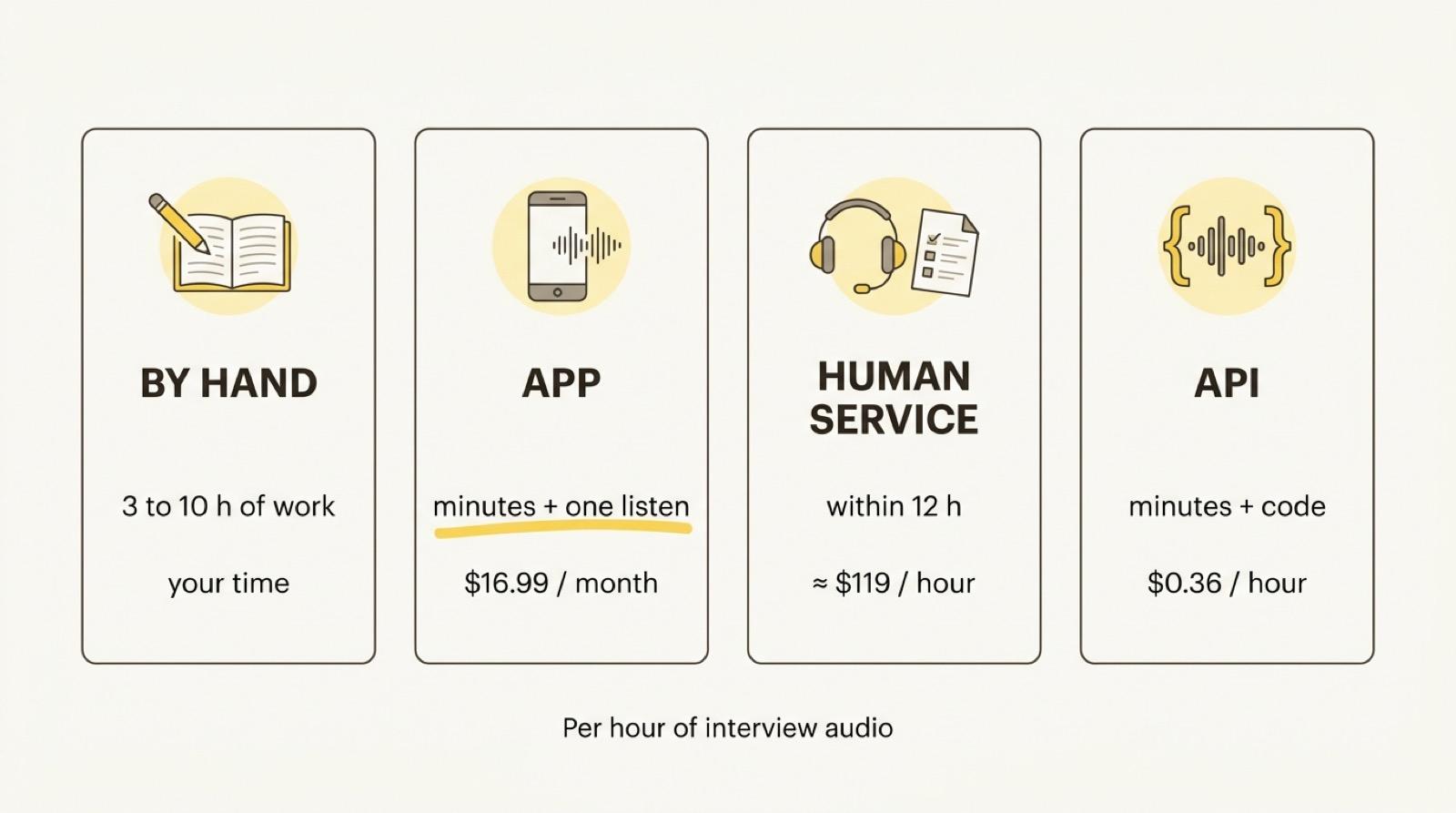
You can type the transcript yourself, run the recording through transcription software, send it to a human service, or call a speech-to-text API from your own code. The four mostly differ on who spends the time, and how much of it.
| Method | Time per hour of audio | Cost per hour of audio | Speakers and timestamps | Best for |
|---|---|---|---|---|
| By hand | 3 to 10 hours of your time | Your time | As careful as you are | A few interviews, full verbatim or Jefferson, getting to know the data |
| Transcription app (Otter, for example) | Minutes, plus one listening pass to correct it | Free up to 300 minutes a month on Otter, then $16.99 a month for 1,200 | Automatic, to check | Clean verbatim of clear recordings, small teams |
| Human service (Rev, for example) | Delivered within 12 hours | About $119 at $1.99 a minute | Included | Hard audio, legal or published quotes, no time to correct |
| Speech-to-text API (OpenAI, for example) | Minutes, plus code and a correction pass | $0.36 at $0.006 a minute, half with the mini model | Depends on the model and your code | Volume, transcripts that feed a pipeline |
Julia Bailey, a general practitioner and researcher at University College London, estimates that typing by hand takes at least three hours per hour of talk, and up to ten hours with fine detail, in her 2008 paper on transcribing in Family Practice. The app, service and API prices are the public ones from Otter, Rev and OpenAI in October 2026.
If you plan to load the transcripts into an analysis tool, check whether it transcribes before you pay for a separate app. Some qualitative analysis software transcribes the recording itself, for $1 to $30 an hour of audio depending on the tool.
Whatever the method, the steps of a careful transcription stay the same.
- Record in a quiet room with a separate microphone. For a call, record each side on its own track. Bad audio costs more than any other choice on this list.
- Choose the level of detail and write down your conventions before you start.
- Write the header, then transcribe or generate a first draft.
- Correct the draft against the recording in one full listening pass, at normal speed or slightly slower.
- Mark every inaudible passage with its timestamp, and flag every guess as a guess.
- Replace names, employers and places with roles in brackets.
- Spot-check a few minutes against the audio after the correction pass, starting with the passages you plan to quote.
In qualitative research, the transcript is the data
In a qualitative study, you code the transcript rather than the recording, so a decision taken while transcribing becomes part of the analysis. A pause left out cannot be coded. A participant’s words corrected into standard grammar get coded as the transcriber’s grammar. Bailey makes the same point: turning speech into text always reduces it, so what you keep is already an analytical decision, taken early and often by someone other than the analyst.
That is why the transcription level belongs next to the questions, in your interview guide and in your method section. Once the transcripts exist, you code short extracts, build themes from the codes and check every theme against the transcripts: those are the steps of a thematic analysis on interview transcripts. A theme built on a cleaned transcript can only be about what was said. A theme like “people keep the door open while saying they left” needs the hesitation, the “really” and the pause.
Transcribing your own interviews also has a benefit nobody bills for. You hear each conversation a second time, slowly, which is where many researchers first notice the patterns they later code. Teams that outsource transcription can get some of that back by listening to two or three recordings in full before reading any transcript.
When automatic transcription is enough, and when it is not
Automatic transcription is good enough when the audio is clear, the speakers take turns, the language is one the model handles well, and you plan a thematic or content analysis that works on the words. Someone still has to read the draft against the recording once, because the errors that matter are hard to spot by reading alone.
Speech recognition models make mistakes that look plausible. Allison Koenecke, an information scientist at Cornell University, and her colleagues found that about 1% of the transcriptions produced by OpenAI’s Whisper contained phrases that appear nowhere in the audio, and that close to 40% of those invented phrases were harmful, in a paper presented at ACM FAccT in 2024. The inventions came disproportionately during long pauses and for speakers with aphasia. In an interview, the long pauses are often the moments you most want to read exactly.
graph TD
  A["You have an interview recording"] --> B{"Will you analyse how things are said: pauses, overlaps, intonation?"}
  B -->|"Yes, conversation or discourse analysis"| C["Transcribe by hand, Jefferson or full verbatim"]
  B -->|"No, themes or content"| D{"Is the audio clear, with speakers taking turns?"}
  D -->|"No: crosstalk, noise, strong accents, speech difficulties"| E["Human service, or automatic draft plus a careful manual pass"]
  D -->|"Yes"| F{"Will quotes be published or used as legal evidence?"}
  F -->|"Yes"| E
  F -->|"No"| G["Automatic transcription, checked once against the recording"]
Automatic transcription falls short in four situations.
- Conversation analysis and discourse analysis, where the pauses, overlaps and intonation are the data. No consumer tool writes Jefferson notation.
- Hard recordings: several people talking over each other, background noise, a phone line, strong accents, speech difficulties.
- Quotes that will be published, or a transcript used as evidence, where every word has to be one somebody can stand behind.
- Sensitive interviews whose consent form does not cover sending the audio to a third-party service. Check that before you upload anything.
Skipping the transcription pass when Raconte runs the interview
Every method on this page assumes a recording exists and someone has to turn it into text. When the interview runs through Raconte, there is no transcription pass. An AI conducts the interview as a voice conversation and follows up when an answer stays vague. The transcript builds up turn by turn as the person speaks.
When the interview ends, you get the transcript with the interviewer’s and the participant’s turns separated, a timestamp on every message, the audio of each message alongside its text, a summary, and a sentiment on each participant message. You can read it in the app, copy it, or pull it into your own analysis through the REST API, the MCP server or a webhook fired when the interview ends. Interviews run in English or French.
Of course, the transcript Raconte returns is the text recognised from speech, at clean verbatim level, without pause lengths or Jefferson marks. When a passage turns on how something was said, play the audio of that message: it sits next to the text, so checking a hesitation takes one click instead of a search through a 40-minute file. For conversation analysis, keep transcribing by hand.
Frequently asked questions
What is an interview transcription?
An interview transcription is the written version of a recorded interview, with each turn attributed to a speaker and usually timestamped. It can keep every word only (clean verbatim), every word plus fillers, pauses, laughter and overlaps (full verbatim), or the full detail of Jefferson notation used in conversation analysis. In qualitative research, the transcript is the material you code, so the level of detail is a decision about your analysis as much as about formatting.
How do you properly transcribe an interview?
Record clear audio, choose the level of detail before you start, and write your conventions on one page. Give every transcript a header with the interview number, date, length and transcriber. Separate the speakers, timestamp each turn, and transcribe or generate a first draft. Then correct it against the recording in one full listening pass, mark every inaudible passage with its time rather than guessing, flag any guess as a guess, and replace names with roles in brackets.
How long does it take to transcribe a 40 minute interview?
By hand, it takes between two and seven hours. Julia Bailey, a researcher at University College London, puts manual transcription at three hours per hour of talk at least, and up to ten hours with fine detail, so a 40-minute interview takes about two hours in clean verbatim and up to almost seven with full notation. Automatic transcription produces a draft in minutes, but you still need at least the 40 minutes of the recording to check it. A human service such as Rev delivers within 12 hours, for about $80 at $1.99 a minute.
Can I use AI to transcribe an interview?
Yes, for most research interviews with clear audio, as long as someone checks the result against the recording. Speech recognition is accurate enough for thematic and content analysis, and costs very little: OpenAI’s API charges $0.006 a minute. It is weaker on crosstalk, noise, strong accents and long silences, where models sometimes write words nobody said. It does not produce the pause and overlap notation conversation analysis needs. Check also that your consent form covers sending the audio to an outside service.
What is the best interview transcription service?
It depends on the recording and on what you will do with the transcript. For clear audio and a thematic analysis, an automatic tool with one correction pass is enough, and Otter’s free plan covers 300 minutes a month. For hard audio, published quotes or legal use, a human service such as Rev, at $1.99 a minute with delivery within 12 hours, is safer. For conversation analysis, no service replaces transcribing yourself. And if the interviews have not happened yet, a tool that runs them and returns the transcript removes the step altogether.
What does an interview transcript example look like?
It opens with a header (interview number, date, length, transcriber, level of detail), then one line per turn: a timestamp, a speaker label such as I for the interviewer and P for the participant, and the words said. In full verbatim, fillers stay in, pauses appear as (.) or a duration in seconds such as (2.5), overlapping talk sits between square brackets, laughter is written ((laughs)), and anything unheard is marked (inaudible) with its time. The annotated extract on this page, an example we wrote of a research interview with a freelance designer, shows each of these marks in context.
Where to start
If you already have recordings, decide the level of detail first. For most product and UX research, we recommend full verbatim with the light notation of the example. Start from an automatic draft and correct it in one listening pass: add the pauses and hesitations and mark every unheard word as inaudible. Then read the transcripts in full before you start coding them.
If the interviews have not happened yet, you can skip the transcription pass entirely. Raconte runs the conversation for you: you write the brief once, send a link, and each person answers by voice whenever it suits them. Each interview comes back as a timestamped transcript with the speakers separated and the audio of each message attached, ready to code. The first 60 minutes each month are free, with no card required. After that, you pay $0.12 per minute of active speech.


