
How to run a thematic analysis on interview transcripts
Braun and Clarke's six phases run on a real verbatim, the reflexive and codebook split, how many interviews you need, and what a language model misses.
September 5, 2026
Godefroy
- A theme is a pattern of meaning you build, not a topic waiting in the transcripts. A heading that names a subject, like "communication", teaches nobody anything.
- The six phases loop. Reviewing your themes sends you back to the codes, and usually all the way back to the transcripts, where most of the analysis happens.
- Counting how often a code appears turns an interview study into a small survey with a bad sample. Frequency answers a different question from the one interviews were for.
- Use reflexive thematic analysis when you interpret alone, and a codebook when several people code the same corpus and someone will audit the method.
- Language models match human coders once a codebook exists, and fall behind on tone, on what people imply, and on anything left unsaid.
Fourteen interviews sit in a folder. Each one ran forty minutes, each transcript is nine or ten pages, and the readout is on Thursday. The temptation at this point is to open the transcripts, pull the five quotes you already remember, and build the slides around them. That produces a deck nobody can argue with and nobody learns anything from, because the five quotes you remember are the ones that confirmed what you thought before you started.
Thematic analysis is the method that stops that from happening. It is also the method most often named and least often followed: papers cite Braun and Clarke, then present a list of subjects the participants talked about. Those are two different things, and the gap between them is most of what this page is about.
Thematic analysis builds themes, not a list of topics
Thematic analysis is a method for finding, building and reporting patterns of meaning across a set of qualitative material. You code the whole corpus, group codes that say the same thing, and construct themes that carry an argument. Virginia Braun and Victoria Clarke, two psychologists then at the University of Auckland and the University of the West of England, set out the version most people use in a 2006 paper that has since become one of the most cited articles in the social sciences.
“Communication” is a topic, and so are “onboarding”, “pricing” and “trust”. A theme says something: people read a rejected expense claim as a signal about the system, not about the receipt they sent. You can disagree with a theme. You cannot disagree with “communication”.
Braun and Clarke call a heading that only names a subject a topic summary, and they name it the most common problem in the work that cites them. In a 2022 paper on avoiding common problems they also object to the verb everyone reaches for. Themes do not emerge. Lisa Morriss, a sociologist at the University of Liverpool, put the same point in the title of an editorial in Qualitative Social Work in 2024, after seeing how often the word came back in submitted manuscripts. You built the theme. Saying it emerged hides the decisions you made and leaves the reader unable to check them.
Two neighbouring methods get confused with it often enough to be worth separating.
| Thematic analysis | Content analysis | Grounded theory | |
|---|---|---|---|
| What you produce | Themes that carry an argument | Categories, usually counted | A theory of a process |
| What it does with meaning | Reads the stated and the implied together | Lets you choose surface content or underlying meaning before you start | Builds upward through open, axial and selective coding |
| Sampling | Fixed before analysis, in practice | Fixed before analysis | Guided by what the emerging theory still needs |
| Relation to numbers | None required, counting is discouraged | Frequencies are the point of most designs | None |
| What a reviewer asks for | A defensible construction of the themes | Reliable category definitions | Constant comparison and theoretical sampling |
| Good for | Interviews, open answers, feedback at any scale | Large corpora with recurring vocabulary | A process nobody has described yet |
Mahnaz Vaismoradi, a nursing researcher, and colleagues drew the line between thematic analysis and content analysis in 2013. Content analysis lets you decide up front whether you code the visible surface of the text or its underlying meaning, and thematic analysis reads both at once. That is why thematic analysis suits interviews, where half of what matters sits in what somebody almost said.
The six phases, run on one verbatim
Braun and Clarke’s six phases are familiarisation, generating initial codes, searching for themes, reviewing themes, defining and naming themes, and writing up. They run in order and they loop backwards. Reviewing a theme usually sends you back into the codes, and often all the way back into the transcripts. That is where the analysis actually happens.
Here is one participant, in a study on why people stop filing expense reports in the tool their company bought.
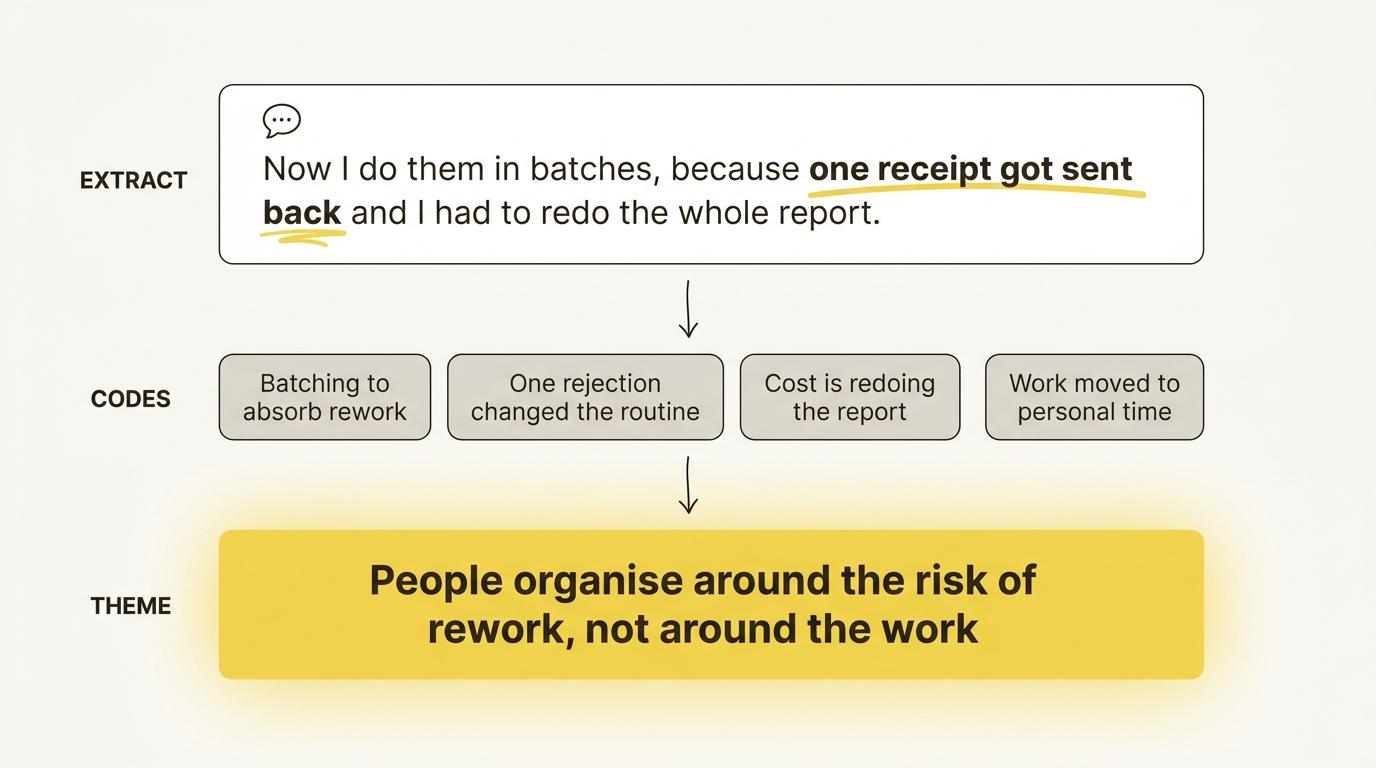
I do them in batches now. I used to do it the same evening, then one receipt got sent back that was perfectly fine, and I had to redo the whole report. So now I wait until I have five or six and I do them all on a Sunday, because if one comes back at least I’m already sitting there.
Familiarisation. Read all fourteen transcripts before coding a single one. Write notes, not codes. The note is that the change of behaviour has a date and a cause, and that the person tells the story unprompted.
Generating initial codes. Four codes come out of that one passage: batching to absorb rework, a single rejection changed the routine, the cost is redoing the report, not the receipt, the work moved to personal time.
Searching for themes. Across fourteen transcripts, batching to absorb rework sits with codes from eleven other people: keeping a parallel spreadsheet, screenshotting receipts twice, waiting for a colleague to file first. All of them are defences against being sent back.
Reviewing themes. Check the candidate theme against the coded extracts, then against the whole corpus. Two of those eleven codes turn out to describe something else, a company policy on receipt dates, so you move them into a theme of their own. This is the phase people skip, and skipping it is how a theme ends up resting on the three quotes that suggested it.
Defining and naming themes. Write two or three sentences per theme saying what it claims and where it stops. If you cannot write those sentences without listing the codes, the theme is still a topic summary. Ours reads: people reorganise their work around the possibility of rework rather than around the work itself, which makes rejection rate the variable that drives filing behaviour, not the time the form takes.
Writing up. The quotes go in as evidence for a claim you have already stated, never as the claim itself.
graph TD
  A["1. Familiarisation<br/>read everything, code nothing yet"] --> B["2. Initial codes<br/>code the whole corpus"]
  B --> C["3. Candidate themes<br/>group codes that argue the same thing"]
  C --> D["4. Review<br/>test each theme against extracts, then against the corpus"]
  D -->|"a theme does not hold"| B
  D -->|"the corpus says something else"| A
  D --> E["5. Define and name<br/>two sentences per theme"]
  E --> F["6. Write up<br/>quotes as evidence, not as findings"]
Coding: from an open code to a theme
Coding means attaching a short label to a passage that says what the passage is doing, then grouping labels that make the same point. A code stays close to the words used. A theme sits one level up and takes a position. In between, you decide which groupings make the same argument, and that one decision does more for the quality of the analysis than anything else.
The extract is what the person said. The code is what it does. The candidate theme is what several codes together let you claim. Only the theme goes on a slide.
Three habits keep the codes usable.
- Code more than you think you need on the first pass. Cutting a code later costs nothing, and noticing at phase four that a whole dimension went uncoded costs a re-read of fourteen transcripts.
- Write the code as a short clause with a verb, not as a noun. Waits for a colleague to file first still means something six weeks later. Timing does not.
- Keep a line of provenance on every code, so you can trace a theme back to the extracts it came from. A reviewer will ask, and so will the colleague who disagrees with your conclusion.
Reflexive thematic analysis or a codebook
Braun and Clarke, with the psychologist Nikki Hayfield, describe three families under the same name. Coding reliability approaches fix a codebook first and measure agreement between coders. Codebook approaches keep the structured codebook and drop the reliability testing. Reflexive thematic analysis treats your interpretation as the instrument and asks you to account for it instead of averaging it away.
The choice depends on who has to accept the result.
| Reflexive thematic analysis | Codebook or coding reliability | |
|---|---|---|
| Who codes | One analyst, or several comparing interpretations | Several coders applying the same definitions |
| When the codebook is fixed | Never, it keeps moving until phase five | Before the main coding pass |
| What agreement means | A conversation about a disagreement | A statistic, usually Cohen’s kappa |
| The risk it manages | Coding what you already believed | Coders drifting apart on a large corpus |
| Fits | Discovery, product research, a small team | Regulated reporting, multi-site studies, a thesis committee that asks for kappa |
Reflexive thematic analysis fits most product and UX work, where one person runs the study and the finding has to convince a team rather than a reviewer. Of course, some contexts really do need a kappa: a clinical or regulated report that several people coded, and any study whose method will be challenged line by line. What Braun and Clarke object to is borrowing the statistic without the design that makes it mean anything, which they call positivism creep.
graph TD
  A["Who has to accept your findings?"] --> B{"Will the method be audited?"}
  B -->|"A committee, a regulator, a journal"| C{"How many people code?"}
  B -->|"Your team, your stakeholders"| D["Reflexive thematic analysis"]
  C -->|"Several, on the same corpus"| E["Coding reliability, with a kappa"]
  C -->|"One analyst"| F["Codebook approach, documented"]
How many interviews before you stop
There is no fixed number. The dozen everybody quotes comes from a study whose design most teams do not share. Around a dozen interviews does cover a homogeneous group asked the same questions, a point our method for writing an interview guide develops. Beyond that, judge the material rather than the count.
Saturation is the usual justification, and Braun and Clarke argue against using it for reflexive thematic analysis at all. Their objection is structural: saturation assumes meaning sits in the data waiting to be exhausted, and reflexive thematic analysis assumes you construct it. On that assumption there is nothing to run out of, so a claim that new themes stopped appearing says more about the analyst’s attention than about the corpus.
Kirsti Malterud, a general practitioner and researcher at the University of Bergen, and her colleagues proposed a workable replacement in 2016. Information power is simple: the more relevant information your sample holds, the fewer people you need. It turns on five things you can check: how narrow your aim is, how specific your sample is, whether established theory frames the study, how good the dialogue in the interviews was, and whether you are analysing across cases or in depth within them.
In practice, the quality of the interviews moves the number more than anything else. Eight conversations where people told stories are worth more than twenty where they gave verdicts, and our bank of open-ended questions for qualitative research exists because how you ask decides which of the two you get.
The mistakes that hollow out an analysis
Four failures do most of the damage, and none of them shows in the final deck. Name them before you start rather than after.
Coding what you went looking for. You had a hypothesis, you wrote the guide around it, and now the codebook has one code per hypothesis. Everything else in the transcripts falls outside the codebook and disappears. The check is mechanical: count how many of your final codes existed in your head before you read the transcripts. A high number means you ran a survey with extra steps.
Counting occurrences. “Nine participants out of fourteen mentioned onboarding” reads like evidence and is not. Fourteen people who were asked about onboarding will mention onboarding, and prevalence in a purposive sample of fourteen tells you nothing about prevalence anywhere else. Frequency answers a question interviews were never the right method for, as our comparison of qualitative research methods sets out method by method.
Skipping the review phase. A candidate theme built from three vivid extracts holds up until you read it against all fourteen transcripts. Phase four exists for that, and it is the first thing to go when the readout is Thursday.
Reporting topics as themes. If your findings section has headings a stranger could have written before the study, you produced a table of contents for your interview guide. A theme states a claim, and the test is whether someone can disagree with the heading itself.
By hand, in a tool, or with a language model
By hand works up to about ten transcripts, in a spreadsheet with one row per extract. Past that, a coding tool earns its licence by keeping provenance from theme back to quote. A language model now codes about as well as a person when the codebook already exists, and noticeably worse when the codebook does not.
The strongest evidence so far is a blinded comparison published in PLOS Digital Health in April 2026 by Callum Hill, a researcher at the University of Southampton, and colleagues. Three models coded a focus group transcript against two blinded human analysts, with an expert panel as the reference. On deductive coding the models agreed with the panel 93.5% of the time against 92.7% for the humans, and both sides scored a kappa of 0.34. The kappa is the figure worth carrying away: agreement on this task is weak, for models as much as for people, so treat any single coding pass as a draft.
Inductive analysis went differently. Only one of the three models reached non-inferiority, hallucinations stayed low at 1.2%, and the overall error rate reached 12.4%. The models lost ground specifically on interpersonal nuance and latent meaning, on affect, and on what participants implied without saying. Those are the parts of an interview that made you choose interviewing in the first place.
Two practical problems sit alongside the accuracy question. A chat window gives you no trail from a theme back to the extracts that produced it, so nothing supports the finding when someone pushes on it. And pasting participant transcripts into a consumer product is usually a consent and GDPR problem, whatever the analysis quality. Our comparison of qualitative data analysis software covers the tools that keep that trail, several of which an agent can drive directly.
The workflow that holds up is narrow: let the model do the first descriptive pass, read every code it wrote against the extract it came from, and do phases three to five yourself. It saves the mechanical hours and leaves the interpretation where a reviewer expects to find it.
The analysis starts during the interview
A thematic analysis is only as good as its transcripts, and three things make a transcript good enough to code: the speakers are separated, the passages are timestamped, and the words are the ones that were said. You cannot code a summary of an interview, because the codes would land on somebody’s interpretation rather than on the participant’s words.
Two habits from practitioners make the difference before any coding starts. Steve Portigal, a researcher and the author of Interviewing Users, tells you to write a top-of-mind summary immediately after each session, because the longer you wait the more the interviews blur into one another. Indi Young, a researcher who works on cognitive empathy, goes further on what to collect: inner thinking, emotional reactions and guiding principles rather than opinions and statements of fact. Transcripts full of opinions produce topic summaries, whatever method you then apply to them.
Raconte produces exactly that kind of transcript. An AI runs the interview as a voice conversation, follows up when an answer stays vague, and returns the transcript with the speaker roles separated, a timestamp on every message, the audio alongside each one, a summary, and a sentiment on each participant message. Nothing to type up, and nothing lost between the recording and the coding.
Frequently asked questions
What are the 5 steps of thematic analysis?
Braun and Clarke describe six, not five, and the five-step versions circulating online usually merge defining themes with writing up. The six are familiarisation with the data, generating initial codes, searching for themes, reviewing themes, defining and naming themes, and producing the report. They are recursive rather than linear: phase four routinely sends you back to phase two, and sometimes back to the transcripts. The count matters less than the phase people drop, which is the review, where each candidate theme is tested against the coded extracts and then against the whole corpus.
What is meant by a thematic analysis?
A thematic analysis is a way of reading a set of qualitative material, usually interviews or open-ended answers, to build patterns of meaning that run across it. You code every transcript, group the codes that make the same point, and construct themes that state a claim about what is going on. The output is a small number of themes, each one defensible from the extracts behind it. It is a method rather than a theory, so it works with almost any research framework, which is both its reach and the reason it gets applied loosely.
What is the thematic analysis approach in research?
It is the default approach for interview material in psychology, health research, education and product research. You collect qualitative accounts, code them fully, and report themes supported by quoted extracts. Three families exist under the name. Coding reliability approaches fix a codebook and measure agreement between coders with a statistic such as Cohen’s kappa. Codebook approaches keep the structure and drop the statistic. Reflexive thematic analysis treats the researcher’s interpretation as the instrument and asks you to account for it. Pick the family according to who has to accept your findings, and say in your write-up which one you used.
Can ChatGPT do thematic analysis?
It can do part of it, with supervision. A blinded comparison published in PLOS Digital Health in April 2026 found language models matched human analysts on deductive coding against an existing codebook, 93.5% agreement against 92.7%, with both sides at a kappa of 0.34. On inductive analysis only one of three models reached non-inferiority, with a 12.4% overall error rate, and all of them lost ground on tone, on implied meaning and on what people left unsaid. A chat window also gives you no trail from a theme back to its extracts, and pasting participant transcripts into a consumer product is usually a consent problem.
What is the difference between thematic analysis and content analysis?
Content analysis lets you decide before you start whether you code the visible surface of the text or its underlying meaning, and it usually ends in counted categories. Thematic analysis reads the stated and the implied together and ends in themes that carry an argument rather than a frequency. In practice the choice follows the corpus: content analysis suits large bodies of text with recurring vocabulary where counting is meaningful, and thematic analysis suits interviews, where fourteen people say the same thing fourteen different ways and the count would tell you nothing.
What is reflexive thematic analysis?
Reflexive thematic analysis is the version Braun and Clarke have developed since 2006, and the one they now recommend. It rejects the idea that themes sit in the data waiting to be found, and treats them as constructions you make from your position, your knowledge and your reading. The codebook keeps changing until the themes are defined, agreement between coders is a conversation rather than a statistic, and the write-up says who the analyst is and how that shaped the interpretation. It suits a single researcher going deep more than a team coding a large corpus to a fixed scheme.
How many interviews do I need for a thematic analysis?
Around a dozen covers a homogeneous group where everyone got the same guide, and that number moves with how narrow your question is. Braun and Clarke argue against justifying a sample by saturation in reflexive thematic analysis, since nothing runs out when you construct meaning rather than find it. Kirsti Malterud and colleagues proposed information power instead: a sample needs fewer people when the aim is narrow, the participants are specific to it, established theory frames the study, the interviews went deep, and the analysis stays within cases. Interview quality moves the number more than anything else.
Where to start
If the transcripts already exist, start at phase one and read all of them before coding any of them. That one discipline removes most of the confirmation bias, and it costs an afternoon. Then pick your family according to who has to accept the findings, code the whole corpus rather than the memorable parts, and treat phase four as the work instead of the formality.
If the transcripts do not exist yet, that is the harder half. Scheduling fourteen conversations takes longer than analysing them, which is why so many studies end up with six. Raconte runs the interviews for you: you write the guide once, send one link, and each person talks for a few minutes whenever it suits them, in French or in English. Each conversation comes back as a speaker-separated, timestamped transcript with the audio, a summary and per-message sentiment, ready to code by hand or to import into any tool. The first 60 minutes each month cost nothing and need no card, then it is $0.12 per minute of active speech, and the pricing page has the rest.
Before either of those, the questions decide what there is to analyse. Our interview guide method turns a research objective into a two-page guide, and our 45 open-ended questions are grouped by what you are trying to learn.


