
The best qualitative data analysis software in 2026, and which ones transcribe your interviews
Fourteen qualitative data analysis tools compared on price, coding depth and what you have to bring. Five expect you to arrive with the transcript.
September 4, 2026
Godefroy
- Lumivero has owned both NVivo and ATLAS.ti since September 2024, so the two packages university guides present as the classic rival choice come from one company.
- Taguette, Delve and QualCoder never transcribe, and Dedoose and QDA Miner do not say whether they can. All five expect you to arrive with a transcript.
- The advertised NVivo price is the base licence. A commercial seat that also uses the AI assistant and 50 hours of transcription costs $1,754 a year rather than $1,005.
- Transcription is the widest price gap in the category, from $1 an hour to $30 an hour for the same recording.
- MAXQDA publishes a full price list in six currencies and still sells perpetual licences, where most AI-first analysis tools publish nothing above their free tier.
The fourteen products in this comparison all call themselves qualitative data analysis software. Each one covers a different part of the job. Some hand you a codebook, an inter-rater reliability score and a Windows installer. Others open a chat box over your transcripts and bill you per seat every month. One question decides your choice before any of that, and most comparisons never ask it: what do you have to bring before the software does anything at all?
Taguette, Delve and QualCoder do not handle transcription. NVivo, MAXQDA and ATLAS.ti will, on a meter, though ATLAS.ti’s transcription credits stop working the moment you open its web version. Condens and Looppanel transcribe without limit and charge for the seats instead. Answer it first and half of these tools drop off your shortlist, whatever their feature lists say.
Raconte publishes this article, and Raconte is not one of the fourteen. Our product runs the interview itself as an AI voice conversation and hands you the transcript, and it does not then code that transcript into a codebook, so ranking ourselves among analysis tools would be dishonest. Raconte has a section of its own further down, on analysing interviews inside an AI agent, which is the workflow it belongs to, plus a row in the comparison table. One of the ranked tools, Marvin, does compete with us, because its free tier now includes an AI moderated interviewer. Its entry describes it on its own terms, and every ranked tool links to its own site so you can check what we say.
Lumivero acquired ATLAS.ti in September 2024, so NVivo and ATLAS.ti now come from the same company. And Notably, still listed as live by several AI tool directories, has had no working website, application, API or help centre since 3 December 2025, which is why it is absent from the ranking.
How we compared them
We evaluated each tool on seven criteria.
- We ask what you have to bring. When a tool reads only text, you pay for transcription somewhere else, and three of the fourteen do not handle it at all.
- We record whether it transcribes and at what rate per hour, because the same recording costs $1 or $30 depending on where you upload it.
- We read the price on the vendor’s own site or its own shop, on 4 September 2026. Where a vendor publishes nothing, we say so rather than repeating a figure from a comparison page written by one of its rivals.
- We check whether it supports a defensible codebook: manual coding you control, coder comparison, and an inter-rater reliability statistic you can put in a methods section.
- We check whether you can reach it from code, through a documented REST API, webhooks or an MCP server. Two years ago barely any of these tools could be driven from code, and today that is one of the clearest differences between them.
- We note the platform, because one of these runs on Windows alone and another splits its features between a desktop client and a web version.
- We name who it is for, since a tool built for grounded theory is the wrong choice for stakeholder dashboards, and the other way round.
The ranking is grouped by job, because a free tagging tool and an enterprise research repository do not belong on one scale. Inside each group we ordered by how much of the job one licence covers before you buy anything else, with the general-purpose packages ahead of the specialists. Rank on price alone and the order changes, with Taguette, QualCoder and Quirkos coming first.
| Tool | What it is for | Entry price | Transcribes audio | What you must bring | Codebook and IRR | Reachable from code |
|---|---|---|---|---|---|---|
| MAXQDA | Mixed methods and statistics | $105/yr student, $278 academic | Paid add-on, $7.50 to $10/hr | Documents, SRT, survey data | Yes | No |
| ATLAS.ti | Theory building | $130/yr student, $387 educational | Paid credits, $6.50 to $9.50/hr | Text, audio, video, images | Yes | MCP server, free |
| NVivo | The academic reference | $130/yr student, $520 academic | Paid add-on, $9.98 to $30/hr | Documents, audio, video | Yes | No |
| Dedoose | Subgroup comparison | $12.95 per active month | Not confirmed | Transcripts plus demographics | Yes | No |
| QDA Miner | Text mining a corpus | $310/yr academic | Not confirmed | Documents, spreadsheets | Yes | No |
| QualCoder | Free full-feature coding | Free, LGPLv3 | No | Your own transcript | Yes | No |
| Taguette | Free highlighting and tagging | Free | No | Text files only | No | No |
| Quirkos | Visual coding on a budget | $69 lifetime desktop, $5/mo student | Separate service from $12/mo | Text documents | Coder comparison | No |
| Delve | Learning to code interviews | $18/mo student, $50 standard | No | Transcripts, PDF, DOCX, CSV | Manual coding, no IRR | No |
| Marvin | Interviews plus analysis | Free tier, then quote only | Yes, and it runs the call | Nothing, it collects too | No | API and MCP on Pro |
| Condens | European research repository | €165/yr | Yes, unlimited | Audio, video, documents | No | API and MCP on Enterprise |
| Dovetail | Enterprise insights hub | Free tier, then quote only | Yes | Interviews, tickets, surveys | No | Documented REST API |
| Looppanel | Moderated call analysis | $4,200/yr, 5 seats | Yes, unlimited | A live call to join | No | Enterprise only |
| Evidano | Cheap AI thematic analysis | Free, then metered | $1/hr after the first hour | DOCX, PDF, XLSX, CSV | No | No |
| Raconte, not ranked | Running the interviews an agent then analyses | 60 free min/month, then $0.12/min | Yes, while it conducts | Nothing, it collects too | No | REST, MCP, webhooks, CLI, SDK |
The CAQDAS packages built for publishable research
These five give you a codebook you control, coder comparison and a reliability statistic. Buy one when your analysis has to hold up in review.
1. MAXQDA
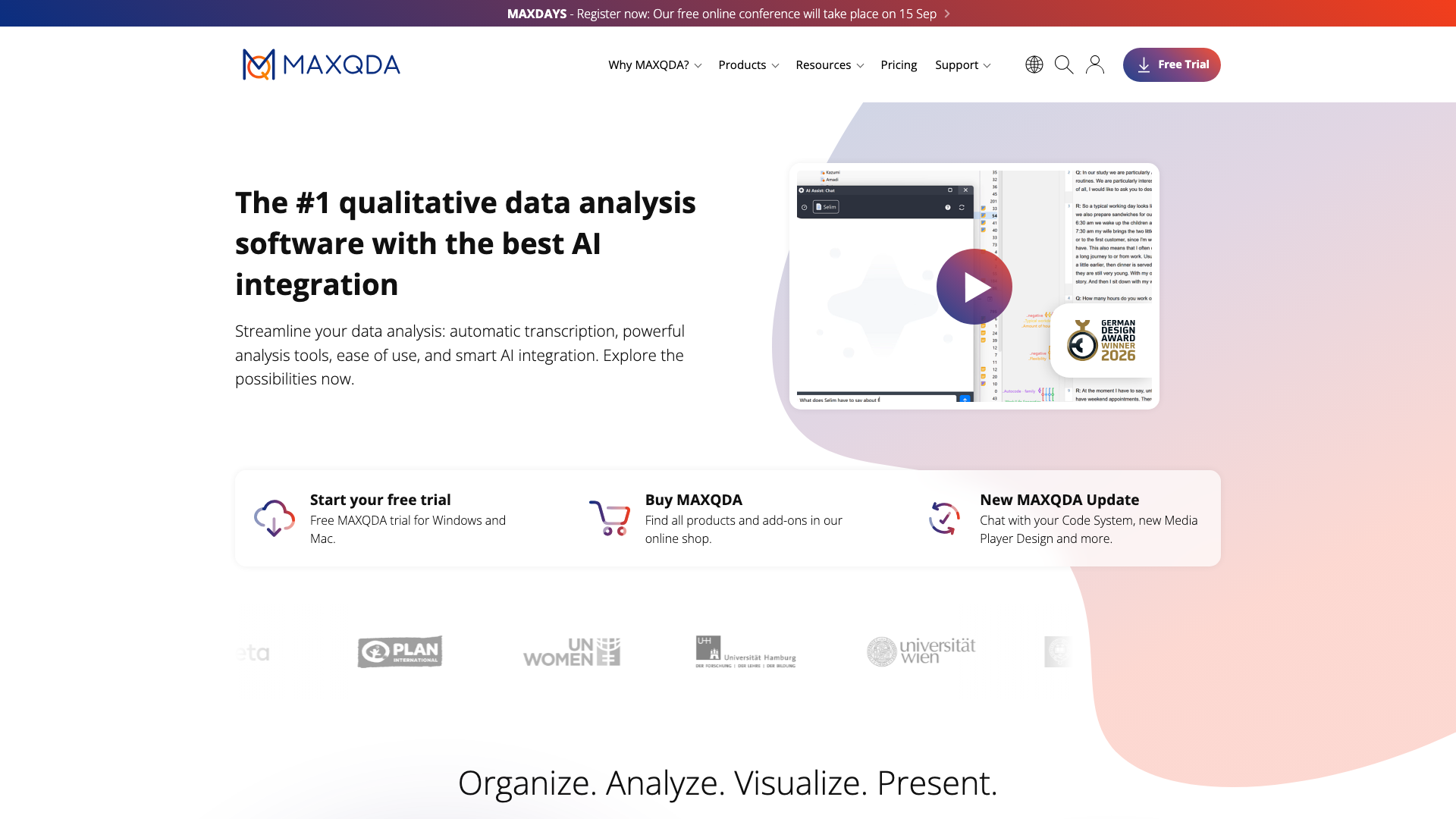
MAXQDA comes from VERBI GmbH in Germany, which has shipped it since 1995 and still owns it outright. It is the most complete single purchase in this group, and the only major package that publishes its full price list.
An academic single-user licence costs $278 a year or $784 perpetual. Students pay $105 a year, businesses $633. MAXQDA Analytics Pro adds frequencies, crosstabs, regression and cluster analysis inside the same application for $317 a year academic, so you do not need a separate statistics package. Prices appear in dollars, euros, pounds, yen, francs and lira, and volume discounts start at three licences.
It imports more formats than anything else here: DOCX, PDF and spreadsheets, and also SRT subtitle files, survey exports from Excel and SurveyMonkey, X and YouTube data, and bibliographies from EndNote and Zotero. Analysis covers manual coding, autocoding, the Code Matrix and Code Relations browsers, MAXMaps, inter-coder agreement and sentiment.
AI Assist Free costs nothing, where the comparable feature at NVivo is a separate $250 line. AI Assist Premium runs $132 a year academic. Transcription is metered, from $20 for two hours to $150 for twenty. No public API, no webhooks and no MCP server exist, so automation stops at the import connectors.
2. ATLAS.ti
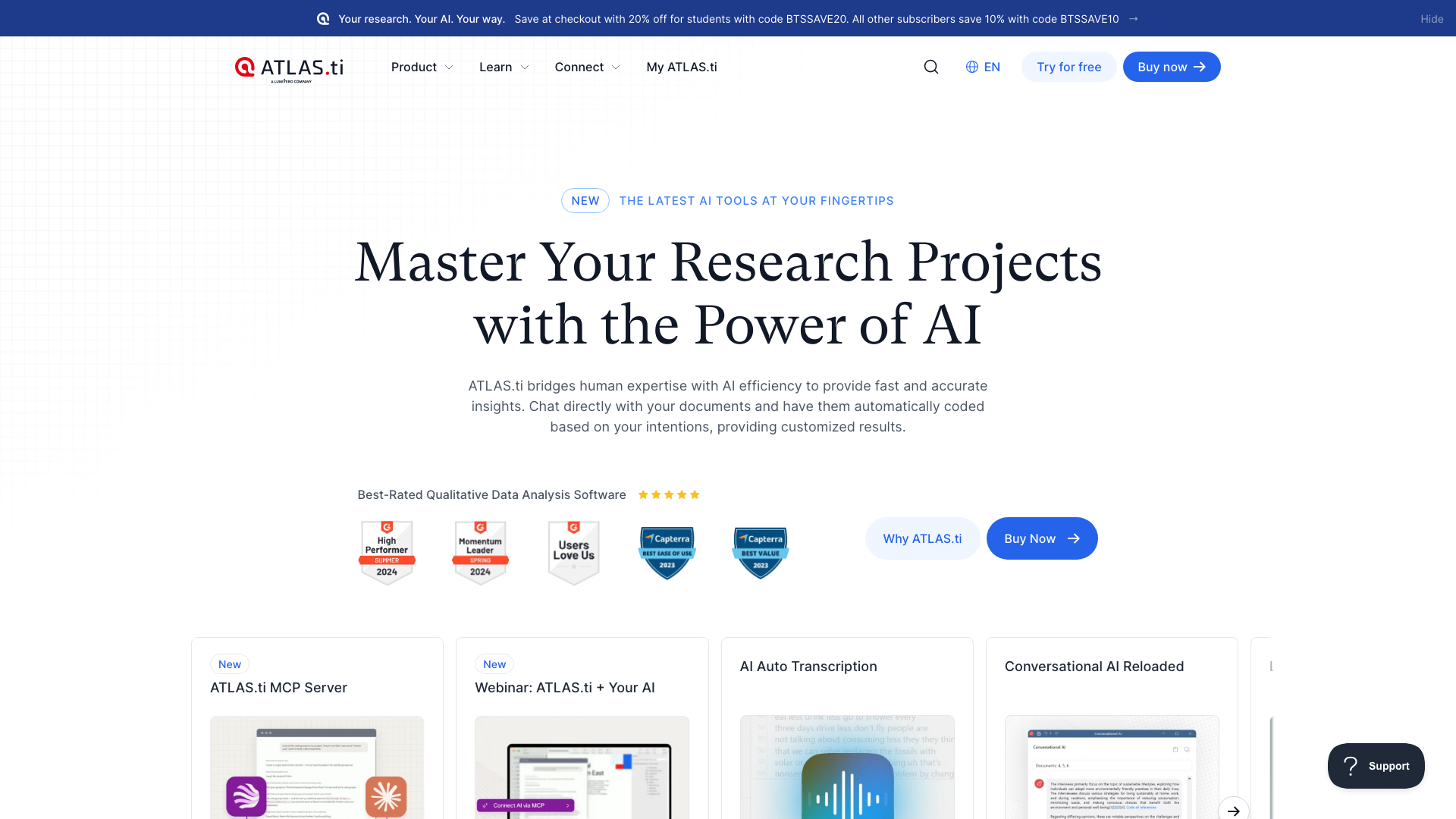
ATLAS.ti has been built in Berlin since Thomas Muhr released it commercially in 1993, and Lumivero bought the company in September 2024. It is the package grounded theory researchers reach for, because its memo, quotation and network tools were designed around building theory from the text rather than counting it.
An educational seat costs $387 a year, $848 for three years. Students pay $130 a year or $71 for six months, governments $498 and commercial users $722. One licence covers Windows, Mac and ATLAS.ti Web together, which no competitor here matches. Transcription runs on credits, from $19 for two hours to $650 for a hundred, and those credits work in the desktop client alone. Anyone planning to work in the browser should budget transcription somewhere else.
Analysis covers manual coding, AI coding in beta, sentiment, code co-occurrence, quotation-level memos, networks, inter-coder agreement and mixed methods. It ranks above NVivo because a single subscription covers more of that list. ATLAS.ti ships an MCP server at no extra charge with every active desktop subscription, and it reads and writes: an AI agent can import material, create and rename codes, write memos attached to quotations and query the coded corpus. It runs locally rather than through the vendor’s servers. Auto-transcription covers 45 languages, and the AI privacy mode lets you pick a data region. MAXQDA stays ahead because the ATLAS.ti transcription credits stop at the desktop client.
3. NVivo
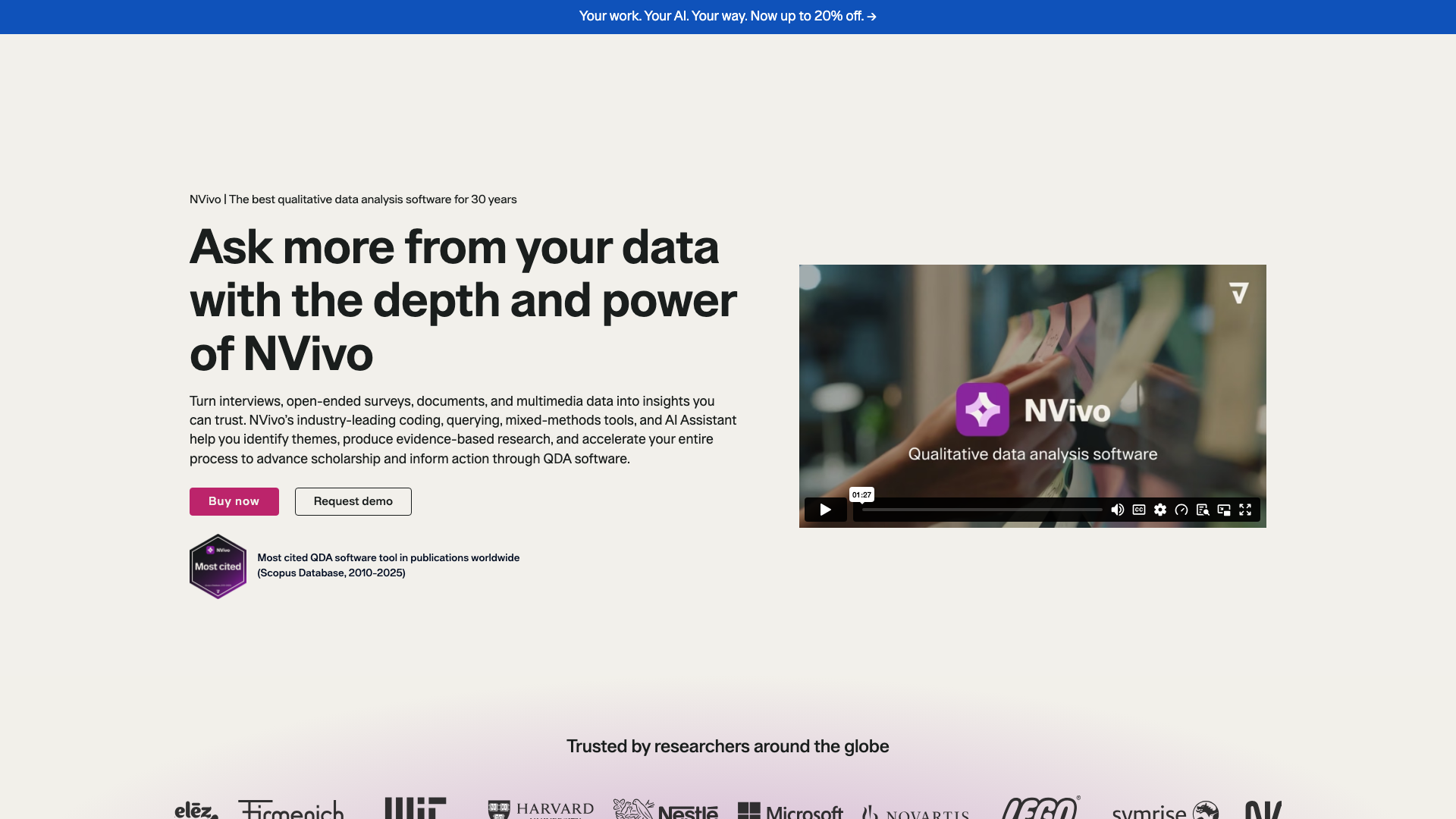
NVivo is the most cited qualitative package in the world, with more than thirty years of history behind it, and Lumivero sells it from Denver. Its advantage is outside the software: the published methods literature, the trainer network, and the odds that your supervisor and your institution already use it.
The catalogue prices a student seat at $130 a year, an academic seat at $520 and a commercial seat at $1,005, with perpetual licences at $1,110 academic and $2,215 commercial. Those are base prices. The AI Assistant costs $250 a year on top, transcription $499 for fifty hours or $30 for a single hour, and Collaboration Cloud $99 a year for one user. A commercial seat using AI and transcription therefore costs $1,754 a year rather than the $1,005 on the shelf.
Analysis covers manual coding, autocoding by pattern, word frequency, heading and speaker, AI-assisted coding with suggested child codes, framework matrices, coding comparison and mixed-methods queries. For statistics you have to go to XLSTAT. There are connectors for Microsoft Office, Citavi, Qualtrics and SurveyMonkey, and no public API, webhook or MCP server exists.
Many universities hold a campus licence that makes all of this free at the point of use. That access ends with your affiliation, so plan for losing it before a thesis rather than after.
4. Dedoose
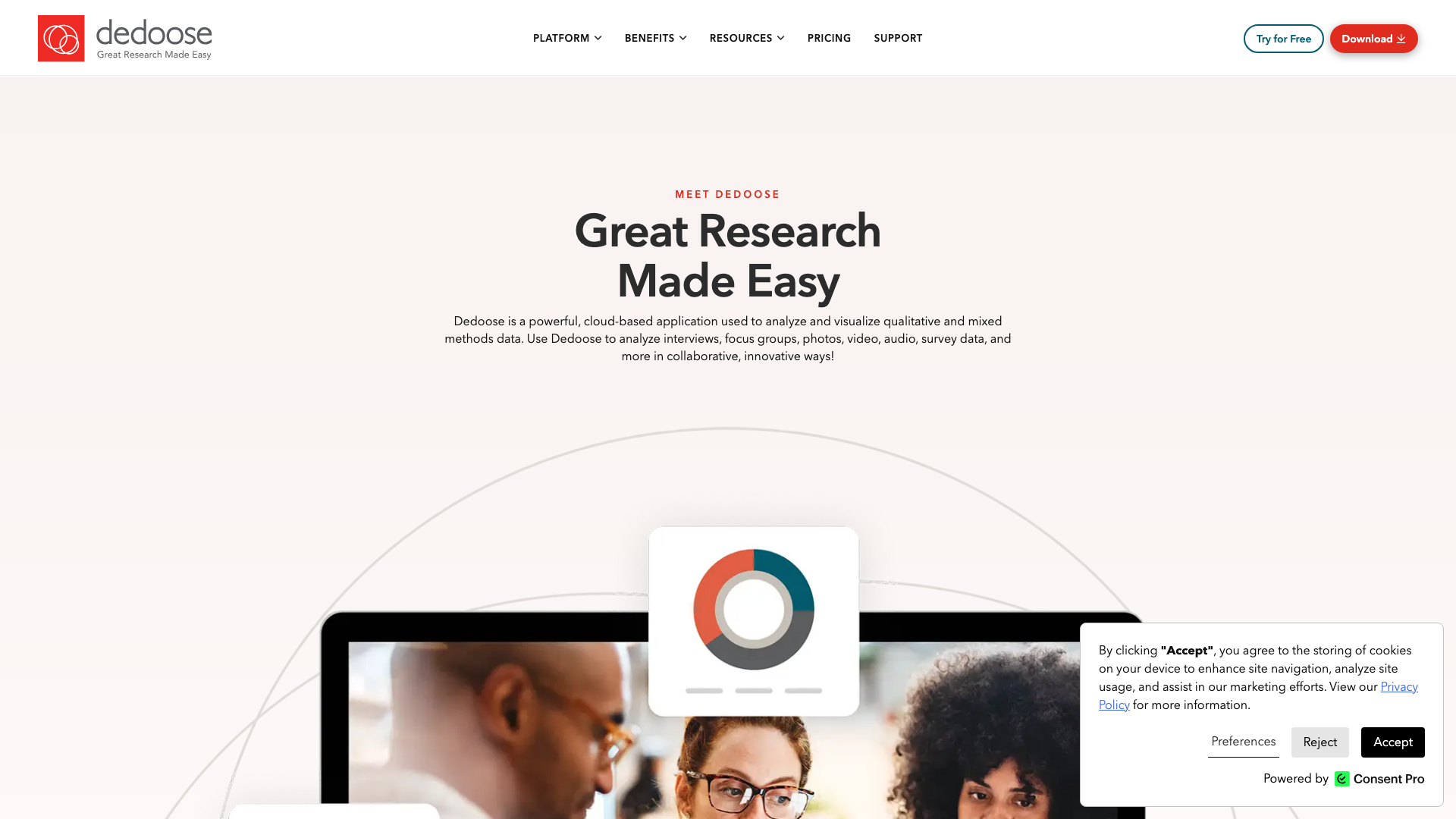
Dedoose is built by SocioCultural Research Consultants in Los Angeles and runs entirely in the browser, with nothing to install on Mac or PC. It is the mixed-methods specialist of the group.
You pay per active month, which nothing else in this article does. A student seat costs $12.95 for a month in which you log in, an individual seat $17.95, a small group $15.95 per user and a large group $13.95. A researcher who codes in bursts across a two-year project pays for the months of work rather than the calendar, which can come to less than a third of the $520 NVivo charges an academic for a year. Premier and Enterprise contracts are annual and quote only. New individual accounts get 30 days free.
Dedoose attaches descriptors to people better than anything else here. Demographic and contextual variables sit alongside the text, so you can break a theme down by segment, site or wave without exporting anything. It ships statistical inter-rater reliability tests and a training centre for calibrating coders, plus interactive charts and clipping of media excerpts.
Dedoose does not say on its own pages whether it transcribes audio, so plan to arrive with text. The UCSF research guide also records that Dedoose cannot be used with P3 or P4 data, which rules it out for higher-sensitivity university classifications.
5. QDA Miner
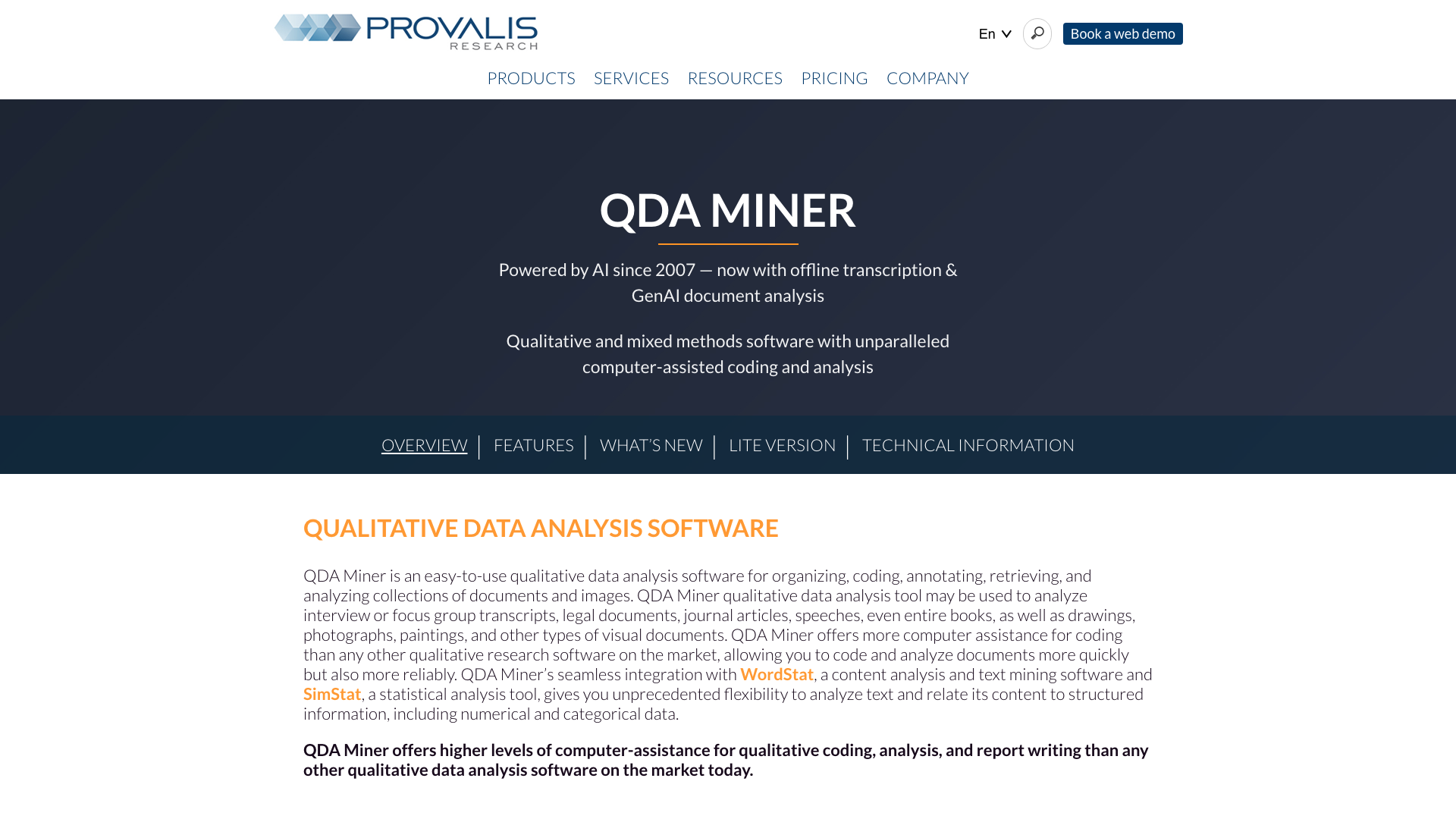
QDA Miner comes from Provalis Research in Montreal and is the most quantitative tool of this group. It pairs with WordStat for content analysis and text mining and with SimStat for statistics, and the three together form ProSuite.
An academic QDA Miner licence costs $310, government $710 and commercial $1,600. ProSuite runs $655 academic and $4,400 commercial. A 14-day trial is available, and volume discounts run to fifty-seat bands.
QDA Miner analyses code co-occurrence more deeply than any other tool here, and it ships an inter-rater agreement module, multi-user coding merge, a full command log for auditability, seven text search and retrieval tools, clustering, correspondence analysis, and GIS mapping with geocoding for anything with a location. Choose it when your corpus is large enough that reading every document twice is off the table. Its pages say nothing about transcribing audio itself, so plan to arrive with text.
It runs on Windows alone, with a documented workaround for macOS rather than a native build, which settles the question for a Mac-only team. QDA Miner Lite is permanently free and genuinely useful, importing text, RTF, HTML, PDF, Excel, CSV and projects from ATLAS.ti, HyperResearch, Ethnograph and Transana. A Lite project imports into the paid version, though not into the trial.
The free tools
Neither of these costs anything, and both expect you to arrive with a transcript.
6. QualCoder
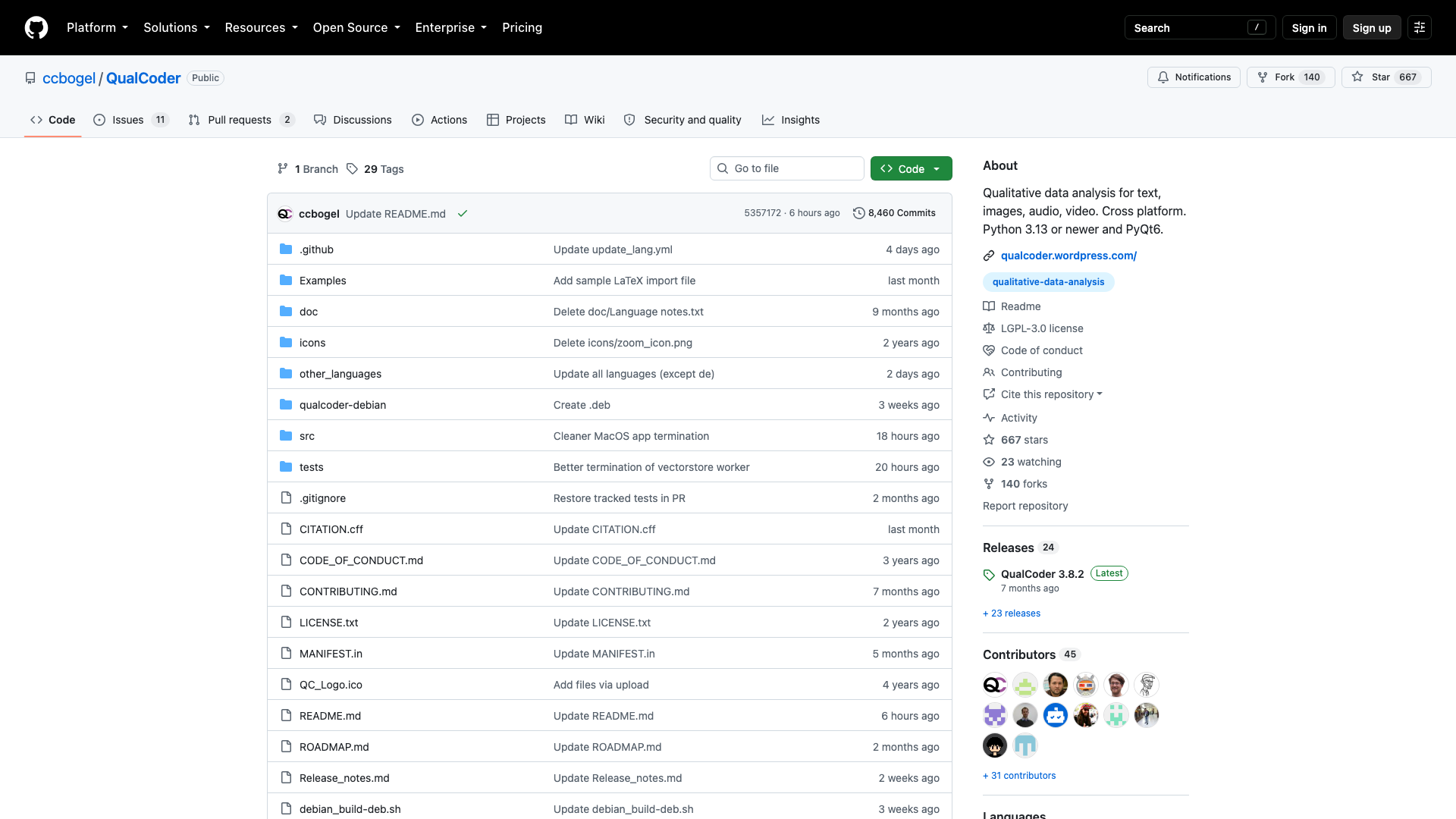
QualCoder is free and does nearly as much as the paid packages. Dr Colin Curtain created it, a small team of academics maintains it, and it ships under LGPLv3 with prebuilt executables for Windows, macOS and Linux.
It codes text, images, audio and video. It supports hierarchical codes with sub-codes and categories, autocoding by exact text and by regular expression, inter-rater reliability and coder comparison reports, code co-occurrence reports with proximity graph exports, coding frequency reports and mind-map visualisation. It exports REFI-QDA, so a project moves to ATLAS.ti, MAXQDA or NVivo later without being retyped. That feature list would cost several hundred dollars a year anywhere else on this page.
Version 4.0 adds agentic AI with tiered permissions, letting you grant a model read-only access, sandboxed write access or full write access to codes and codings. Very few commercial vendors have thought that carefully about what an LLM is allowed to touch in a research project.
It transcribes nothing. It gives you an interface for coding media while you type the text yourself. Support is GitHub issues, since nobody is paid to answer the phone. The Illinois and Chicago School library guides both name it as the serious free option.
7. Taguette
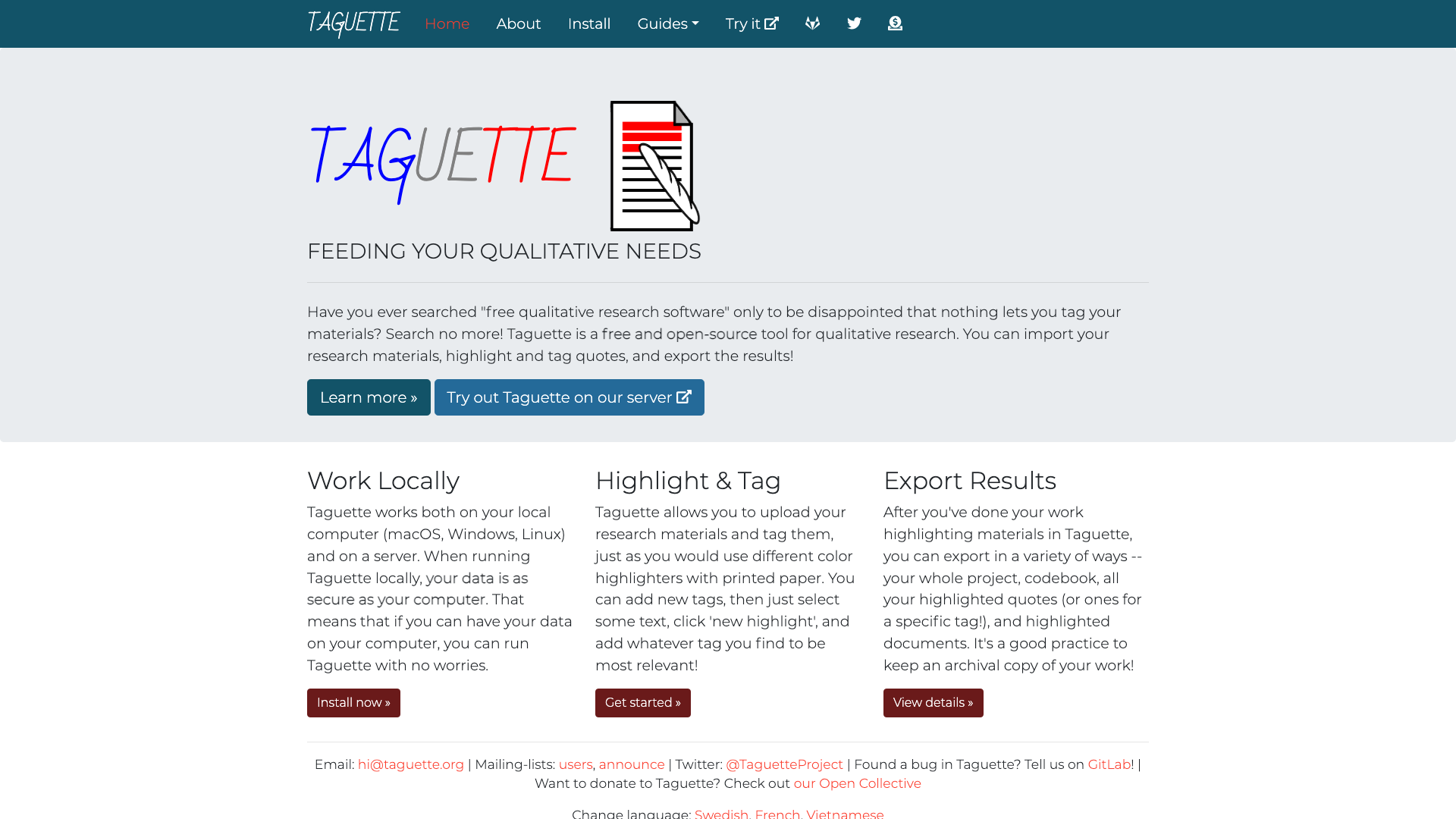
Taguette does one thing and refuses to do more. You import a document, highlight words, sentences or paragraphs, tag them with codes you create, and export the codebook, the quotes per tag and the highlighted documents. That is the complete feature list.
Its About page explains why: existing software is far too expensive, or will not let you highlight and tag, or performs quantitative analysis on text and calls it qualitative. Rémi Rampin develops it, Vicky Rampin handles product and Sarah DeMott runs training, out of NYU, funded by donations on Open Collective. It is citable as Rampin et al. (2021) in the Journal of Open Source Software.
Three ways to run it cost nothing: install it locally on macOS, Windows or Linux, self-host it for a team, or use the project’s own server at app.taguette.org. It turns up in ethics applications because you can host it yourself and the data never leaves your institution.
It imports PDF, DOCX, TXT, HTML, EPUB, MOBI, ODT and RTF. It has no audio, no video, no transcription, no AI, no inter-rater reliability, no query language and no visualisation. It is what to recommend to anyone asking for a free NVivo, as long as they know it covers a fraction of the job. NYU, Illinois, UCSF and the Chicago School all recommend it.
The cheap tools for coding interviews by hand
Both are built around one person doing the coding, and both cost a fraction of the CAQDAS packages.
8. Quirkos
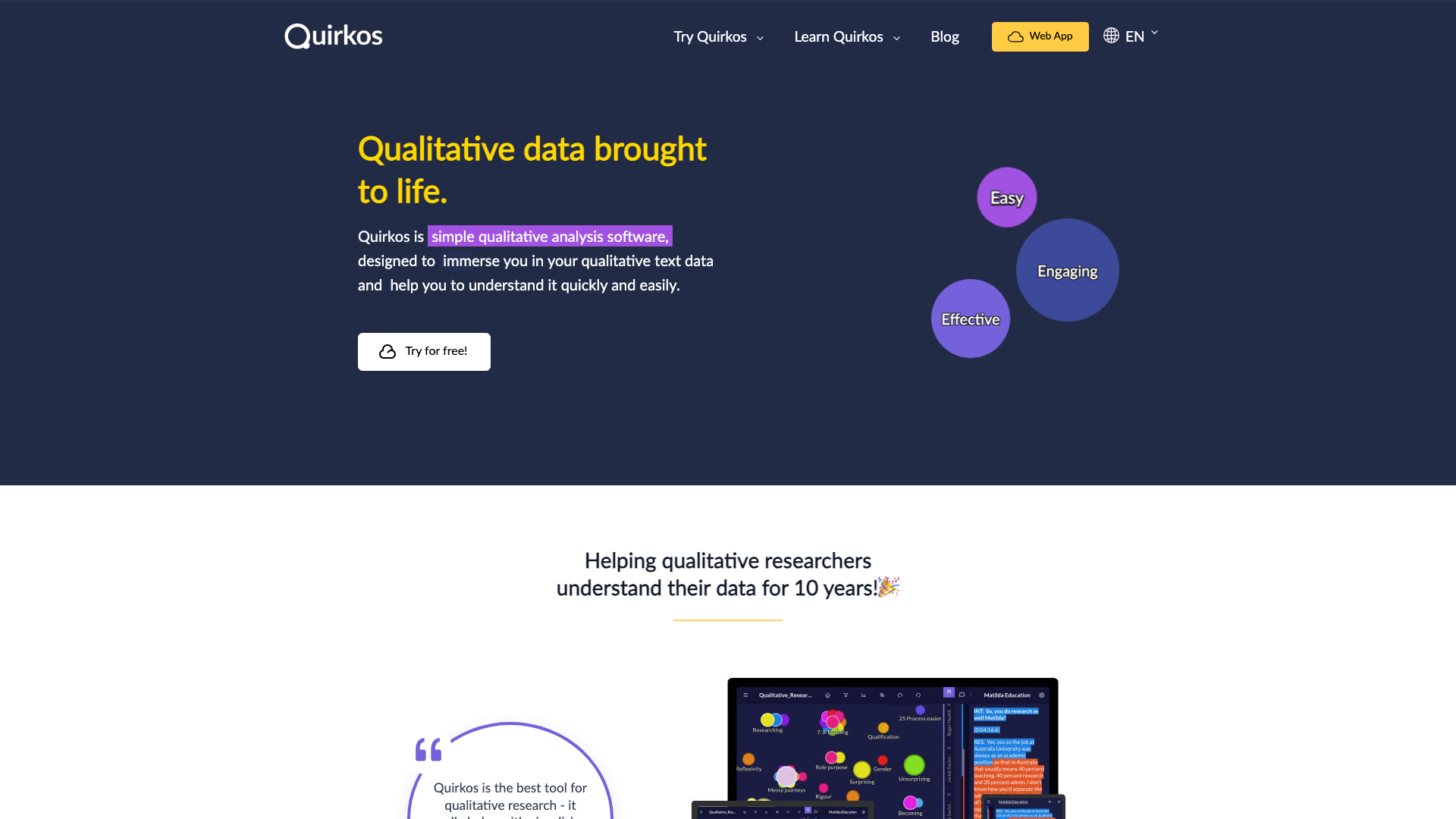
Quirkos has been built in Edinburgh since Dr Daniel Turner launched it in October 2014, by a core team of four. It shows your codes as coloured bubbles that grow as you add quotes to them, which is the quickest way on this page to see how a dataset is distributed.
Its pricing is the most generous of any paid tool on this page. The offline desktop licence costs $69 for life on one computer or $110 on two, transferable between machines, which is the cheapest perpetual CAQDAS licence in this article. Quirkos Cloud costs $5 a month for students, $13 academic, $17 public sector and $23 commercial when billed annually, with a 14-day full-feature trial. Researchers in low and lower-middle-income countries get 25% off.
It does manual coding, visual exploration, query and comparison views, and side-by-side coder comparison. That coder comparison puts it ahead of Delve here. LLM auto-coding is not a headline feature. Full REFI-QDA support means a project moves out to ATLAS.ti, NVivo or MAXQDA whenever you outgrow it, which makes it a reasonable place to start rather than a trap.
Quirkos Transcribe is a separate subscription from $12 a month, with 100 minutes included in the cloud trial, so the desktop licence on its own reads text and nothing else. Their transcription server runs on solar power.
9. Delve
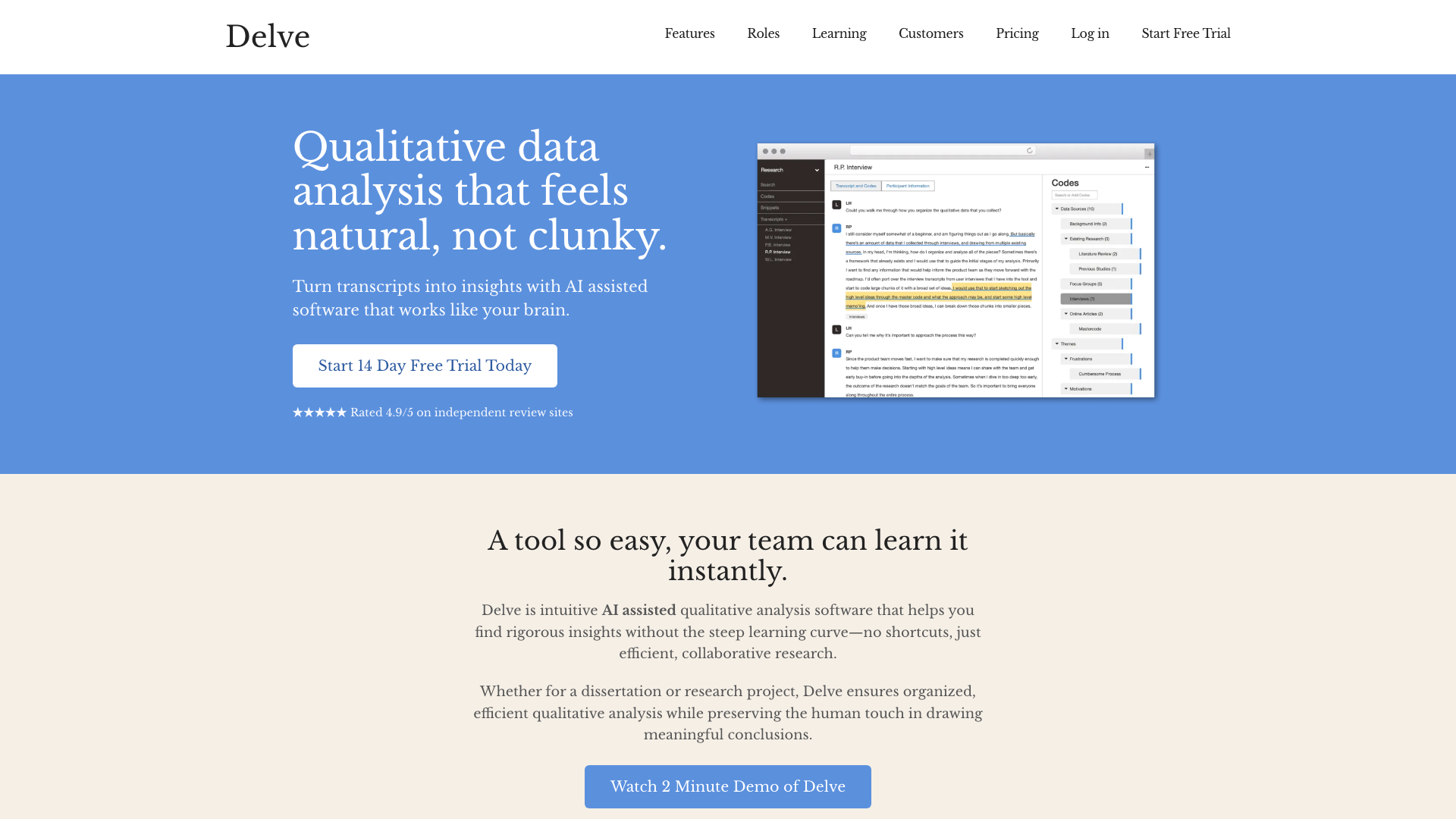
Delve is made by a small New York team, LaiYee Ho and Alex Limpaecher, and sells on a single promise: you can start coding today. It strips out everything that makes a CAQDAS package take a workshop to learn.
A standard seat costs $50 a month and a student seat $18, so a year of student use comes to $216, which is more than three Quirkos desktop licences. A 14-day trial needs no commitment. Only editors are billed, so anyone reading along costs nothing, and every seat carries unlimited projects, transcripts and codes.
Its AI applies a codebook you already wrote rather than inventing one. It answers questions about your transcripts, suggests initial codes, helps refine themes, and acts as what they call a personal peer debriefer. Automated thematic generation, sentiment and inter-rater reliability are all absent. That suits a tool that wants you doing the interpretation, and it is why Delve sits behind Quirkos here.
It takes transcripts, PDFs, CSVs and Word documents. Audio transcription is not among them, so budget for it elsewhere. Delve also publishes one of the best free method libraries anywhere, with detailed guides to grounded theory, interpretative phenomenological analysis, narrative analysis and discourse analysis, which is worth reading whichever tool you end up buying.
The AI analysis platforms and research repositories
These five analyse and store rather than code. None ships a codebook you control or an inter-rater reliability statistic, so none belongs in a methods section that needs one. They are built for product and insight teams.
10. Marvin
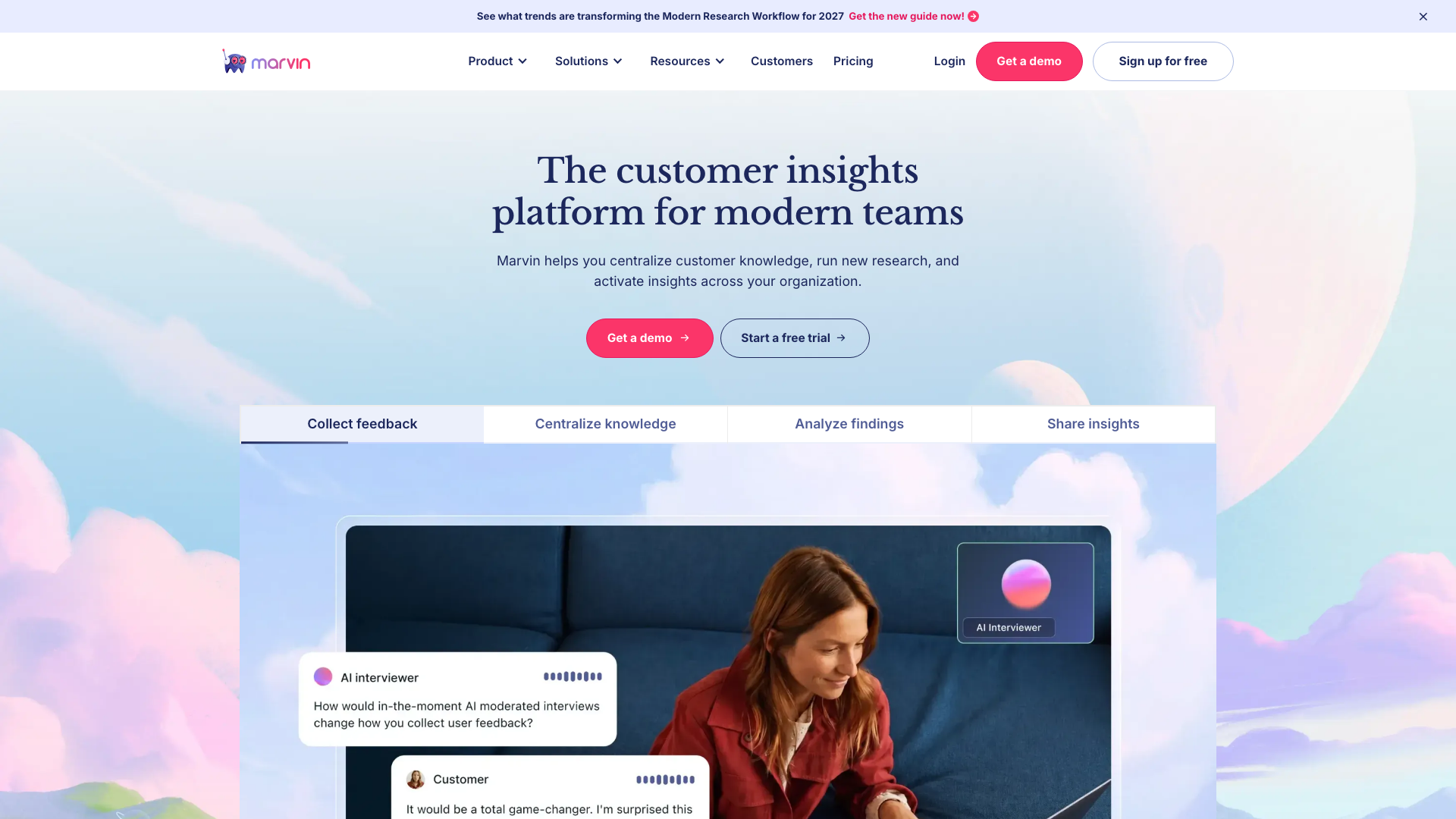
Marvin is built by Equafin Inc., co-founded by Prayag Narula and Chirag Narula, with a team across San Francisco, Bangalore and Delhi. It covers more of the research workflow than anything else in this group, because it now collects the data as well as analysing it.
The free tier includes an AI Moderated Interviewer, the Marvin AI Notetaker and project-wide Ask AI, capped at five file uploads a month. Starter, Pro and Enterprise all say contact sales, and no figure appears anywhere on the pricing page. Starter adds unlimited ingestion, repository-wide Ask AI, automatic translation and data residency options. Pro adds research-platform and support-ticket integrations, Deep Research, thematic and emotion analysis, and Marvin API and MCP access. Enterprise adds automatic PII redaction, HIPAA compliance and a dedicated success manager.
Marvin takes material four ways: uploads, an AI notetaker that joins your calls, integrations with support and research tools, and interviews it moderates itself.
It does no codebook work, so you get no inter-rater reliability, no coder comparison and no mixed-methods statistics. The API and MCP server also sit behind an unpriced tier, so an engineering team cannot evaluate the integration before a sales conversation.
11. Condens
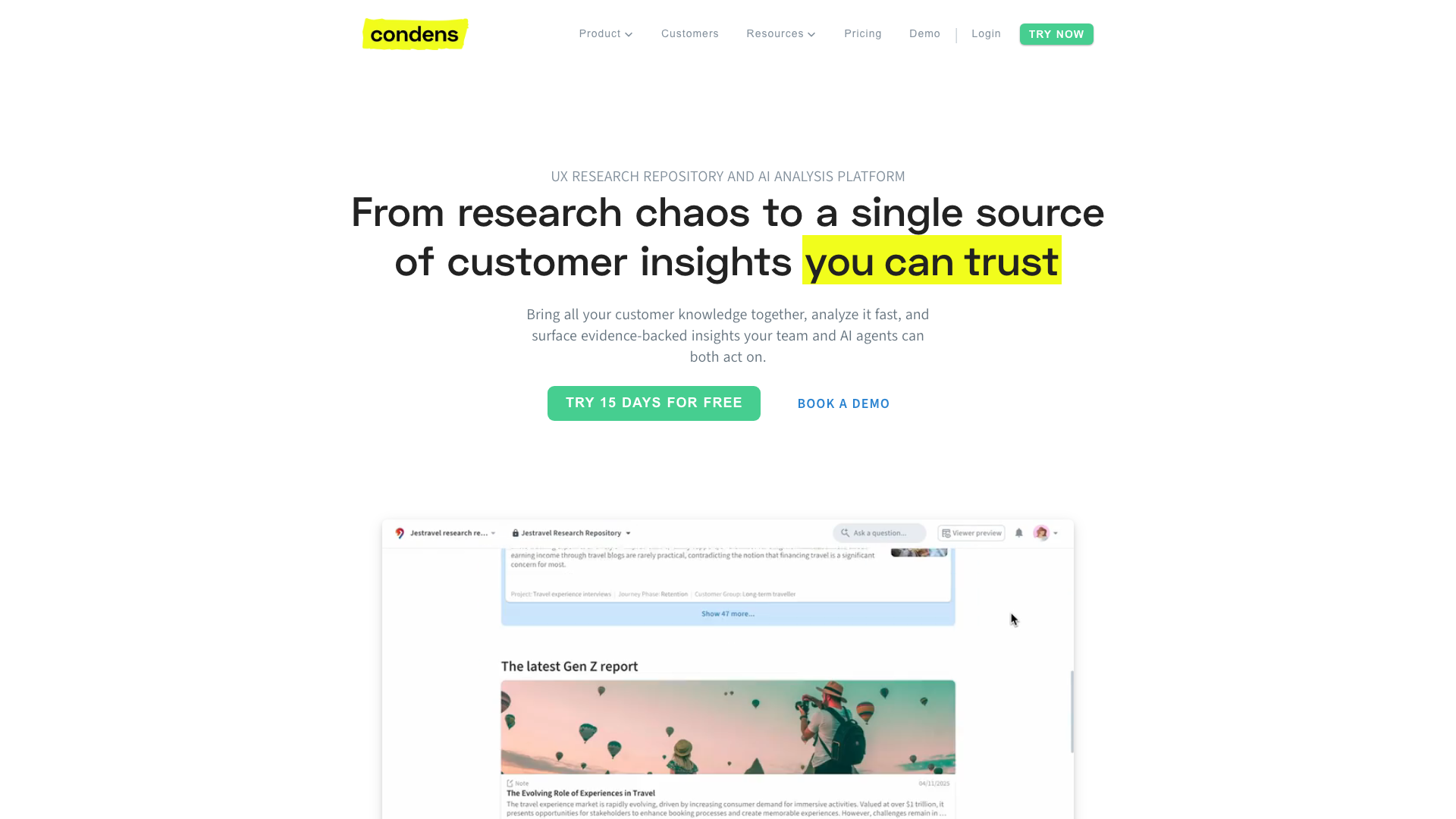
Condens is built by Condens Insights GmbH in Munich, and the company states on its own site that the founders own 100% of it with no investors. It is the European answer to Dovetail, and the only serious repository in this group that publishes a full price list.
Lite costs €15 a month or €165 a year for one contributor, with additional contributors at €15. Business costs €500 a month billed yearly, so €6,000, and includes five contributors with extras at €85. Enterprise is quote only with a five-contributor minimum. Every tier gets unlimited projects, unlimited viewers and a 15-day trial without a card, and seats can be reassigned monthly.
Unlimited automated transcription comes with every paid tier, starting at that €165 a year. Almost every other tool in this article meters it, which makes Condens the cheapest way to have your recordings transcribed and searchable inside a real repository.
Analysis runs on tagging and highlighting, an affinity-clustering whiteboard, AI summaries and chat over the repository, and insight pages built for stakeholders. Business connects ChatGPT and Claude, and Enterprise adds API access and custom LLM integration over MCP. It has no codebook governance and no reliability statistic, which is deliberate for the audience.
12. Dovetail
Dovetail was founded in Sydney in 2017 by Benjamin Humphrey and Bradley Ayers, both formerly at Atlassian, and has raised around $65 million, including a $63 million Series A led by Accel in January 2022. It defined the research repository category and now calls itself an AI-first insights hub for enterprise customer feedback.
A free tier costs nothing with no card and no seat minimum, giving you one channel, one project, AI chat with basic summaries, search and contacts. Enterprise is custom and invoiced, with unlimited everything, semantic search, SSO, access control, data redaction, audit logs and an optional HIPAA add-on. No mid-tier price and no per-seat figure appear anywhere, so a 2026 comparison quoting a Dovetail seat price is copying a price list that no longer exists.
Its REST API is the best documented in this article. It authenticates with a bearer token and exposes endpoints for projects, notes and documents, full CRUD on comments and threads, plus tags, themes, people and custom fields. Dovetail publishes an llms.txt as well, so AI agents are part of the audience it writes for.
It analyses by AI summarisation, semantic search, opportunity tracking, tagging and dashboards, with no codebook, no reliability statistic and no mixed-methods statistics.
13. Looppanel
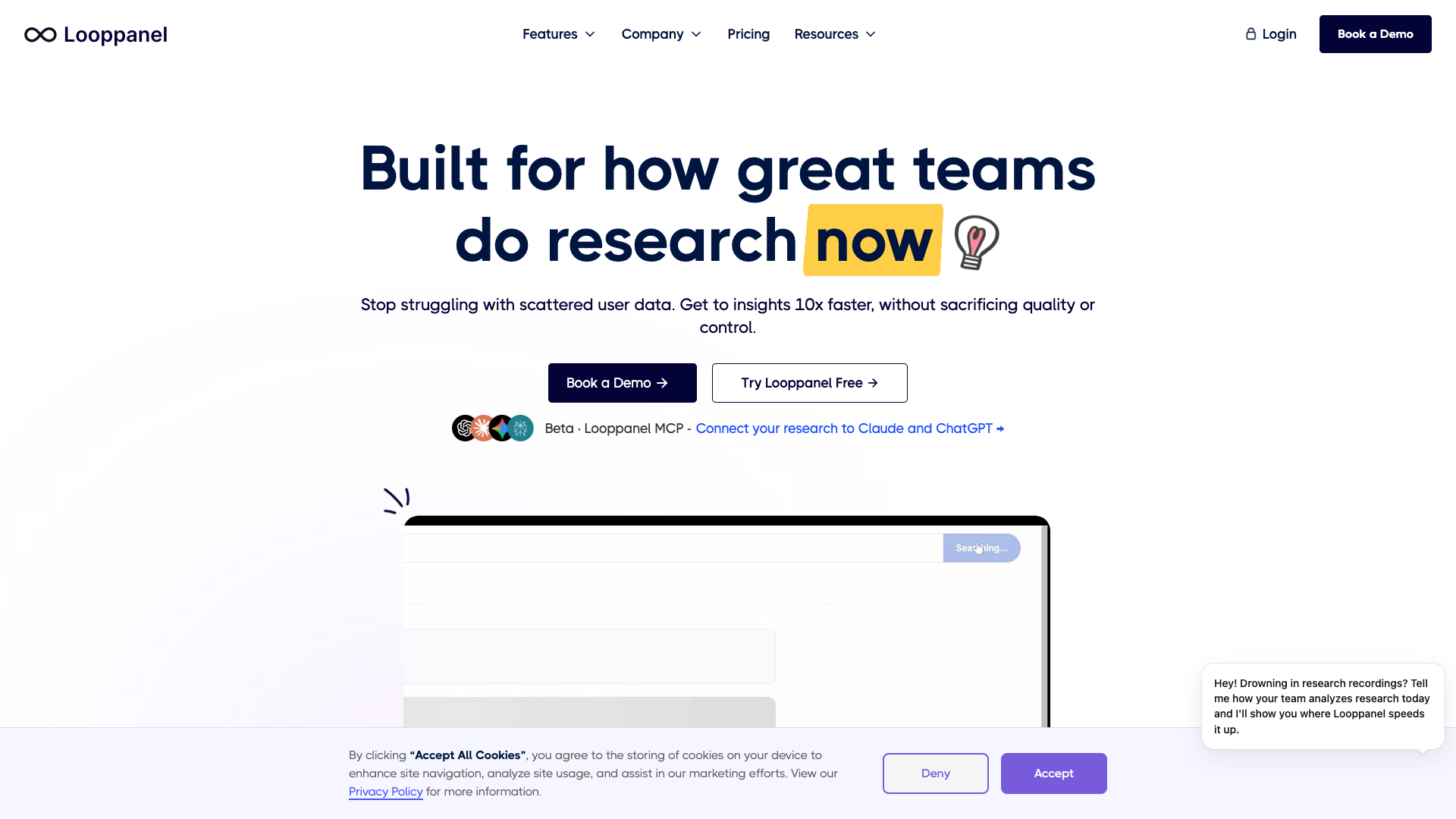
Looppanel was founded in Delhi in 2021 by Kritika Oberoi and Akash Tandon, both formerly at Atlan, on a $1 million pre-seed led by Speciale Invest. Its bot joins your Zoom, Meet or Teams call through your calendar or a pasted link, then records, transcribes and takes notes tied to timestamps.
Pro costs $395 a month or $4,200 a year, includes five editor seats and unlimited viewers, and bills extra editors at $75 a month up to ten. Transcription hours are unlimited, and Auto-Analysis runs three times per project. Enterprise needs at least ten editors and adds PII redaction, translation in 96 languages, SSO, API access and an account manager. The five-seat minimum is not optional, so the real entry price is $4,200 a year, the highest of any small research tool here.
The product is built around the live moderated session. Someone has to book the call, show up and run it. Looppanel removes the evening you would otherwise spend writing up what was said, and its own site reports customer analysis time dropping from two weeks to two days.
API access exists on Enterprise alone, with no public documentation, no webhooks and no MCP server.
14. Evidano
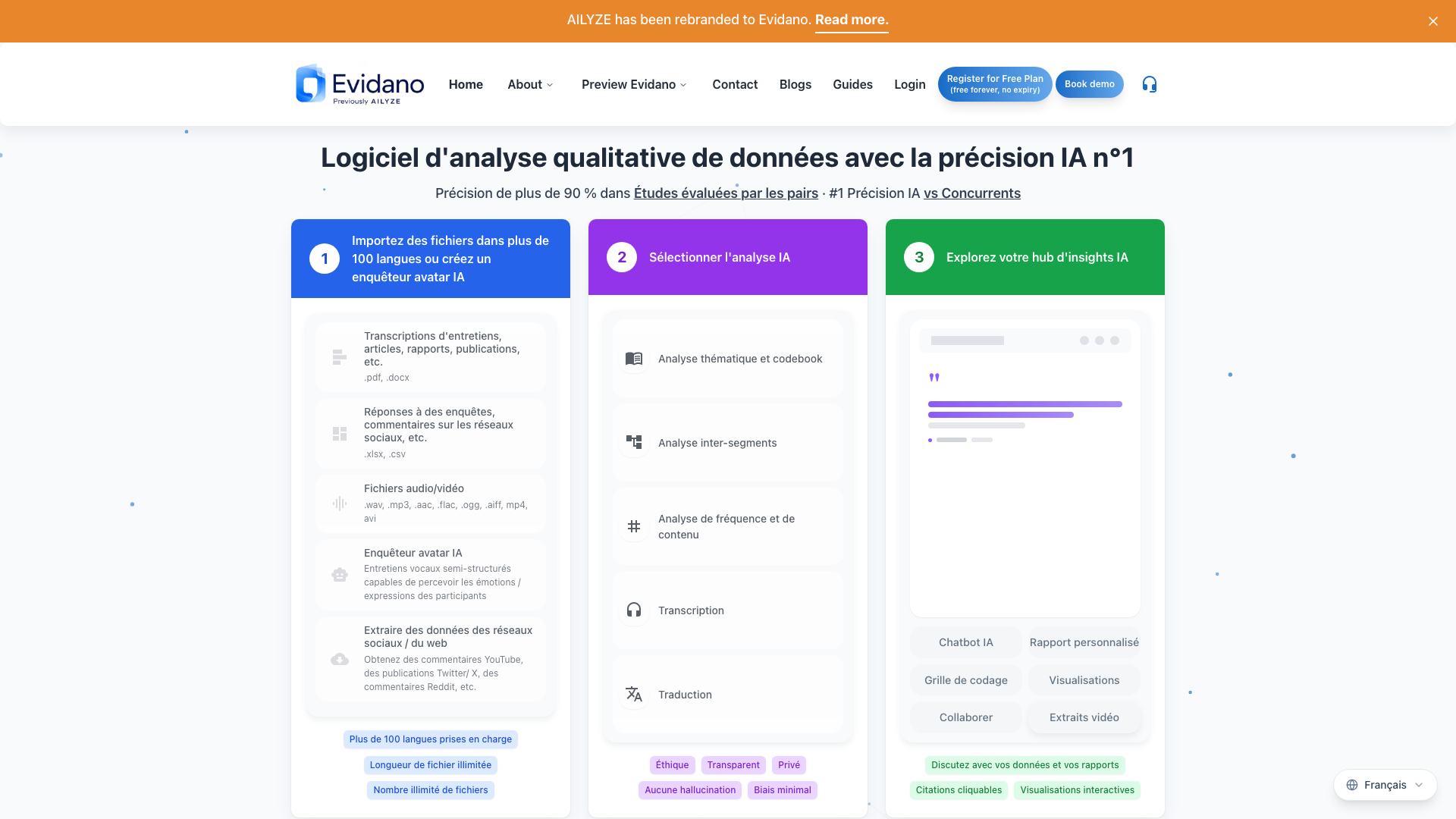
Evidano is the product that used to be sold as AILYZE. The old domain now redirects permanently to the new one, so any 2026 comparison still calling it AILYZE is out of date. It does the narrowest job in this group and charges the least for it.
The free tier is free forever with no card and no expiry, limited to one theme per project for AI Thematic Analysis and one question per project for AI Content Analysis, with the same limit on assisted coding, cross-segment analysis and data visualisation. Pro is billed monthly per user and its price is not published. The Institution plan is annual, with a buy-five-get-fifteen offer in the first year, and no published figure either.
Transcription costs $1 an hour after the first free hour, translation $1.50 per 10,000 words after the first thousand, and website extraction $1.50 per ten URLs after the first hundred. That transcription rate is the lowest published in this article, against $6.50 an hour at ATLAS.ti, $7.50 at MAXQDA and up to $30 at NVivo.
Everything it produces comes from an AI. It has no manual codebook, no coder comparison and no reliability statistic, and it reads DOCX, PDF, XLSX and CSV.
Analysing interviews in an agent rather than in a package
One option appeared in 2026 that none of the established guides to this subject covers. Several of these tools now expose an MCP server or a documented API, so an AI agent can drive them directly instead of a person clicking through them.
ATLAS.ti went furthest. Its MCP server comes with every active desktop subscription at no extra charge, and it writes as well as reads: an agent can import material, create and rename codes, write memos attached to quotations, query the coded corpus and propose codebook merges. It runs on your own machine rather than through the vendor’s servers. Dovetail publishes a REST API with token authentication and an llms.txt alongside it. Condens keeps MCP for Enterprise, Marvin for Pro.
All of that is the analysis half. The collection half is the harder one to automate, because every tool above waits for a transcript that somebody still has to produce. That is the half Raconte does, which is why it appears here rather than in the ranking.
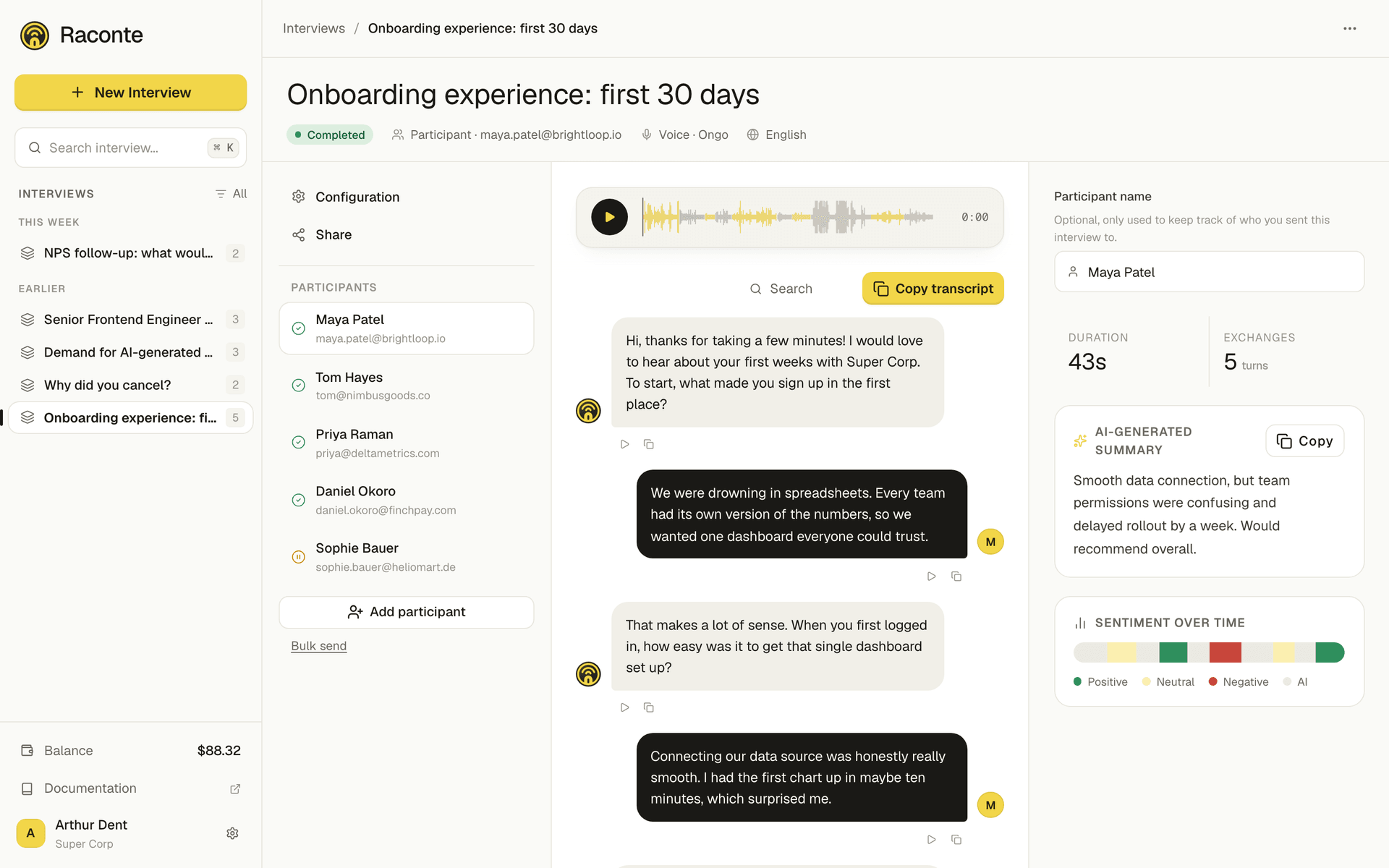
Raconte runs the interview itself as a voice conversation, in French or English, then returns the transcript, the audio, a summary and per-message sentiment. Everything it holds is reachable from code: the OpenAPI spec is public at raconte.ai/openapi.json, @raconte/node-sdk and @raconte/cli are on npm, the MCP server exposes eight tools to any agent, and webhooks fire when an interview starts and ends. None of it sits behind a higher tier, and no tool in the ranking above publishes that combination.
An agent holding Raconte’s MCP server and ATLAS.ti’s can therefore run the whole chain: send the interview out, wait for the webhook, pull the finished transcript and code it into an ATLAS.ti project, without anyone exporting a file or opening an interface. Sixty interview minutes a month cost nothing and need no card, then $0.12 per minute of speech, so a study of twenty half-hour conversations costs $72 including the interviewing.
The limit is the same one every agent workflow has. The analysis stays in the agent’s context unless the tool at the other end stores it, so a study that has to hold up in review still needs a package from the first group to keep the codebook and the reliability statistic. The agent gets you there faster rather than letting you skip it.
How to choose between them
Start from the question your analysis has to answer to someone else, because that tells you which group to look at first.
If your findings go into a thesis, a paper or a regulated report, you need a codebook you control and a reliability statistic, which leaves the CAQDAS packages and QualCoder. Pick MAXQDA when you also need statistics and predictable pricing, ATLAS.ti when you are building theory or want an agent working inside the project, NVivo when your institution already runs it, Dedoose when your themes have to break down by segment, and QDA Miner when your corpus is too big to read twice.
If nobody is going to audit your method, the AI platforms and repositories answer a different question. Product and insight teams want a searchable archive and a summary their stakeholders will read, which is Condens at €165 a year, Dovetail if you need the API, Marvin if you also want it running the interviews, and Looppanel if your sessions stay live and moderated.
Transcription costs $1 an hour at Evidano, $6.50 to $9.50 at ATLAS.ti, $7.50 to $10 at MAXQDA, and $9.98 to $30 at NVivo, while Condens and Looppanel include it without limit and Taguette, Delve and QualCoder do not handle it at all. Twenty hours of interviews therefore cost $19 at Evidano, around $200 at NVivo’s bulk rate, and $600 if you buy those hours one at a time.
Put a free coding tool next to cheap metered transcription and the cheapest defensible setup here costs about $20. QualCoder is free and ships inter-rater reliability, coder comparison and REFI-QDA export, and Evidano will transcribe twenty hours of audio for $19. That combination gives up nothing on method, and it is what we would suggest to anyone working on a tight budget.
Two more questions cut the list quickly. Can you reach the tool from code? Five of the fourteen can be driven by an agent or a script, and four of those keep it for a higher tier: Dovetail for its enterprise contract, Condens and Looppanel for Enterprise, Marvin for Pro. ATLAS.ti is the only one that includes it at no extra charge. What happens to your project when you leave? QualCoder, Quirkos, ATLAS.ti, MAXQDA and NVivo all read and write REFI-QDA, so a project moves between them, while none of the AI repositories offers an equivalent.
Two other products do a different job. CoLoop sells AI analysis with evidence linked back to source, aimed at market research agencies, with SOC 2 Type 2 and an EU deployment option, and publishes no price. Thematic starts at $25,000 a year for 25,000 comments and analyses short verbatims at volume rather than long interviews. Neither is a substitute for anything ranked here.
Check that a tool is alive before you build a research programme on it. Notably has been offline since December 2025 and still appears in AI tool directories as a current product.
Frequently asked questions
What is the best software to analyze qualitative data?
No single tool wins, and the answer depends on who has to accept your findings. For publishable research needing a defensible codebook, MAXQDA, ATLAS.ti and NVivo are the three established packages, and QualCoder does the same job for free. For mixed methods where themes break down by demographic subgroup, Dedoose costs $12.95 to $17.95 per active month. For a product team wanting a searchable archive, Condens starts at €165 a year and Dovetail has a free tier. For zero budget, Taguette is the simplest and QualCoder the most capable. The University of Illinois research guide puts it well: the best tool is the one you can access and use effectively, which may be highlighters and sticky notes.
How much does NVivo cost?
Lumivero’s own shop lists a student subscription at $130 a year, academic at $520, government and non-profit at $710, and commercial at $1,005, all per seat. Perpetual licences cost $1,110 academic, $1,630 government and $2,215 commercial. Those are base prices. The AI Assistant adds $250 a year, transcription $499 for fifty hours or $30 for a single hour, and Collaboration Cloud $99 a year for one user or $445 for five. A commercial seat with AI and transcription therefore comes to $1,754 a year. Many universities hold campus licences that make NVivo free to their members, and that access ends when your affiliation does.
Is there a free alternative to NVivo?
Three tools come close, in descending order of capability. QualCoder is LGPLv3, runs on Windows, macOS and Linux, codes text, images, audio and video, and ships inter-rater reliability, code co-occurrence and REFI-QDA export, which makes it the closest free equivalent to a paid package. Taguette is free to install, self-host or use on the project’s own server, and covers importing, highlighting, tagging and exporting, with no audio and no AI. QDA Miner Lite is permanently free and imports text, RTF, HTML, PDF, Excel and CSV, though it runs on Windows alone. Dovetail, Marvin and Evidano also have permanent free tiers, all heavily capped.
Is NVivo free software?
No. NVivo is proprietary commercial software from Lumivero, sold per seat from $130 a year for students to $1,005 a year commercial, or as a perpetual licence between $1,110 and $2,215. Two things create the confusion. A free trial exists, and many universities hold campus licences that make NVivo free at the point of use for their students and staff, which is why several library guides list it as free. That access is tied to your affiliation and disappears with it, so anyone finishing a thesis on an institutional licence should plan the handover before submission.
What is better, NVivo or MAXQDA?
They differ on four points you can check rather than on overall quality. MAXQDA belongs to VERBI GmbH and stays independent, while NVivo and ATLAS.ti have both belonged to Lumivero since September 2024. On a like-for-like academic seat, MAXQDA costs $278 a year against NVivo’s $520, and $784 perpetual against $1,110, with MAXQDA’s AI Assist Free included where NVivo’s AI Assistant is a $250 line. MAXQDA reads SRT files, X and YouTube data, and EndNote and Zotero bibliographies, which NVivo does not. And MAXQDA Analytics Pro folds the statistics into the same application, while NVivo sends you to XLSTAT. NVivo wins on the weight of published methods literature and on the odds your institution already runs it, which often settles the question.
Can you use ChatGPT for qualitative data analysis?
For first-level open and descriptive coding, yes, with supervision. A systematic review of large language models for qualitative analysis reports overall reliability around 79.7%, which counts as substantial agreement on standard intercoder benchmarks, and time savings are real. Most of the studies it reviews were published in 2024, so treat the field as young. Accuracy drops sharply once a theme needs interpretation of context or affect. Three practical problems remain: a general chat interface gives you no audit trail linking a theme to the quotes that produced it, no codebook versioning and no reliability statistic, and pasting participant transcripts into a consumer product is usually an ethics and GDPR problem. This is why the vendors have built LLM features inside the tools instead, with ATLAS.ti’s local MCP server and privacy mode, MAXQDA’s AI Assist and Condens’s evidence-linked chat.
What are the 5 methods to analyze qualitative data?
Thematic analysis identifies and reports patterns across a dataset and is the default for interview material. Content analysis categorises and usually counts occurrences, which is the bridge to quantitative work. Grounded theory builds theory inductively through open, axial and selective coding with constant comparison. Narrative analysis treats accounts as stories and reads their structure and sequence rather than fragmenting them into codes. Discourse analysis examines how language constructs meaning, identity and power. Interpretative phenomenological analysis is frequently listed as a sixth. Our guide to qualitative research methods covers how to pick the method that collects the data in the first place.
How do I get my interviews transcribed for these tools?
Five of the fourteen tools here will not do it for you, so the transcript has to come from somewhere else. Evidano charges $1 an hour, the cheapest published rate in this comparison. Condens and Looppanel include transcription in the subscription, without a limit. NVivo, MAXQDA and ATLAS.ti meter it between $6.50 and $30 an hour depending on the pack you buy, and ATLAS.ti’s credits work only in its desktop client. If the interviews have not happened yet, Raconte runs them as AI voice conversations and returns the transcript, the audio, a summary and per-message sentiment, at $0.12 a minute with 60 minutes free each month, then serves all of it through a REST API, an MCP server and webhooks so it lands in whichever tool you picked.
Can an AI agent do the qualitative analysis for me?
Partly, and it depends on what the tool lets an agent touch. ATLAS.ti ships an MCP server with every desktop subscription that reads and writes, so an agent can create codes, write memos on quotations and query the coded corpus inside a real project. Dovetail has a documented REST API, Condens keeps MCP for Enterprise and Marvin for Pro. On the collection side, Raconte exposes eight MCP tools, a public OpenAPI spec, webhooks and an npm SDK, so an agent can send an interview out and pull the transcript back without anyone opening an interface. What no agent gives you on its own is the record: unless the tool at the other end stores the codebook, you have no reliability statistic and no trail from a theme back to its quotes, which a reviewer will ask for.
Where to start
Coding software and interviewing software are two different purchases, and buying one when you needed the other leaves you with a licence that does not do the job. Three of the fourteen do not handle transcription, two more do not say whether they can, four charge a meter for it and Quirkos sells it as a separate subscription. Only four include transcription in what you already pay.
If your transcripts already exist and the blocked step is making sense of them, pick your group by whether anyone will audit your method. If the blocked step is holding the conversations at all, that is what we built Raconte for. You write the interview once as a brief, send a link, and each person talks for a few minutes whenever it suits them. Each call comes back with the transcript, the audio, a summary and per-message sentiment, ready to import into any tool here. The first 60 minutes each month cost nothing and need no card, then it is $0.12 per minute of active speech, which works out at $7.20 an hour. That is more than the $1 an hour Evidano charges to transcribe a recording, and it should be, because the hour includes running the interview rather than typing up one you already held. The pricing page covers the rest.
If you are still deciding what to ask, our guide to writing an interview guide turns a research objective into questions worth asking, and our comparison of user interview platforms ranks thirteen tools by who actually runs the conversation. If the licence is settled and the coding is what you are stuck on, we run the six phases of thematic analysis on a real verbatim.


