
The best exit interview software in 2026, sorted by who asks the questions
We compared 10 exit interview tools (AI interviewers, HR suites, outsourced programs, forms) on who asks, who sees the answers and the price.
October 5, 2026
Godefroy
- Pick exit interview software by who asks the questions: an AI in a spoken conversation, a survey, or a human interviewer from an outside firm.
- A departing employee answers more frankly when the person asking is neither their manager nor someone who will write their reference.
- Exit modules inside HR suites start on their own from the leaving date in your HR system, but they send a form and rarely follow up on a vague answer.
- Outsourced programs put a neutral firm between the company and the person leaving, by phone or online, at a price you only get on quote.
- Five of the ten exit interview tools compared here publish a price: Raconte, Tambre, Leapsome, Typeform and SurveyMonkey. You can try Raconte, Tambre, Xobin, Typeform and SurveyMonkey without talking to sales.
The best exit interview software depends on who you want asking the questions. To have an AI hold a conversation with each departing employee and follow up on vague answers, look at Raconte, Tambre or Xobin. To send an exit survey that starts on its own from the leaving date in your HR system, use the exit module of Leapsome, Culture Amp or Qualtrics, inside the suite you may already pay for. To hand the whole conversation to a neutral third party with human interviewers, People Element and Work Institute run outsourced programs. And to collect a few answers on a small budget, Typeform and SurveyMonkey have ready-made exit templates. This page compares the ten tools on who asks, who sees the answers, how they connect to your HR system and what they cost, with facts read on each vendor’s site in October 2026.
Raconte publishes this article and is one of the ten tools it compares. We put our own group first because this is our article. Since the four groups answer four different needs, we do not rank one group above another. Start with the group that matches how you want to run your exit interviews. The numbers run from 1 to 10 so the list reads in one go, but a number only ranks a tool against the others in its group. Inside a group, the order follows one rule you can check and dispute: how far an HR team can go on its own before talking to sales. Every entry links to the vendor’s site.
If you are still deciding what to ask, start with our exit interview questions. This page is about the software that asks them.
How we compared them
We read each vendor’s exit interview page, pricing page and help center in October 2026, and compared the ten tools on six criteria.
- We note who asks the questions: an AI by voice, a survey, the manager or HR, or an interviewer from an outside firm.
- We note who follows up when an answer stays vague, and how many times.
- We check who sees the answers: named, anonymous, or anonymous above a minimum number of respondents.
- We check how an exit interview starts: from the leaving date in your HR system, from an automation you build, or by hand.
- We record the price to start. A published number counts for more than a quote. Where a vendor publishes nothing, we say so.
- We check the languages, French included, and where the data is stored when the vendor says.
Inside each group, the order follows four levels. A free plan or a free monthly allowance with no end date comes first, then a free trial you start without a sales call, then a published price you reach after a sales call, then a quote only. Between two tools at the same level, a published price comes before a quote and the lower price comes first. Between two tools on quote only, the order is alphabetical. That order suits an HR team that wants to run its next exit interview this month. A large company that ranks on HR system integrations, benchmarks or the depth of the dashboards would put Qualtrics, Culture Amp or People Element higher.
| Tool | Who asks | Who follows up | Who sees what | Free to start | Paid from | HR system connection |
|---|---|---|---|---|---|---|
| Raconte | An AI, by voice in the browser | The AI, during the whole conversation | Named on email invitations, no name asked on a public link | 60 interview minutes a month | $0.12 per minute of speech, top-ups from $12 | No native connector. API, webhooks, MCP, n8n or Make |
| Tambre | An AI, by voice on the web or by phone | The AI, during the conversation | Anonymous by default in the reports | Free trial, no card | $29.99 a month for 100 minutes | None named |
| Xobin | An AI interviewer | The AI, during the conversation | HR sees each answer, reports are anonymized | 14-day free trial | Quote | Workday, BambooHR, SAP SuccessFactors, HiBob, CSV |
| Leapsome | A survey | The survey owner, in writing, afterwards | Anonymous or named, your choice | Sandbox after a sales call | €4 per employee a month for the engagement module | Personio, BambooHR, HiBob |
| Culture Amp | A survey, plus an optional interview by the manager or HR | The interviewer, if you add one | Named by default | None | Quote, billed yearly | Leaving date from your HR system |
| Qualtrics | A survey | An AI, one typed question in lifecycle surveys | Not stated on the exit page | None for the exit program | Quote | Trigger from your HR system |
| People Element | A survey, plus callers for hard-to-reach staff | Callers, on the phone | A neutral third party | None | Quote, priced per employee surveyed | Integration, systems not named |
| Work Institute | A trained interviewer, by phone, or a web form | The interviewer | A third party. In a confidential study, a report needs 5 people or more | None | Quote | Not published |
| Typeform | A form | An AI, up to two typed questions, on the Talent plan at $119 a month billed yearly | Anonymous by default on the exit template | Free plan | $28 a month, billed yearly | Through Zapier |
| SurveyMonkey | A survey | Rules you write | Anonymous responses switch | Basic plan, 10 questions per survey | €36 a month, billed yearly | Workday and BambooHR, announced September 2026 |
AI interviewers
These three tools hold a conversation with the person leaving. An AI asks an opening question, listens and decides what to ask next. When an answer stays general, such as “I wanted a new challenge”, the AI asks for the details a form would never get. Nobody from the company is in the conversation, which takes away the reason most people soften their answers.
1. Raconte
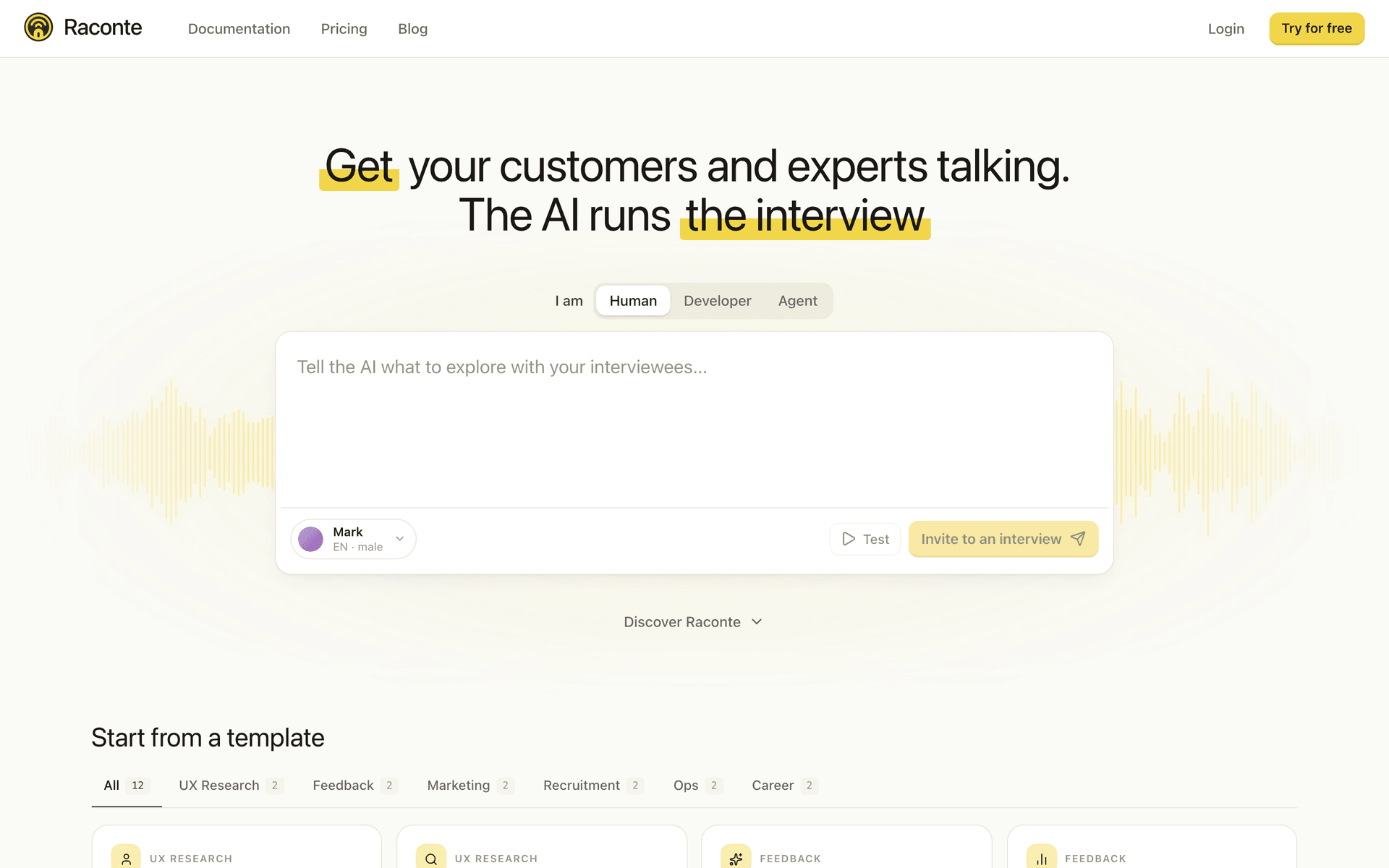
Raconte runs voice interviews with an AI. An HR team writes the interview as a prompt or starts from the exit interview template in the app, then sends a link or an email invitation, one by one or in bulk from a CSV file. The departing employee opens the link in a browser, with no account and nothing to install, and talks whenever it suits them, evenings included. The AI asks follow-up questions whenever an answer stays vague. Once the interview ends, the team gets the full transcript, the replayable audio, a summary and the sentiment of each answer.
Raconte sends the reminders on its own. An invitation nobody has opened gets a reminder email after one, two, three, five and ten days. Someone who stops halfway gets an email inviting them to resume. During a notice period, when the person is busy handing over, those emails do the chasing HR would otherwise do by hand.
The first 60 interview minutes each month are free and need no card. After that, Raconte charges $0.12 per minute of active speech, silences excluded, with top-ups from $12 and no subscription. A twenty-minute exit interview costs about $2.40. A company with three such departures a month stays inside the free minutes. The Enterprise plan adds volume discounts, white-label, SSO and an SLA, on quote.
Raconte only runs the interviews. It has no native connector to an HR system. Each interview gets its own transcript and summary, with no built-in report across departures. A team that wants either one sets it up itself, through code or an automation tool. Webhooks fire when an interview starts and ends, the REST API creates invitations, and an n8n or Make automation can send one when a leaving date appears in the HR system. To compare departures, the team can connect an AI assistant such as Claude to the MCP server, ask it to read every transcript of the quarter and run a thematic analysis of the reasons for leaving, with each theme backed by quotes.
An email invitation carries the person’s name. A public link can instead ask for no name and no email, so the team reads the interview without knowing who gave it. Interviews run in English and French only, and by voice only, with no typed answers. In return, the team gets the audio of every answer and can hear a hesitation or a change of tone, which never shows up in a typed answer. Every voice the AI can use is in a public catalog, so HR can listen to them before sending anything. Data is stored in France. An organization can also switch off non-European AI models in its settings, so that all processing stays with European providers.
Raconte names no HR customers on its site yet. Before paying, a team can listen to the recorded demo interview on the homepage, then run a test exit interview on a colleague with the free minutes.
2. Tambre
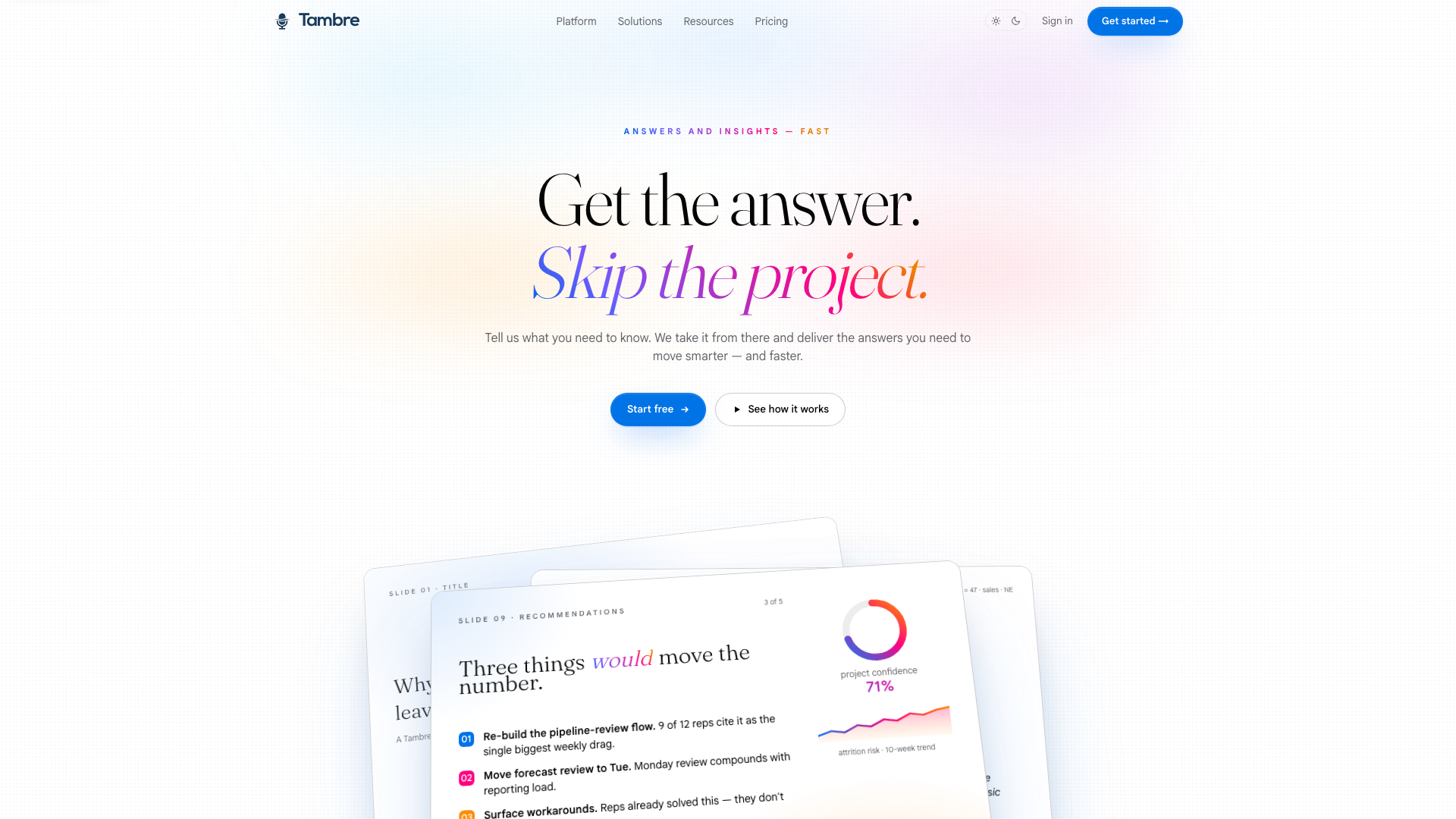
Tambre launched in 2026 and is run by its co-founder and CEO Mike Winkler. It sells voice research run by an AI and lists exit interviews among its uses. A departing employee gets a short, confidential voice interview, on the web or by phone, in which the AI follows up on the answers.
Tambre is anonymous by default. Its reports strip identifying details from what managers see and show quotes without pointing at anyone. It ranks the themes it finds, quotes the answers behind each one, and delivers narrated reports that export to PowerPoint and PDF. A single interview stops at 30 minutes.
Pricing is published and starts with a free trial without a card. Plans run from $29.99 a month for 100 voice minutes, about $0.30 a minute, to $1,199.99 a month for 10,000 minutes, about $0.12 a minute. Unused minutes stay valid for three months. One-off packs start at $39.99. Tambre names no customers, no HR system integration and no list of languages on its site.
3. Xobin
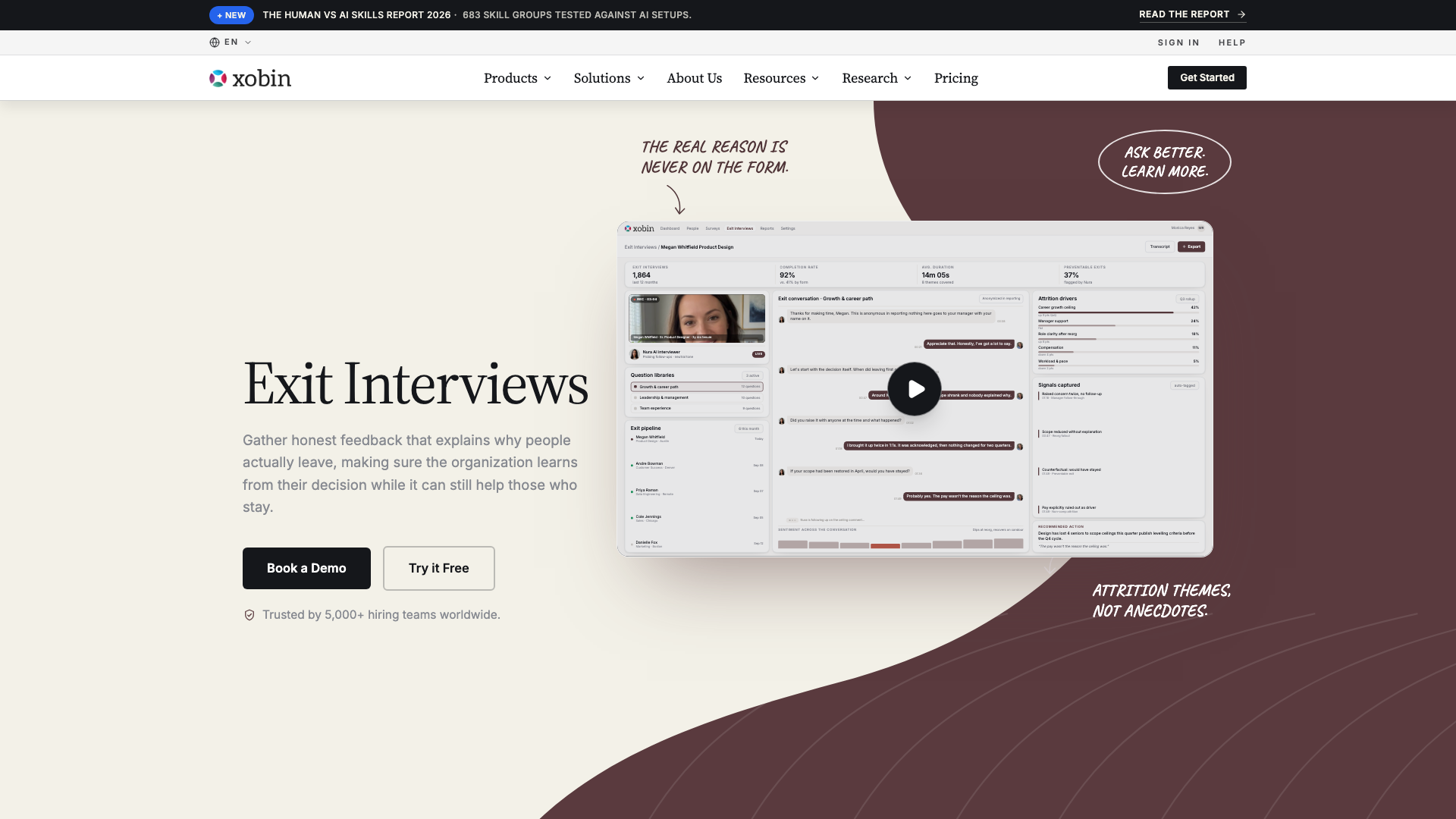
Xobin was founded in 2016 in Bengaluru and is best known for skills assessments and AI interviews for hiring. Its exit interview product uses an AI interviewer called Nura, which runs a conversation of about fourteen minutes and asks a further question on each answer.
Xobin puts a lot of work into exit reporting. It ranks the reasons for leaving, which HR can then filter by team, tenure and manager. It also tags each departure as regretted or not and flags the exits it judges preventable. HR sees individual answers, reports are anonymized, and team views only appear once a team has enough departures. Xobin connects to Workday, BambooHR, SAP SuccessFactors and HiBob, or takes a CSV file, so an interview can start from the leaving date.
The exit page offers a 14-day free trial without a card. After that, Xobin sells through a demo and a quote. Its site claims 20 languages for its hiring interviews, but the exit page does not say which ones apply to exit interviews.
Exit modules in HR and engagement suites
These suites run engagement surveys, performance reviews and sometimes payroll. Their exit module is a survey that starts on its own from the leaving date in the HR system. Its results sit next to the engagement data of the same person. These exit modules make sense when the suite is already in place. None of these suites sells the exit module alone.
4. Leapsome
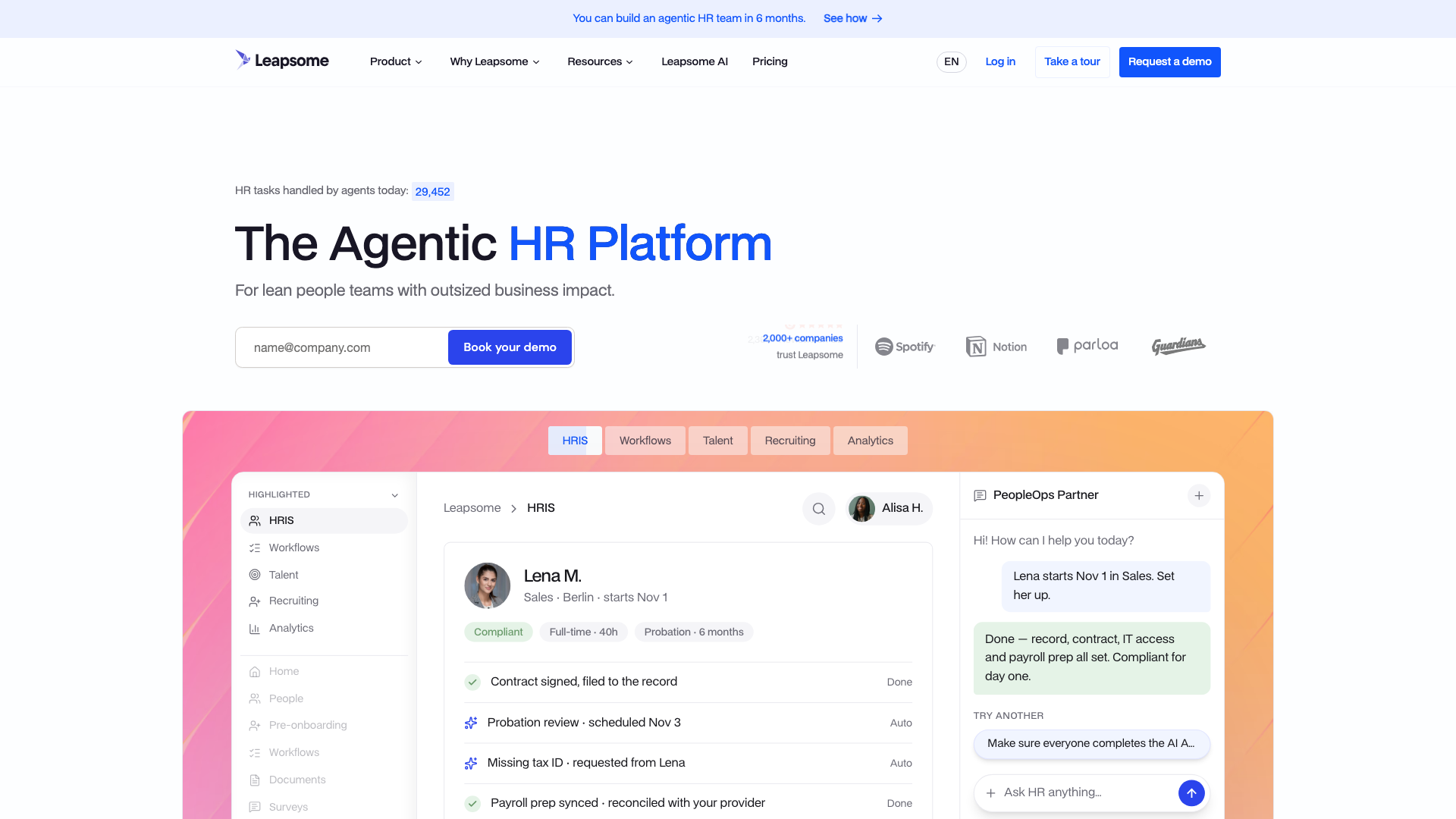
Leapsome was founded in 2016 in Berlin, has offices in New York, has raised $60M and claims more than 2,000 customers, Spotify, Notion and Bumble among them. In July 2026 it launched its own HR system with AI agents hosted in the EU.
Its exit survey starts from the leaving date synced from Personio, BambooHR or HiBob. It can be anonymous, though Leapsome advises named answers when only a few people answer. The follow-up happens after the fact: with Anonymous Survey Conversations, the survey owner can reply in writing to a comment without learning who wrote it. AI summarizes the comments. Surveys run in 38 languages, French included. Data is hosted in the EU.
Leapsome sells its surveys in its engagement module, listed at €4 per employee per month. You reach a 14-day sandbox after a call with sales.
5. Culture Amp
Culture Amp was founded in 2009 in Melbourne and claims more than 6,000 customers, McDonald’s, Etsy and MLB among them. Caroline Rawlinson became CEO in January 2026. The company cut jobs in November 2025 and again in July 2026.
Its exit survey runs continuously and starts from the last day of employment synced from the HR system. Answers are named by default, so admins see who said what. Culture Amp also has a “Survey and Interview” workflow: a person, usually the manager or someone in HR, reads the survey answers and then holds an interview, logging the notes in the tool. That workflow starts by hand. AI summarizes the comments. Surveys run in more than 40 languages, French included.
Pricing is on quote, billed yearly. Culture Amp suits a company that already runs its engagement surveys there and wants the exit answers next to them.
6. Qualtrics
Qualtrics was founded in 2002 in Provo, Utah, was taken private for $12.5 billion in 2023 and closed the $6.75 billion purchase of Press Ganey Forsta in May 2026. Its EmployeeXM product includes an exit program built by its organizational psychologists.
The exit survey starts from the HR system when a departure is confirmed. Its dashboards split the results by department, team and manager. An AI layer sorts the comments by topic and sentiment and suggests actions. The Conversational Feedback feature asks a typed follow-up question when an open answer stays vague. In lifecycle surveys, the kind Qualtrics uses for exits, it asks one follow-up question at most. French is among the supported languages.
Pricing is on quote and depends on usage. The marketplace version of the exit program requires an Employee Experience license and is listed in English only. Ardent Health is a named customer. Qualtrics suits a large company that wants exit answers inside the same platform as its engagement and customer surveys.
Outsourced exit interview programs
These firms take the exit interview off your hands. A neutral third party contacts the departing employee, by phone or online, and sends you the results, along with data from the other employers it works for. They sell on quote, usually under a yearly contract.
7. People Element
People Element is based in Denver. It started in 1988 as a leadership development firm and launched its own survey platform in 2017. Health First, which says it saved $1.15 million in turnover costs, and TMC Transportation are named customers.
It sends exit surveys by email, text message, phone or a kiosk on site. Its in-house callers reach the employees who never open an email, which matters for frontline staff. People Element works as a neutral third party, adds AI analysis and benchmarks by industry, connects to the HR system and translates surveys into any language.
Pricing is on quote, based on the number of employees surveyed and billed yearly, with no setup fee, no per-user fee and unlimited surveys. No free trial is listed.
8. Work Institute
Work Institute was founded in 2000 in Franklin, Tennessee, by Thomas Mahan. It runs exit interviews by phone with trained interviewers, with a web option, in twelve to fifteen minutes per person. Results come back in about three business days.
Work Institute claims more than a million interviews. Its yearly Retention Report, built on about 100,000 exit interviews, reached its tenth edition in February 2026. In a confidential study, a report only shows a group of five people or more, so nobody can be singled out. Parkview Health, a hospital group, credits the program with a 34% cut in first-year nurse turnover.
Pricing is on quote. Work Institute publishes neither its HR system integrations nor its languages.
Forms for a small budget
These tools send a form after the last day. They ask everyone the same questions and give you numbers you can count. Both have a ready-made exit template.
9. Typeform
Typeform was founded in Barcelona in 2012 and makes the most polished one-question-at-a-time form. Its exit survey template is anonymous by default, with optional fields to identify the person. Typeform suggests sending the answers to Google Sheets or to the HR system through Zapier.
The Talent plan, built for HR teams, costs $169 a month ($119 billed yearly) for 3,000 responses and includes Clarify with AI, which asks up to two typed follow-up questions when an open answer stays short. In June 2026 Typeform also launched Research Flow, AI-moderated interviews by text, voice or video, sold through sales and aimed at product and market research. A free plan exists, Basic costs $28 a month billed yearly for 100 responses a month, and the form itself can be in French.
10. SurveyMonkey
SurveyMonkey has made online surveys since 1999. Its exit survey template has been used more than 16,000 times. Each collector has an anonymous responses switch, though IP addresses still go into SurveyMonkey’s logs for 13 months.
In September 2026 SurveyMonkey announced integrations with Workday and BambooHR, along with connectors for Claude, ChatGPT and Gemini. Its AI helps build a survey and analyzes the open answers afterwards, by theme and sentiment, from the Advantage plan. Follow-up questions inside a survey come from rules you write.
The free Basic plan limits a survey to 10 questions. On SurveyMonkey’s European price list, Advantage costs €36 a month billed yearly and Standard €39 a month billed monthly.
How to choose between them
Start from who you want asking, then check who will read the answers.
- You want the depth of a real interview without blocking thirty minutes of HR time per departure. Take an AI interviewer. Raconte starts free every month and runs in English and French only. It gives one transcript per interview. You connect it to an HR system through its API and run the comparison across departures yourself. Tambre anonymizes by default and delivers ready-made reports. Xobin connects natively to Workday, BambooHR, SAP SuccessFactors and HiBob and has the most detailed exit reports of the three.
- Your company already runs an HR or engagement suite. Turn on its exit module first, since it starts on its own from the leaving date. Leapsome publishes its price, Culture Amp adds a human interview step, Qualtrics suits the largest companies.
- You want a neutral third party and a comparison with other employers. Take an outsourced program. People Element calls the people who never answer an email. Work Institute’s interviewers do the whole conversation by phone.
- You have three departures a year and no budget. A Typeform or SurveyMonkey exit template is enough to start, provided someone reads every answer.
You can also pair two tools. Your HR suite sends the exit survey. An AI interview then goes to the people whose survey answers need explaining, or to every regretted departure. A webhook does the handoff: when a survey comes back with a low score, n8n or Make sends the interview invitation.
Pay attention to who sees the names. Two tools name the person by default: Culture Amp in its exit surveys, Raconte in its email invitations. If people need to answer without being identified, use an anonymous link, a tool that anonymizes its reports like Tambre, or one that only shows a group above a minimum size, like Work Institute. Xobin sets a minimum for its team views only. HR still sees each answer. If the language of the conversation matters, Raconte runs exit interviews in English and French only, Leapsome runs surveys in 38 languages and Culture Amp in more than 40, and Tambre, Xobin and Work Institute publish no language list for exit interviews.
Other tools came up in our research and did not make the list for lack of room: Workday Peakon Employee Voice, Lattice and 15Five for their exit surveys, Perceptyx for its text conversations in Slack and Teams, HSD Metrics ExitRight, Ethico and ExitPro for outsourced programs, Koji for AI interviews, and Microsoft Forms or Google Forms for a free form.
Frequently asked questions
What is exit interview software?
Exit interview software is a tool that asks departing employees why they are leaving and collects the answers in one place. The category covers four kinds of products: AI interviewers that hold a conversation by voice or text, exit modules inside HR and engagement suites that send a survey from the leaving date, outsourced programs where a third party interviews people by phone, and form builders with an exit template.
Is an exit interview a trap?
No, but a departing employee has good reasons to be careful: they may need a reference, and they may work with these people again. That is why the person asking matters. Research published in Harvard Business Review found that the manager’s own manager gets more candid answers than the direct manager. An AI or an outside firm goes further and removes the company from the conversation altogether. If you are the one leaving, describe situations rather than people, and keep what you would not want quoted out of the conversation.
Can exit interviews be anonymous?
Yes, with the right tool. Tambre anonymizes reports by default. Work Institute only shows a group of five people or more in a confidential study. Xobin shows team views once a team has enough departures, though HR still sees each answer. Typeform and SurveyMonkey have an anonymous mode. Raconte can collect an interview through a public link that asks for no name and no email. Culture Amp exit surveys are named by default. In a small team, the content of an answer can still give away who wrote it, whatever the tool.
Should an AI run exit interviews?
An AI interviewer is useful when HR cannot hold a thirty-minute conversation with every departing employee, or when people would hold back in front of someone from the company. It asks follow-up questions like an interviewer would, at any hour, and leaves the team a transcript. Keep a human conversation for sensitive departures, such as a complaint about harassment, which need a person who can act on what they hear.
How much does exit interview software cost?
Five of the ten tools publish a price. Raconte gives 60 free interview minutes a month, then charges $0.12 per minute, about $2.40 for a twenty-minute interview. Tambre starts at $29.99 a month for 100 minutes. Leapsome lists its engagement module, surveys included, at €4 per employee per month. Typeform starts at $28 a month and SurveyMonkey at €36 a month, both billed yearly. Xobin, Culture Amp, Qualtrics, People Element and Work Institute sell on quote.
What is the difference between an exit survey and an exit interview?
An exit survey asks everyone the same written questions and gives you numbers you can compare. An exit interview is a conversation in which the person asking follows up on what they hear, which is how you learn the real reason behind “a better opportunity”. AI interviewers sit between the two: they ask the same opening questions every time and follow up like an interviewer.
Which exit interview tools connect to an HR system?
Xobin connects to Workday, BambooHR, SAP SuccessFactors and HiBob. Leapsome syncs the leaving date from Personio, BambooHR and HiBob. Culture Amp and Qualtrics start the exit survey from your HR system. People Element connects to it too. SurveyMonkey announced Workday and BambooHR integrations in September 2026. Typeform goes through Zapier. Raconte has no native connector, but an n8n or Make automation can send its invitation when a leaving date appears.
Can the same tools run stay interviews?
Yes. A stay interview asks people who are still in the company what keeps them and what would make them leave. Any tool that runs a conversation or a survey works for both: you keep the software and change the questions. Leapsome, Culture Amp and Qualtrics already run engagement surveys. An AI interviewer like Raconte can run stay interviews through the same kind of link as exit interviews. For the questions themselves, adapt these stay interview questions.
Where to start
An exit survey counts how many people left over pay or a manager. To know what happened, and what would have kept them, you need the person to tell the story in their own words, to someone who asks for the details.
If you want that conversation with every departing employee without booking it, that is what we built Raconte for. Start from the exit interview template, send the link during the notice period, and read the transcript the same day. The first 60 minutes each month cost nothing and need no card. After that, you are billed by the minute.


