Focus group vs interview: choose by the evidence you need
Compare a focus group and a one-to-one interview by what each records, how the group shapes answers and what each costs, with a table to pick one.
October 31, 2026
Godefroy
Updated on November 22, 2026
- Choose individual interviews to understand one person’s experience, decisions and reasoning. Choose a focus group to study how people respond to one another.
- In a 2017 randomized study of 350 men in Durham, interviews produced a broader range of ideas per person, while some sensitive disclosures appeared more often in focus groups.
- A focus group can cover ground quickly in one session, but you have to recruit, schedule and moderate several people at once.
- Use a focus group when interaction is part of the research question, because a crowded session alone adds no useful evidence.
- Raconte runs asynchronous voice interviews and returns an individual transcript, audio, summary and per-message sentiment. It does not produce a built-in report across multiple interviews.
Choose an individual interview when your question is about one person’s experience, decisions or reasoning. Choose a focus group when the way participants react to one another is part of what you need to learn. An interview records each account on its own, while a focus group records a discussion between several people, with the agreement, disagreement and social pressure that shape it. A focus group lets your team hear more people at once, but it does not automatically make the study cheaper.
Focus group vs interview: which one answers your question?
| Decision factor | Individual user interviews | Focus groups |
|---|---|---|
| Main evidence | One person’s experience, reasoning and sequence of events | Reactions, agreement, disagreement and shared language |
| Best research question | “What happened, and why did this person respond that way?” | “How do people respond to this idea when they hear one another?” |
| Influence to account for | The researcher’s questions and presence | The moderator, the first speakers, group relationships and social pressure |
| Recruitment and scheduling | Recruit and schedule each participant. Sessions can happen separately | Recruit people who fit the same session, then align everyone’s availability |
| Cost drivers | Researcher time per conversation, participant incentives, transcription and analysis | Moderator and analysis time, participant incentives, and possibly a room or platform |
| What analysis compares | Each account, then patterns across participants | Each contribution and the interaction that shaped it |
| Often a poor fit | Testing how a group negotiates or develops a shared view | Reconstructing an individual decision or a sensitive personal experience |
The budget for either method depends on participant incentives, recruitment difficulty, researcher rates, session length, transcription needs and the number of groups. Running sessions online saves travel, but you still have to schedule and moderate them.
What does each method record?
An individual user interview is a conversation between a researcher and one participant. The researcher can ask what happened, when it happened and what the participant did next. The participant can take time to reconstruct a particular experience without waiting for a turn or responding to other people’s stories.
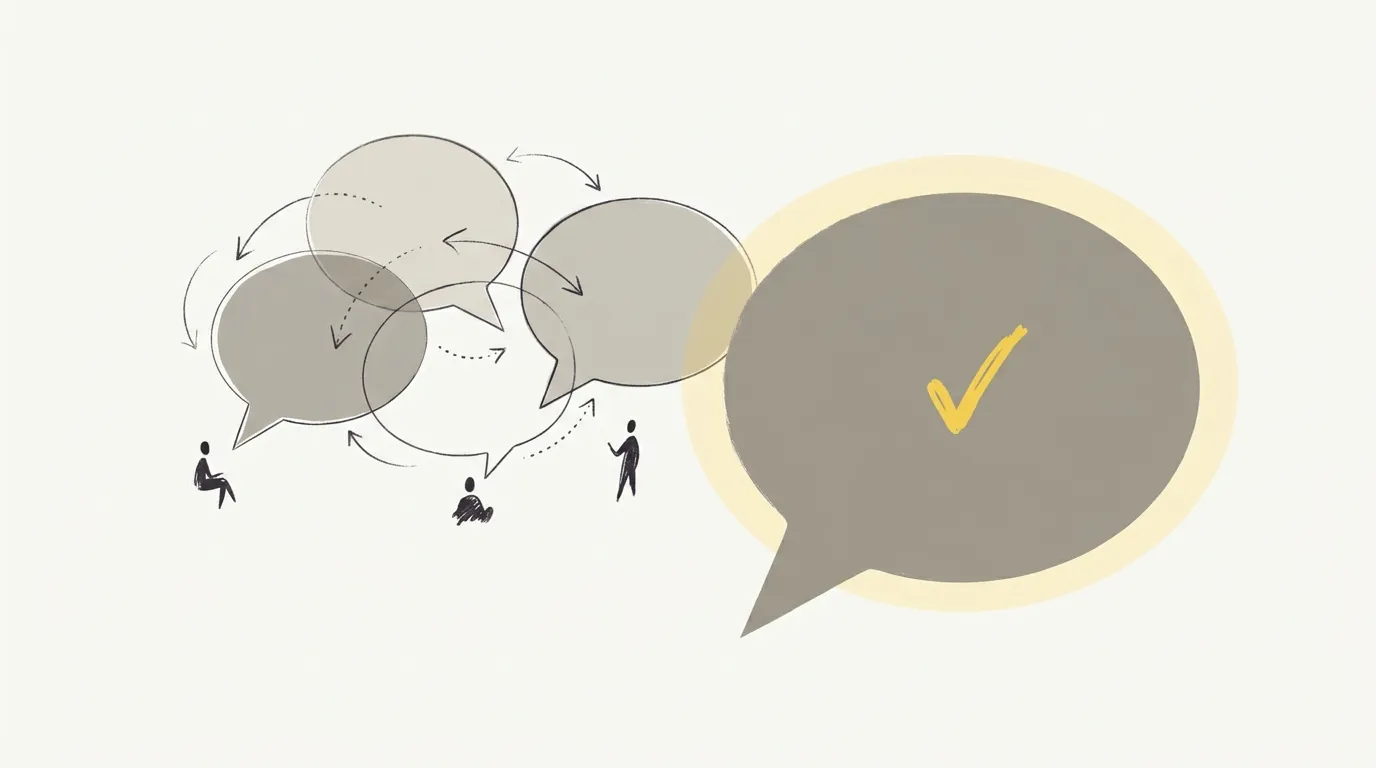
A focus group is a moderated discussion with several participants. The answers matter, but so does the conversation between them. One person may introduce a concern that others had not thought to mention. Another may challenge an assumption or bring the group to a shared position. Those reactions are data if your study asks how an opinion forms or how people discuss a shared experience.
That difference is easy to lose when a team calls any conversation with users an interview. In a focus group, participants influence the answers you collect. In an individual interview, the researcher still influences the conversation through the questions and follow-ups, but each participant responds on their own.
When should you choose individual user interviews?
Choose one-to-one interviews when your question concerns an individual’s experience, behaviour, beliefs or decision. They work well when you need someone to explain a sequence in detail: what they were trying to do, what they tried, where they hesitated and what they did after that.
For example, a product team wants to understand why users abandon an onboarding flow. An interview lets the researcher ask one person to walk through the last time they tried it. If the participant mentions an unexpected workaround, the interviewer can pause the guide and ask how that workaround began. A group can discuss onboarding in general, but it is harder to separate an individual’s memory from the group’s interpretation of it.
Individual interviews also fit when participants should not meet each other. That may include people from competing organisations, a manager and direct reports, or customers whose relationship to the product is sensitive. A one-to-one conversation gives the researcher a clearer view of each person’s account, though it does not remove interviewer bias or guarantee candour.
An interview is also easier to adapt when each participant has a distinct context. You can keep the same core questions and probe the differences. If the study needs comparable answers, write a shared guide and use it consistently. Learn how to prepare shared interview questions and follow-ups without turning the conversation into a rigid questionnaire.
When does a focus group work better?
Choose a focus group when the interaction itself helps answer the research question.
A focus group can help when a team wants to hear how people interpret a new product name, compare two messages, or build on one another’s ideas. It can also reveal vocabulary and assumptions that participants share. A moderator can ask someone to respond to a point another participant raised, making disagreement and consensus visible in the room.
The format has practical limits. Participants need to attend at the same time, and the moderator has to make room for quieter people while keeping one voice from dominating. The group should also make sense for the topic. If participants feel exposed, fear a workplace consequence or have very different levels of authority, they may withhold what they would say alone. A private interview does not solve every trust problem, but it avoids asking people to disclose in front of one another.
What does the research say about interviews and focus groups?
The evidence does not support a simple rule that groups always generate more ideas, or that personal topics belong only in individual interviews. The result depends on what researchers count and what the participants are discussing.
Marketing researcher Edward Fern compared individual interviews with focus groups in a 1982 Journal of Marketing Research study of idea generation. Individual interviews produced more ideas overall, while groups of eight generated more than groups of four, in his findings on individual interviews and group size. The result applies to one task, so use it as evidence for your decision alongside the research question and participants. It challenges the assumption that putting people together automatically creates more useful ideas. Abbie Griffin and John Hauser reached a similar result in 1993 by counting customer needs: two one-hour individual interviews surfaced as many as one two-hour group. We place their study among eleven ways to study your customers.
Greg Guest, Emily Namey and colleagues compared the methods in a randomized study of 350 Black men in Durham, North Carolina. Participants answered the same questions about seeking health care, either in a focus group or an individual interview. The two formats produced similar numbers of unique items per data-collection session. Individual interviews produced a broader range of items per person. Several sensitive themes appeared more often in the focus groups, and some appeared only there. The topic, participants and study design matter, so these findings should guide a choice rather than dictate one. The authors describe the results in the 2017 study in the International Journal of Social Research Methodology.
A related cost-effectiveness analysis by Emily Namey, Guest and colleagues examined thematic saturation in the same research programme. Their simulations found that individual interviews took longer to collect, but cost 20% to 36% less than focus groups at the compared saturation levels, given the costs they included. The estimate reflects the study’s cost assumptions, so use it to compare research inputs rather than as a current market price. It shows why a focus group’s ability to hear several people in one session does not automatically make the overall study cheaper. Namey and colleagues describe the assumptions in their cost comparison of individual interviews and focus groups.
Read more about moderating group discussions and managing group dynamics, including the cases where the discussion itself is useful.
How do you decide which method to use?
Write the question you need to answer before you choose the format. Then ask what kind of evidence would settle it.
graph TD
  A["What do you need to understand?"] --> B{"Does interaction between participants matter?"}
  B -->|"Yes, study reactions or group decisions"| C["Focus group"]
  B -->|"No, understand one person's experience"| D{"Can the participant describe the event?"}
  D -->|"Yes, ask about a specific past episode"| E["Individual interview"]
  D -->|"No, watch the behaviour or collect it over time"| F["Usability test, observation or diary study"]
If the team needs to learn how participants react to a concept after hearing each other, use a focus group. If it needs to reconstruct an individual’s experience, use interviews. If the team needs to understand behaviour, observe a task, study behaviour over time or check product analytics. Interviews and focus groups both collect what people say. Observation answers a different question.
It is also fine to combine methods. Interviews can reveal the language and personal experiences that shape a topic. A later focus group can explore how a group reacts to concepts built from those findings. A survey can then measure how common a pattern is across a larger sample. Each step answers a different question, so plan the sequence around the decision rather than collecting formats for their own sake.
How should you account for bias?
An individual interview is not a neutral window into someone’s thoughts. The researcher can lead with a question, interrupt a story, or make a participant want to please them. Use open questions, ask for concrete past examples and keep your assumptions out of the wording. The customer discovery interview method shows how to ask about what someone did instead of asking them to predict what they might do.
A focus group adds group influence to those risks. Early answers can set the direction. A confident participant can take more time than others. Some people may agree to keep the discussion moving, even when they would choose differently alone. The moderator should make space for individual answers before discussion, invite quieter participants without putting them on the spot, and note when someone changes their answer after hearing another person.
Group influence is not only a flaw. It is the subject of the research when you need to understand how opinions shift, how shared language forms or how a team reaches a decision. The important distinction is whether the interaction is evidence or noise for your question.
Can asynchronous interviews replace a focus group?
An asynchronous interview collects separate accounts without a shared calendar slot. A focus group captures how participants react to one another and negotiate a shared view. Choose the group format when those interactions are part of the research question.
Raconte runs asynchronous voice interviews from a prompt and a link. Participants answer when they have time, and the product returns each interview’s transcript, audio, summary and per-message sentiment. The team reviews each person’s material separately. There is no built-in report that combines several interviews, so teams comparing participants need to work across the individual transcripts, for example through the API or MCP server.
This format suits a team that wants individual stories without putting a researcher on every call. Use a live session to watch someone use a prototype, a focus group to study group negotiation, and a human interviewer for a sensitive conversation that calls for presence and judgement. Our comparison of tools for running user interviews covers products that handle different parts of that workflow.
Which method should your product team start with?
Choose interviews when the decision depends on a person’s own experience, past actions or reasoning. Choose a focus group when the group’s reactions and discussion are the evidence. Use observation or analytics when the question concerns actual behaviour. Start with the study question, then compare budget and speed. A session earns its cost when it produces the evidence your decision needs.
If individual interviews are the right fit and scheduling limits how many people your team can reach, Raconte lets you run asynchronous voice interviews from a link. Each organisation gets 60 free interview minutes a month, with no card required. The pricing page explains the cost after that.
Frequently asked questions
What is the difference between a user interview and a focus group?
A user interview is a one-to-one conversation about a participant’s experience and reasoning. A focus group is a moderated discussion where participants respond to one another. Interviews help you understand an individual account. Focus groups help you study interaction, shared language and group reactions.
When should you use a focus group instead of individual interviews?
Use a focus group when the research question depends on people reacting to one another, such as testing how a group discusses a concept, message or shared decision. Use individual interviews when you need to follow one person’s experience in depth or keep participants separate.
Are focus groups cheaper than individual interviews?
They can collect several people’s reactions in one session, but the total cost depends on recruitment, participant incentives, moderator time, facilities or video tools, transcription and analysis. A 2016 cost-effectiveness study found individual interviews cost 20% to 36% less at the saturation levels it compared. The estimate depends on the study’s cost assumptions, so read it as a comparison of research inputs rather than a current market price.
How many people should take part in a focus group?
Set a group size that gives each participant room to contribute. A small group may bring too few perspectives, while a larger one gives each person less time and asks more of the moderator.
Can focus groups tell you what individual users will do?
No. A focus group records what participants say in a discussion, shaped by the other people in the room. To learn what users actually do, observe them completing a task, examine product behaviour or use a diary study. Use interviews to ask about a specific past experience, while remembering that reported behaviour and observed behaviour are not the same evidence.