
Six user research methods, and the question each one answers
Four qualitative research methods and two quantitative ones side by side: the question each one answers, the one it cannot, and how to choose between them.
August 28, 2026
Godefroy
- A method is qualitative when the person answering chooses the form of their answer. Fix that form in advance and you get numbers to count rather than stories to read.
- Start from what you want to know rather than from the method you know best. A question about what people did rules out every method that only records what they say.
- Five users is enough when you test again next sprint, and risky for a study you run once.
- People raise sensitive subjects more readily in a focus group than its reputation suggests. Each of them still contributes less than they would one to one.
- Qualitative samples stay small because new themes stop appearing quickly. Around a dozen interviews cover a homogeneous group, as long as everyone was asked the same things.
Your team has a question about its users and two weeks to answer it. Someone suggests a survey, because the last three studies were surveys and the form template is already there. This time, though, the question is why people stop using the export feature after a month, which is the one thing a bar chart never returns.
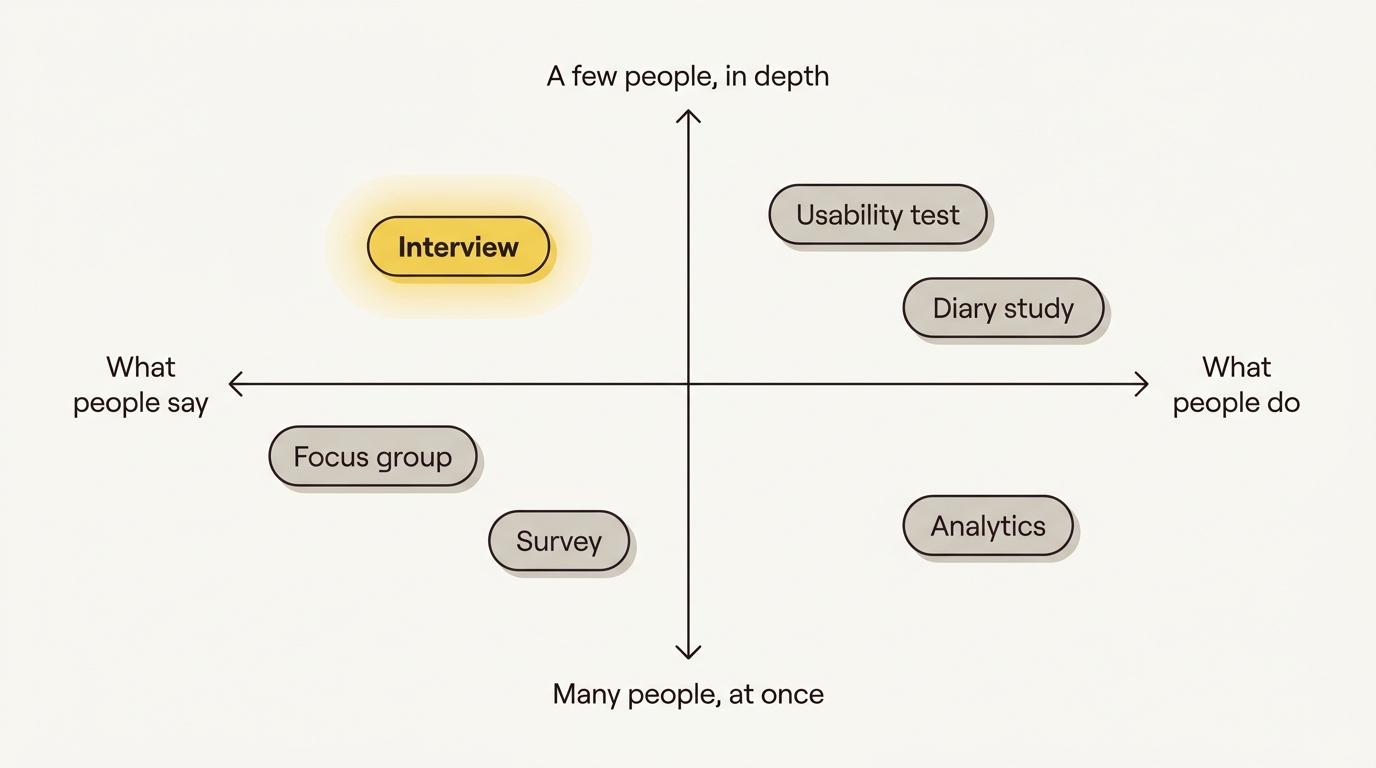
The method you pick fixes what you can learn, yet most teams pick it from habit rather than from the question. Choosing from the question means knowing what each method gives back. Christian Rohrer, the UX researcher behind Nielsen Norman Group’s map of research methods, sorted twenty of them along three axes. One axis settles most arguments on its own: does the method record what people say, or what they did?
That question alone takes three of the six methods off the table. This page puts four qualitative research methods and two quantitative ones side by side, with the question each one answers, the question it cannot answer, and the number of people it takes.
Spot a qualitative research method by the shape of the answers
A qualitative research method collects what someone said or did, in the form they gave it and in their own order, and leaves the interpretation to you. Interviews, focus groups, usability sessions, diary entries and open-ended answers all qualify. A rating out of ten does not, because the shape of the answer was fixed in advance, so the value is counted without anyone reading it.
If everyone who means the same thing produces the same value, the question was quantitative. Anything you have to read against the next answer is qualitative material.
A second split matters more when you pick the method. Interviews, surveys and focus groups record what people say. Usability tests, diary studies and analytics record what they did. Rob Fitzpatrick, a startup founder and the author of The Mom Test, built a whole interviewing method on that gap: ask about specifics in the past rather than opinions about the future. You can check what someone did last month. Nobody can check what they say they would pay for.
Six user research methods, side by side
| Method | What it answers | What it cannot answer | People per study | What it costs you |
|---|---|---|---|---|
| Interview | Why someone did what they did, in their words | Whether that reason is common | 6 to 12 per segment | 45 minutes each, plus scheduling and reading |
| Usability test | Where someone gets stuck in a task | Whether they wanted the task at all | 5 per round, several rounds | A prototype, a script, a moderator |
| Diary study | What happens between sessions, over weeks | One decision in detail | 10 to 20 | One to four weeks of reminders |
| Survey | How many, how often, which option | Why the number moved | 100 and up | Question design, with one shot at it |
| Focus group | How people argue about a topic in front of each other | What any one of them actually does | 6 to 8 per group, 2 to 4 groups | A moderator, a room, and group effects |
| Analytics | What everyone did inside the product | Anything about intent | Your whole base | Events named before you needed them |
The survey and analytics are quantitative. They belong in the same comparison because the choice runs across all six. A team comparing only interviews with focus groups has already narrowed the question too far.
Which method answers your question
graph TD
  A["What do you want to know?"] --> B{"What people say, or what people do?"}
  B -->|"What they do"| C{"Where does it happen?"}
  C -->|"Inside the product, at scale"| D["Analytics"]
  C -->|"On one task you can watch"| E["Usability test"]
  C -->|"Spread over weeks"| F["Diary study"]
  B -->|"What they say"| G{"Do you already know the options?"}
  G -->|"Yes, and you need counts"| H["Survey"]
  G -->|"No, you need the reasons"| I["Interview"]
  G -->|"No, and you want to hear them disagree"| J["Focus group"]
In Just Enough Research, Erika Hall, co-founder of the design studio Mule Design, sorts studies by the question instead of by the technique.
- Generative research asks what is going on here.
- Descriptive research asks what and how.
- Evaluative research asks whether you are getting closer.
- Causal research asks why this is happening.
Put your own question into one of those four kinds of research before booking anything. Plenty of teams book a usability test while asking a generative question. A prototype is no use in front of someone who has not yet told you what they were trying to do.
Interviews answer why people did what they did
An interview is the only one of the six where you can follow the answer. Someone calls the export “a bit annoying”, you ask what happened the last time they used it, and four minutes later you have the sequence: the file opened in the wrong tool, they rebuilt it by hand, and they stopped exporting.
Steve Portigal, a research consultant and the author of Interviewing Users, reduces the skill to four habits: check your worldview at the door, embrace how other people see the world, build rapport, and listen. Most interviewers fail on the worldview. They steer the conversation towards their own hypothesis in the first few minutes.
The product discovery coach Teresa Torres asks teams, in Continuous Discovery Habits, for one customer interview a week and for story-based questions. “What do you look for in a reporting tool?” returns an opinion. Ask instead “Tell me about the last time you had to pull a report” and you get a story, with a date, a tool and the moment it went wrong. Most teams that give up on continuous customer discovery stop over the logistics of that weekly pace.
Our interview guide covers the structure and a full example to copy. The bank of 45 open-ended questions gives the wording, grouped by research goal. It takes eight steps to conduct a qualitative interview, from the study question to the summary you write within the hour.
Usability tests show where people get stuck
A usability test measures one task at a time. It says nothing about whether the person would have attempted that task on their own. That is the question people most often bring to it by mistake.
The five-user rule comes from this method. Laura Faulkner, a usability researcher at the Applied Research Laboratories of the University of Texas at Austin, went and checked it. She ran sixty participants through a web timesheet and drew a hundred random samples at each size. Five users found 85% of the problems on average. Some draws of five found 99%, the worst 55%. Twenty users pushed that worst draw up to 95%.
Five works when you run a round every sprint and whatever you missed comes back next time. For the single study that decides whether you ship, run more.
Diary studies record what happens between sessions
Some behaviour has no session to watch. Choosing a supplier takes three weeks. Giving up on a habit takes two months. Neither shows up in a 45-minute conversation except as a summary the person has already smoothed over.
A diary study asks participants to log entries as things happen, over days to a month or more. The period follows the behaviour rather than your sprint. A week covers a first onboarding. Habits need several weeks before they either form or fade.
Some participants log carefully at first, then go quiet after a few days. Plan reminders and recruit more people than the number of diaries you need.
Surveys count what you already know how to ask
A survey reaches a population no interview will. It gives you how many, how often and which option, across hundreds of people, in a week.
You set its blind spot when you write the questions. You only learn what you thought to ask. The answers come back in a shape you chose before anyone read the question. Our post on quantitative research questions goes through the eight closed formats and what each one measures. The one on customer satisfaction surveys takes apart what a score out of ten hides.
Send a survey when you understand the behaviour and want to know how much of it there is. Once the number has moved and nobody can explain it, the survey has done its job and interviews take over.
Focus groups produce fewer ideas per person, and more sensitive ones
The received advice is that focus groups work for breadth and fail on anything personal, because nobody admits to a sensitive habit in front of the rest of the group. Both claims are wrong.
Edward Fern, a marketing researcher, compared the two formats in a 1982 study in the Journal of Marketing Research. He found that individual interviews generated more ideas than focus groups, and that eight-person groups produced more than four-person ones.
Greg Guest, the research methodologist whose saturation study is the reason twelve interviews is a common target, came back to the question in 2017. He and his co-authors randomised 350 African-American men in Durham, North Carolina into focus groups or individual interviews, all asked the same questions about seeking health care. Per session, the two formats produced a similar number of unique items. Per person, the interviews produced a broader range. Several sensitive themes came up only in the focus groups. None appeared exclusively in the interviews.
So a group covers as much ground as interviews in one session, and less per person. Run a focus group when watching people disagree is the point, for instance when you are choosing between two names and want to hear the argument happen. Run interviews when you want one person’s reasoning, uncontaminated by the loudest voice in the room.
Analytics answers how many, never why
Analytics is the only one of the six that records everyone, all the time, at no cost per person. It shows that most accounts never reach a second export.
Then it stops. An event log records no intent. The events have to exist before the question does. A team that instrumented clicks instead of outcomes finds out six months later that the outcome it now cares about was never recorded.
Pair it with interviews or a diary study. Where the accounts drop off is the finding. The reason comes out of a conversation.
Qualitative and quantitative research answer different questions
A qualitative method returns the shape of a problem and the vocabulary people use for it. A quantitative one then tells you how big it is. Our comparison of qualitative vs quantitative research sets them side by side and covers the order to run them in.
Saturation is why qualitative samples stay small
Twelve interviews sounds arbitrary until you see where the number comes from. Guest, with the qualitative researchers Arwen Bunce and Laura Johnson, coded sixty in-depth interviews in the order they were run, watching for the point where new themes stopped appearing. Nearly every theme showed up within the first twelve interviews, and the broad strokes within the first six.
That number holds for one homogeneous group. Two very different segments mean two counts, so six to twelve each. And it only holds if everyone got the same guide, since twelve improvised conversations leave you with twelve anecdotes.
A survey follows the opposite logic. Its sample size comes from the precision you want on a proportion, so you calculate it rather than judge it.
Interviews get cheaper when nobody books a slot
The method a team picks is often the method it can afford. Teams pick surveys over interviews because a conversation costs a slot to book, an interviewer who is free and someone to write it up. That cost repeats per person.
We built Raconte to remove that cost. You write what you want to ask once, as a brief, then send a link. The person opens it in their browser whenever it suits them and talks for a few minutes. The AI listens, follows up as soon as an answer stays vague, and stops once your themes are covered. Each call comes back with the transcript, the audio, a summary and per-message sentiment, plus aggregated reports once several people have been through the same brief. The API and the MCP server push all of it into your own tools or into an agent.
It replaces none of the six on its own. An AI works from the voice, so it misses the look on someone’s face. A negotiation or a painful subject still calls for a human interviewer. Watching someone fail at a task takes a usability test. And when one countable fact from a few hundred people is all you need, a survey is faster for everybody.
Raconte fits between the interview and the survey. You get the depth of a conversation across tens or hundreds of people, which no team can do by hand. The first 60 interview minutes each month are free with no card. The pricing page has the rest.
Where to start your qualitative research
Write your question in one sentence, then decide whether it is about what people say or about what they do. That single split leaves you three methods to choose between.
Take the smallest method that still answers it. Five usability sessions cover a screen redesign. A product redesign needs six to twelve interviews per segment first. The survey comes once you can write its options in your users’ words rather than your own.
If the people you study are your customers, the choice also depends on what they are doing right now: deciding to buy, using your product or cancelling. Each of those stages has its own customer research methods.
If what you are missing is a tool rather than a method, our comparison of user interview platforms ranks thirteen of them and names who runs the interview in each.
Frequently asked questions
What are the 4 methods of qualitative research?
The list usually given is interviews, focus groups, observation (field studies or ethnography) and analysis of existing documents. In product work the four you will actually run are interviews, usability tests, diary studies and focus groups. The number four is a habit of textbooks. What matters is which method answers what you want to know.
What is qualitative research, with an example?
Qualitative research collects what people said or did in their own words and leaves you to interpret it. Say you want to know why customers stop exporting data after a month, so you interview ten of them about the last export they actually ran. You come back with ten stories. Reading them against each other shows that seven rebuilt the file by hand because it opened in the wrong tool.
What is the difference between qualitative and quantitative research?
A quantitative method fixes the shape of the answer in advance, so every response becomes a value you can count. A qualitative method leaves the shape to the person, so every response is material you read. Our post on quantitative research questions sets the two side by side format by format.
What are the methods of user research?
The six that cover most product work are interviews, usability tests, diary studies, surveys, focus groups and product analytics. Nielsen Norman Group maps twenty methods, adding card sorting, tree testing, eyetracking, A/B testing, concept testing and field studies among others. Nearly every project would benefit from combining two. Most teams use only the one they know best.
How do you choose a qualitative research method?
Start from your question rather than from the method. If it is about what people do, watch them: analytics across your whole base, a usability test on one task, a diary study when the behaviour is spread over weeks. If it is about what people say and you cannot yet write the answer options, interview them. If you can write the options, send a survey.
How many participants does qualitative research need?
Guest, Bunce and Johnson found nearly every theme within the first twelve interviews of a homogeneous group, with the broad strokes visible after six. Count six to twelve per segment when you are studying very different profiles. A usability test needs five per round if you run several rounds, and a diary study ten to twenty because some participants stop logging.
Is AI replacing UX research?
No. What an AI changes is the cost of talking to people: it can run a structured conversation, follow up on a vague answer and produce the transcript, so the scheduling and the note-taking go away. You still decide what to ask, read the stories against each other and judge which finding to act on. That is the research itself. An AI changes none of it. It changes the sample. A team that ran six interviews because six was what the calendar allowed can run fifty.


