
New hire survey: 15 questions to ask at 30 and 90 days
A new hire survey built on the French "rapport d’étonnement": five sections, 15 questions, a written example, a template, and what HR does with the answers.
October 16, 2026
Godefroy
- A new hire survey asks someone one to three months into the job what surprised them, good and bad, and what they would change.
- Send a new hire survey between day 30 and day 90. Earlier, the new hire has seen too little. Later, they have stopped noticing what bothered them.
- Good answers name a dated fact and suggest a fix. "Onboarding was fine" tells nobody anything.
- The survey only works if someone replies: one written action per problem, and a check-in at day 90 on what changed.
- Someone on probation writes politely to the person who will confirm their job. Have HR collect the answers, or let people answer out loud with nobody in the room.
A new hire survey asks someone who joined one to three months ago what surprised them about the company, in good ways and bad, and what they would do differently. French companies run a written version under the name rapport d’étonnement, roughly a “fresh eyes report”, and it is one of the cheapest ways to see your onboarding through the eyes of the people it is meant for. This post gives the five sections that structure it, fifteen questions, a written example, a template, and what HR should do with the answers.
What a fresh eyes report is
A fresh eyes report is a short, signed document in which a new hire reviews their hiring process, their onboarding, their role and the organization, while everything still looks unfamiliar. It runs one to two pages and goes to their manager, with a copy to HR.
It flips the end-of-probation review, where the manager assesses the new hire: here, the new hire assesses the company. Doctolib, the French healthcare booking company, calls it its “Fresh Eyes Report”.
BambooHR, the US HR software vendor, surveyed 1,565 full-time employees for its 2023 onboarding study: 70% know within the first month whether the job is right for them, and 44% had regrets or second thoughts within the first week. Send the survey at day 30 and you hear from new hires when most of them already know whether the job fits.
When to send a new hire survey, and to whom
Hand over the questions on day one, and suggest the new hire jot down surprises as they happen. First-day surprises fade fast: someone writing everything from memory at day 30 only remembers the broad strokes.
Collect the answers at day 30, day 90 at the latest:
- Before a month, the new hire has not been through a full work cycle (a month-end close, a release, a steering meeting).
- After three months, they have picked up the team’s habits and stopped noticing what bothered them.
- At day 90, hold a second round on what changed since the first answers.
Ask every new hire, internal transfers included. Interns get a shorter version halfway through.
15 new hire survey questions, in five sections
Each question asks for a fact rather than a feeling.
Good surprises
- What worked better than you expected since you joined?
- Which team habit would you take with you if you left?
- Who helped you without being asked, and how?
Bad surprises
- Where does the actual job differ from the one described during hiring?
- What moment made you wonder whether you had made the right choice?
- Which task took far longer than it should have?
Gaps
- What information did you spend more than a day hunting for?
- Which tool, access or contact did you need on day one?
- What question did you not dare to ask?
Practices to rethink
- Which rule or habit seems to exist without anyone knowing why?
- Which meeting could be shorter, or go away?
- What did your previous company do better, and how?
Ideas
- What small thing would you change next week?
- What would you set up for the next person who joins?
- What skill do you bring that the team does not use yet?
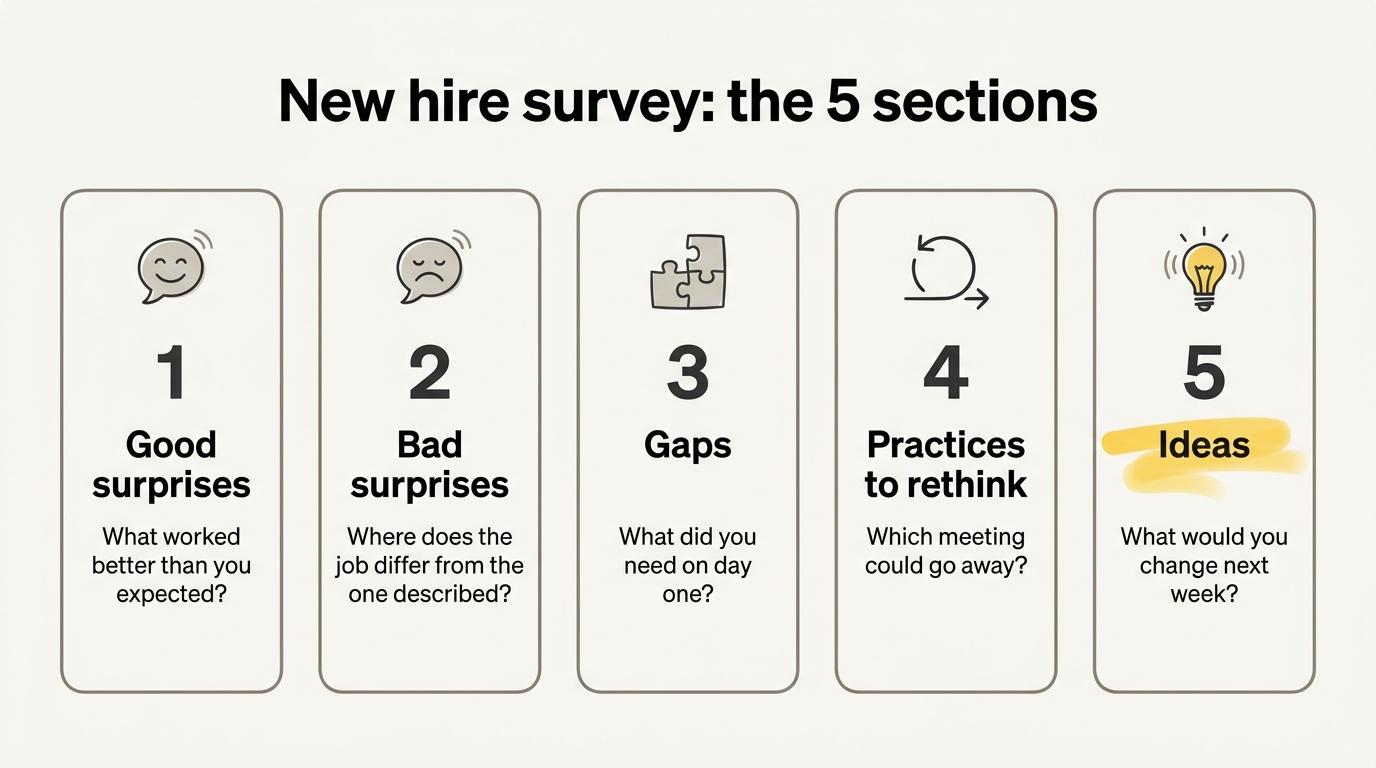
A written example
This example is fictional, built from common situations. Camille is an account manager at a 90-person medical supplies distributor. She joined on September 2 and hands in her report on October 3.
Good surprises. On day one my desk was ready, with CRM access and a list of ten clients to call, each with two lines of context. The field sales team answers questions in the shared channel within the hour. The Monday meeting lasts twenty minutes and ends on time.
Bad surprises. Prices exist in three versions: the PDF on the website, the team spreadsheet and the discounts logged in the CRM. In a month I quoted the wrong price twice. A colleague caught the first quote before it went out, but the second one reached the client. Complaints land in the team inbox, which nobody checks on Friday afternoons.
Gaps. Nobody showed me the warehouse, yet half of client calls are about delivery times. Half a day with logistics would have stopped me from guessing dates. I still don’t know who handles billing disputes.
Practices to rethink. I would keep one price list, the CRM one, and retire the other two. I suggest a rota for the team inbox on Fridays.
Ideas. We could set up a one-page “who to call for what”, which each new hire updates during their first month.
Every bad surprise rests on a checkable fact and comes with a fix, so her manager can act the next morning. Notice what is missing too: Camille says nothing about her manager. Few new hires mention their manager in writing, since they are writing to the person who will confirm their job.
A template to copy
NEW HIRE SURVEY
Name:Role:Start date:Date of this report:Sent to: (manager, HR)
1. Good surprises   What worked better than expected, with a dated example.
2. Bad surprises   Gaps between what was promised and what you found.   For each: the fact, the date, what it cost.
3. Gaps   Information, tools, access or contacts you were missing.
4. Practices to rethink   What you would do differently, and why.
5. Ideas   One to three concrete suggestions, including one for   the next person who joins.
What I would like to discuss when we meet:
What HR does with the answers
When a survey gets no reply, the new hire concludes that speaking up is pointless. That is worse than not asking at all. Reply within a week, hold a 30-minute conversation, write one action per problem with an owner and a date, and check what changed at day 90.
graph TD
  A["Day 1: the questions, and a notebook for surprises"] --> B["Day 30: the new hire hands in their answers"]
  B --> C["The manager and HR read them within the week"]
  C --> D["30-minute conversation with the new hire"]
  D --> E["One written action per problem, with an owner and a date"]
  E --> F["Day 90: check what changed"]
  F --> G["Every quarter: HR reads all the reports side by side"]
Every quarter, read the last ten reports side by side. A surprise named by four people in different departments comes from your onboarding process rather than from one team. Cross-check those surprises with what your exit interviews and your social barometer say: a complaint that shows up on the way in and on the way out goes to the top of the list. Six months in, a stay interview takes over.
Why written answers stay polite
A written new hire survey has three weaknesses:
- People write politely to the manager who will confirm them at the end of probation, so, like Camille, they mention the price list and leave out the manager.
- Writing two pages takes an evening, so reports slip to day 60, then past probation, and some never arrive.
- Even with the template, each person picks their own topics and level of detail, so ten reports read like ten different documents.
We built Raconte, an AI voice interview tool, for this kind of collection. You write the survey questions once as a brief, then send each new hire a link at day 30 and day 90. They open it in a browser when it suits them and answer out loud for about ten minutes. The AI follows up when an answer stays vague (“when was that?”, “what did you do next?”) and stops once it has covered the five sections.
HR gets the transcript, the audio, a summary and the sentiment of each answer for every interview. Since everyone answers the same questions, you can compare answers from one person to the next. Raconte does not produce a cross-interview report. To compare a quarter’s interviews, connect an AI assistant to Raconte’s API or MCP server: it reads every transcript and lists the surprises that keep coming back.
New hires also speak more freely to an AI than to their manager. Gale Lucas, a researcher at the University of Southern California’s Institute for Creative Technologies, showed in Computers in Human Behavior in 2014 that people interviewed by a virtual agent disclose more when they believe no human is running the conversation.
| Written report | Asynchronous voice interview | |
|---|---|---|
| Effort for the new hire | An evening of writing | About ten minutes, out loud |
| Turnaround | Often late, sometimes never | A link to open, no meeting to book |
| Candor | Written for the manager who assesses them | Answers collected by an AI, read by HR |
| Comparing new hires | Topics and detail vary | Same questions for everyone |
| Reflection | Writing forces people to sort their thoughts | People answer on the spot |
Writing keeps one advantage: it forces people to sort their thoughts, so some new hires arrive with thought-through proposals they want to sign. Keep the written report for them, on top of the interview everyone takes so the answers stay comparable.
Where to start
Take the fifteen questions, keep ten, and decide who reads the answers and how fast. Send those questions to everyone who joined one to three months ago, then put the first side-by-side reading in the calendar now. To order the questions, follow this method for building an interview guide. For the rest of the year, pick from these 48 employee survey questions.
To run these surveys out loud, create a Raconte account: the first 60 minutes of interviews each month are free, no credit card required.
Frequently asked questions
What is a rapport d'étonnement in English?
There is no fixed English term. Companies talk about a new hire survey, new hire feedback or onboarding feedback, and some use “fresh eyes report”. The literal translation, “astonishment report”, means little to English speakers.
When should you send a new hire survey?
At day 30, then again at day 90. Before a month the new hire has too little to say, and after three months they have stopped noticing what surprised them. Keep it away from the end-of-probation review, or people write to secure their confirmation.
Should a new hire survey be anonymous?
Usually not, since it starts a conversation with the manager. For more candid answers, have HR collect them instead of the manager, and share recurring themes without naming anyone.
How long should the answers be?
One to two pages written, or about ten minutes spoken. Five short sections with dated facts teach you more than a long text of general impressions.


