
30 exit interview questions that actually get honest answers
A full set of exit interview questions grouped by theme, plus a copy-paste template and the reason most exit interviews produce nothing useful.
July 28, 2026
Godefroy
- 52% of people who quit voluntarily say their manager or their company could have done something to keep them.
- Most exit interviews fail because they happen two weeks too late, once the person has decided and has nothing left to gain from candour.
- Asking the same themes in the same order at every departure is what lets you compare one resignation with the next.
- Who asks the questions changes the answers. The manager of the manager gets more candor than the direct manager, and an asynchronous interview, with nobody in the room, gets more still.
- One exit interview on its own proves nothing. Ten of them read side by side show what is wrong in the company.
Someone resigns. Two weeks later, HR books thirty minutes, runs through a form, takes notes, files them. Everyone is polite. The person leaving wants a decent reference and does not want to burn a bridge on their way out. The company gets a document nobody reads again.
That is the standard exit interview, and it wastes a genuinely rare moment: the only conversation where a person has almost nothing left to lose by telling you the truth.
The stakes are countable. Gallup puts the cost of replacing one employee at half to twice their annual salary, and finds that 52% of people who leave voluntarily say their manager or their organization could have done something to prevent it. And 51% say that in the three months before they resigned, no manager or leader had spoken to them about their job satisfaction or their future. The information was there. Nobody went to get it.
What an exit interview is, and why most of them produce nothing
An exit interview is a structured conversation with a departing employee, run between the resignation and the last day (or shortly after), to understand why they are leaving and what the company should change.
That is the theory. In practice, Harvard Business Review researchers Everett Spain and Boris Groysberg found in Making Exit Interviews Count that fewer than a third of executives could name a single specific action their company had taken as a result of an exit interview. Three failure modes explain most of it.
They happen too late. By the time a resignation letter is signed, the useful decision has already been made. The exit interview cannot save that person. It can only save the next one, and only if the answers travel somewhere.
The wrong person asks. A departing employee sitting across from HR, or worse from the manager they are leaving because of, will round every sharp edge. Second-line managers, the managers of the direct manager, collect noticeably more honest feedback than the direct manager does, according to the HBR research.
Nobody aggregates. A single exit interview is an anecdote and gets treated as one. The same complaint appearing in four interviews across six months is a management problem, but only if someone reads the four side by side.
The questions below are built to hold up against all three. They are grouped by theme so you can run the same structure on every departure and compare answers over time, and they are open-ended so the interview follows the person rather than a checkbox.
30 exit interview questions, grouped by theme
The decision to leave
- What was going on when you first started thinking about leaving?
- What finally made you decide, and how long was it between that moment and your resignation?
- What was the single thing that, if it had changed, would have kept you here?
- Did you talk to anyone here about it before you resigned? What happened?
- What does your new role offer that this one did not?
The manager and the management
- Describe how you and your manager worked together day to day.
- When you had a problem, how did you raise it and what happened next?
- What kind of feedback did you get on your work, and how often?
- Did you feel your manager knew what you were actually working on?
- What would you tell the person who takes over your manager’s team?
The role and the daily work
- How close was the job you did to the job you were hired for?
- Which part of your week felt like a waste of your time?
- What did you need to do your job well that you never got?
- Where did you spend energy working around a process instead of working?
- What was the last thing you built or shipped here that you were proud of?
The team and the culture
- How would you describe this team to a friend considering a job here?
- Was there something everyone knew but nobody said out loud?
- When a decision affected your work, how did you usually find out about it?
- Did you feel safe disagreeing with someone more senior than you? What made you say that?
- What does this company say about itself that does not match what you experienced?
Pay, recognition and career
- Was compensation part of your decision, and where did it rank?
- When was the last time your work was recognized in a way that mattered to you?
- What did the next step in your career here look like to you?
- Did anyone ever discuss that next step with you? Who, and when?
- What did your new employer offer that made the move feel like a step up?
What to change, and what comes next
- What is the first thing you would change if you ran this company tomorrow?
- What should we absolutely not change?
- Would you consider coming back in a few years? What would have to be true?
- Would you recommend this company to someone in your network? Be specific about who and why.
- What have I not asked that I should have?
Thirty questions is more than one conversation can hold well. Treat the list as a bank, pick fifteen to twenty for a given departure, and always keep question 30.
“I wanted a new challenge” is a polite exit. The value is in the next question: what challenge, when did you stop finding it here, who could have given it to you. A good exit interview asks why twice more than it feels comfortable doing.
Who is in the room changes the answer
Every departing employee is running a quiet calculation during the exit interview. They may need a reference. They may work with these people again. Their new job starts in ten days and the last thing they want is a difficult final week.
So they soften. They cite “a new opportunity” rather than a manager who never gave them feedback. The company records a market-driven departure and changes nothing.
You can improve the odds in three ways. Move the interviewer up a level, so the person describes their manager to someone other than that manager’s peer. Move the timing, because an interview run two to four weeks after the last day, when the person is settled somewhere else, is consistently more direct than one run during the notice period. Or remove the room altogether.
Running the exit interview asynchronously
The notice period is the worst possible time to book thirty minutes. The person is closing files, handing over, saying goodbye, and half checked out. Scheduling a call is friction on both sides, and the calendar dance alone kills a fair share of exit interviews before they happen.
Asynchronous voice removes that. This is what we built Raconte for. You write the interview once as a prompt, with your objectives and your questions, and you send a link. The person opens it in their browser whenever it suits them, evening included, and talks. The AI listens, follows up where an answer deserves it, and stops when it has what you asked for. You keep your calendar free.
Two things change beyond convenience. Voice gets you the texture that a form flattens, the hesitation before naming a problem, the story behind the resignation, the sentence that starts with “honestly”. And talking to a machine lowers the social cost of candor: research published in Computers in Human Behavior found that people disclose more and self-censor less when they know their counterpart is not human. Nobody is in the room to be disappointed.
You get back the full transcript, per-message sentiment and a summary a few seconds after the interview ends. If your HRIS or your analysis tools should receive it, the API and MCP integrations push it there without a manual export. We compared Raconte with nine other exit interview tools, split into four groups: AI interviewers, exit modules in HR and engagement suites, outsourced exit interview programs and forms for a small budget.
An exit interview template you can copy
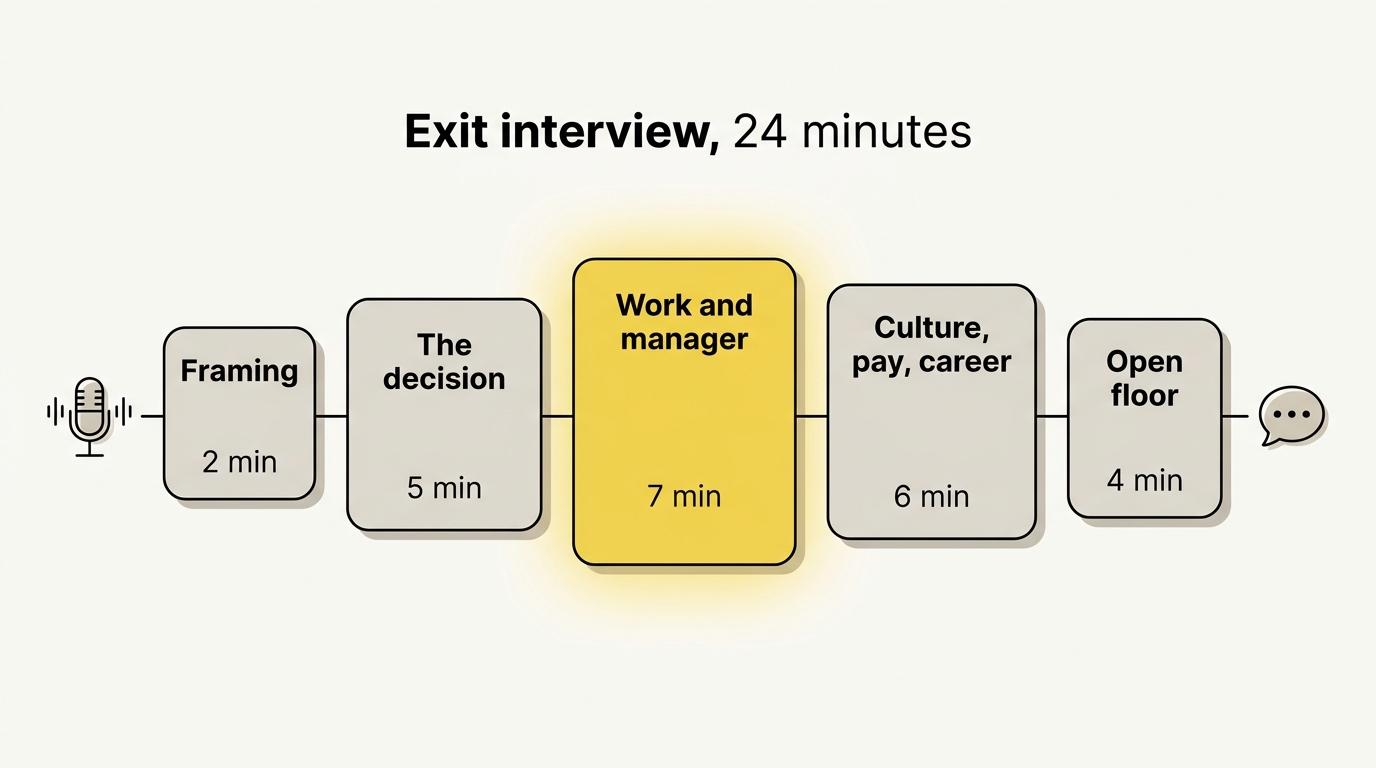
A workable exit interview has five blocks, live or asynchronous. It is an interview guide applied to someone leaving. The interview runs twenty to twenty-five minutes.
| Block | Time | What you are after |
|---|---|---|
| Framing | 2 min | State who will read this, what will be done with it, and that nothing affects the reference |
| The decision | 5 min | The trigger, the timeline, the one thing that would have changed it (questions 1 to 5) |
| The work and the manager | 7 min | Concrete situations rather than judgments (questions 6 to 15) |
| Culture, pay and career | 6 min | What was said versus what was experienced (questions 16 to 25) |
| Open floor | 4 min | The change they would make, the odds of a return, “what have I not asked” (questions 26 to 30) |
Two rules hold the format together. Ask about situations rather than people, so “tell me about a time a decision was made without you” rather than “was your manager bad at communicating”. And never ask them to name names, because the moment you do, everything after it gets careful.
If you want to run this as an asynchronous interview, the prompt version fits in a paragraph:
You are running an exit interview with someone leaving the company. Your goal is to understand precisely why they are leaving, what would have kept them, and what should change for the people staying. Cover the decision to leave, the relationship with their manager, the daily work, the team culture, pay and career progression, and what they would change first. Ask about specific situations rather than opinions, and follow up whenever an answer stays general. Never ask them to name colleagues. Stay neutral, never defend the company. Close by asking what you should have asked.
Paste that into Raconte, adjust two or three lines to your context, and the interview is ready to send.
Reading the answers across several departures
A single exit interview tells you about one person. Ten of them, read together, tell you about the company. This is where the practice either pays for itself or becomes filing.
Three habits make the difference. Keep the question set stable, because comparison only works if everyone got roughly the same prompts. Tag every answer against a small fixed list of causes, something like manager, workload, pay, career path, product direction, commute, and refuse the catch-all “personal reasons” bucket. Then read by segment rather than in bulk: departures within the first year say something different from departures at year four, and one team’s numbers can hide inside a healthy company average. If you run a social barometer, compare the causes of departure in a team with that team’s scores. When someone leaves over workload in a team that already rated its workload low, you know the problem also concerns their colleagues. For the people who stay, a short quarterly interview per team can explain what an engagement survey score leaves out.
The threshold for acting is lower than people assume. Four exits from the same team citing the same missing feedback loop is enough to act on, and it is exactly the pattern the HBR research opens with. Compare those patterns with your new hire survey answers too: a complaint that shows up on the way in and on the way out goes first.
Exit interview or stay interview?
Exit interviews diagnose. Stay interviews prevent. Running only exit interviews means every lesson arrives from someone already gone.
| Exit interview | Stay interview | |
|---|---|---|
| When | After the resignation | While the person is staying, twice a year |
| Who asks | HR or a skip-level manager | The direct manager, usually |
| What you learn | Why this person left | What would make this person leave |
| Who it helps | The next hire | The person in front of you |
| Candor | High, if the format protects it | Variable, depends on trust |
Both are worth running, and the questions overlap more than you would think. Questions 3, 13, 23 and 26 work almost unchanged in a stay interview, and asking them of someone who is not leaving is the cheapest retention work available.
Getting started
Pick fifteen questions from the list, decide who asks and when, and commit to reading every batch of answers together rather than one by one. That alone puts you ahead of the more than two thirds of executives who cannot name a single action that came out of an exit interview.
If the scheduling is what has been stopping you, you can drop it entirely. Write the interview once, send a link, and let people answer when they have a moment. The first 60 interview minutes each month are free, no credit card, and the pricing page has the rest. The getting started guide has your first interview out the door in a few minutes.
Frequently asked questions
What is an exit interview?
An exit interview is a structured conversation with an employee who is leaving, run between their resignation and their departure or shortly after, to understand why they are leaving and what the company should change. It is one of the few moments where a person has little to lose by being direct.
Who should conduct the exit interview?
Avoid the direct manager the person may be leaving because of. Harvard Business Review research found that second-line managers, meaning the manager of the direct manager, collect more honest feedback. HR works too, provided the person trusts that the notes will not come back at them. An asynchronous format removes the question entirely, since nobody is in the room.
How long should an exit interview last?
Twenty to twenty-five minutes is enough for fifteen to twenty questions with real follow-ups. Beyond thirty minutes, answers get shorter rather than deeper.
Are exit interviews mandatory?
No, they are a voluntary practice in most countries, and participation is one of the main obstacles. Making them easy to complete, asynchronous rather than scheduled, does more for the completion rate than making them a formal step in the offboarding checklist.
What should you not ask in an exit interview?
Avoid anything that asks the person to name and blame colleagues, anything that invites them to rate individuals on a scale, and any question you would be tempted to argue with. The moment the interview turns into a defense of the company, candor stops.
What not to say at an exit interview?
People leaving usually keep three subjects out of the conversation: the manager’s name, the pay on the offer they are leaving for, and anything the company could hold against them in a reference. Nobody owes you those answers. If you are the one running the interview, read what you get knowing those three subjects are absent from it.
Do people answer honestly in an exit interview?
Less often than companies assume, because most people protect their reference and their last two weeks. Candor improves when the interviewer is not the person being discussed, when the conversation happens after the last day, and when the format lowers the social stakes. Research in Computers in Human Behavior found people disclose more and self-censor less when they know they are talking to a machine.

