
The social barometer: what a workplace climate survey measures, what to ask, and how often to run it
A social barometer tracks how employees see their work. Read it with your HR figures, adapt our sample questionnaire and collect the reasons behind the scores.
October 9, 2026
Godefroy
- A social barometer measures what employees think of their work. Read it next to the HR figures you already have, such as absenteeism and resignations, or you cannot tell whether a perception matches a real problem.
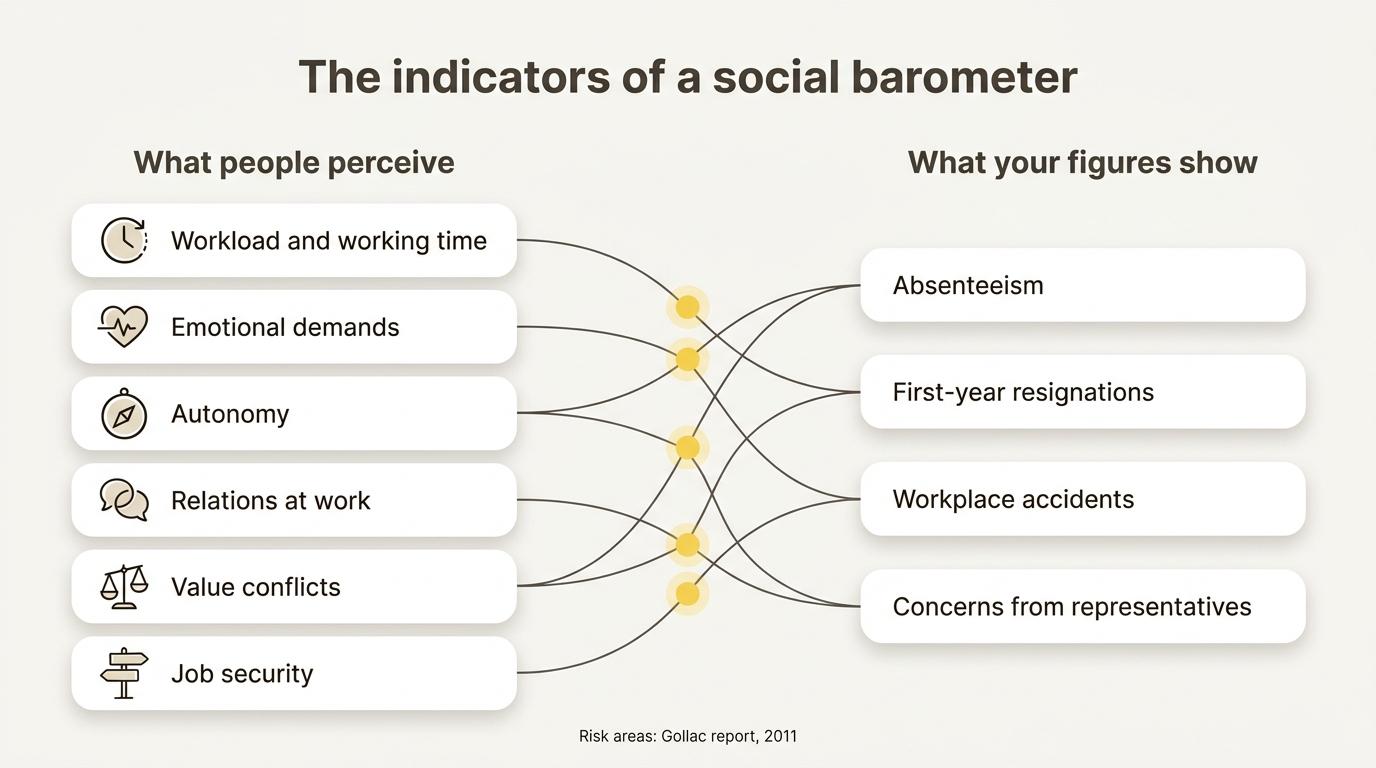
- Build the questionnaire on the six areas of psychosocial risk (workload, emotional demands, autonomy, relations at work, value conflicts, job insecurity), then keep the exact same wording from one round to the next.
- An annual score does not say what to change. Managers get it two or three months after the events, it averages very different teams together, and it gives no reason.
- A short voice interview on the lowest-scoring topic collects the reasons from a whole team. A voice can be recognised, so before you send the link, present the interview as confidential and say who will listen.
- One full barometer a year, or every two years, is enough, as long as you publish what was decided within two months of each round.
A social barometer is a recurring internal survey, usually anonymous, that a company runs at fixed intervals (often every year or every two years) to measure what employees think of their workload, their manager, their working conditions and where the company is heading. The term comes from French HR practice, where baromètre social is the standard name for a workplace climate survey. It tracks the social climate over time and shows in which teams the climate is getting worse, but its scores do not say why. To decide what to change, read them against your HR figures and collect the reasons from the teams concerned, which a short interview does better than a comment box.
This article lists the indicators to track, gives a sample questionnaire with a note on each question, and says how often to run it so that you decide something after each round.
What a social barometer actually measures
A social barometer measures perceptions. When 40% of a team answers “disagree” to “My workload is reasonable”, you know those people feel swamped. You do not yet know whether the work grew, the team lost two people, or a new tool costs everyone an hour a day.
To find out, read the barometer next to what the company already measures: headcount, hires, leavers, absenteeism. The barometer adds how people experienced those facts. A drop in the workload score that comes with a rise in absenteeism in the same team deserves a closer look. An isolated drop may come from a reorganisation announced the day before the survey opened.
People often mix up a social barometer and an employee engagement survey. An engagement survey measures the effort people put into their work and whether they want to stay. A social barometer covers more ground: working conditions, health, labour relations, trust in management. Many companies run both in the same questionnaire.
| Social barometer | Engagement survey | HR indicators | |
|---|---|---|---|
| What it measures | How people perceive working conditions and climate | Effort and intent to stay | Facts: leavers, absences, accidents |
| Source | Employee questionnaire | Employee questionnaire | Payroll, HR system, filings |
| Usual frequency | Every year or every two years | Once or twice a year | Continuous, consolidated yearly |
| Limit | Gives no reasons | Gives no reasons | Arrives after the fact |
No law requires a social barometer. Most employers, though, have a duty to protect their employees’ mental health and to assess psychosocial risks. In France, the duty comes from article L4121-1 of the Labour Code. French employers must also record psychosocial risks in a mandatory written risk assessment. A well-built barometer feeds straight into that assessment, which is often enough to justify its budget.
The indicators that matter
The indicators of a social barometer fall into two families: the ones you calculate from your own data, and the ones you measure with the questionnaire.
Take the factual indicators from your HR data:
- the absenteeism rate, team by team
- the resignation rate, and above all resignations in the first year
- workplace accidents and visits to occupational health at the employee’s request
- concerns raised by employee representatives
In France, the insurer Malakoff Humanis measured an absenteeism rate of 4.3% in the private sector in 2025, the highest level since 2019. Its survey ranks mental health problems among the three leading causes of long sick leave.
The soundest grid for perception indicators comes from a 2011 report to the French Ministry of Labour by an expert panel chaired by the sociologist Michel Gollac. The report sorts psychosocial risk factors into six areas. Build the questionnaire on those six areas: you then cover every risk factor the report identifies and can copy the results straight into your risk assessment.
| Risk area (Gollac report) | Statement to rate | Factual indicator to compare |
|---|---|---|
| Work intensity and working time | ”My workload is reasonable.” | Overtime, absenteeism |
| Emotional demands | ”I can do my job without hiding how I feel.” | Long sick leave, incidents with the public |
| Autonomy | ”I can organise my work the way I see fit.” | First-year resignations |
| Social relations at work | ”My manager helps me when I need it.” | Internal transfer requests, concerns raised by representatives |
| Value conflicts | ”I can do quality work.” | Customer complaints, rework |
| Job insecurity | ”I know what my role will look like in two years.” | Resignations, ongoing reorganisations |
Sample social barometer questionnaire, with notes
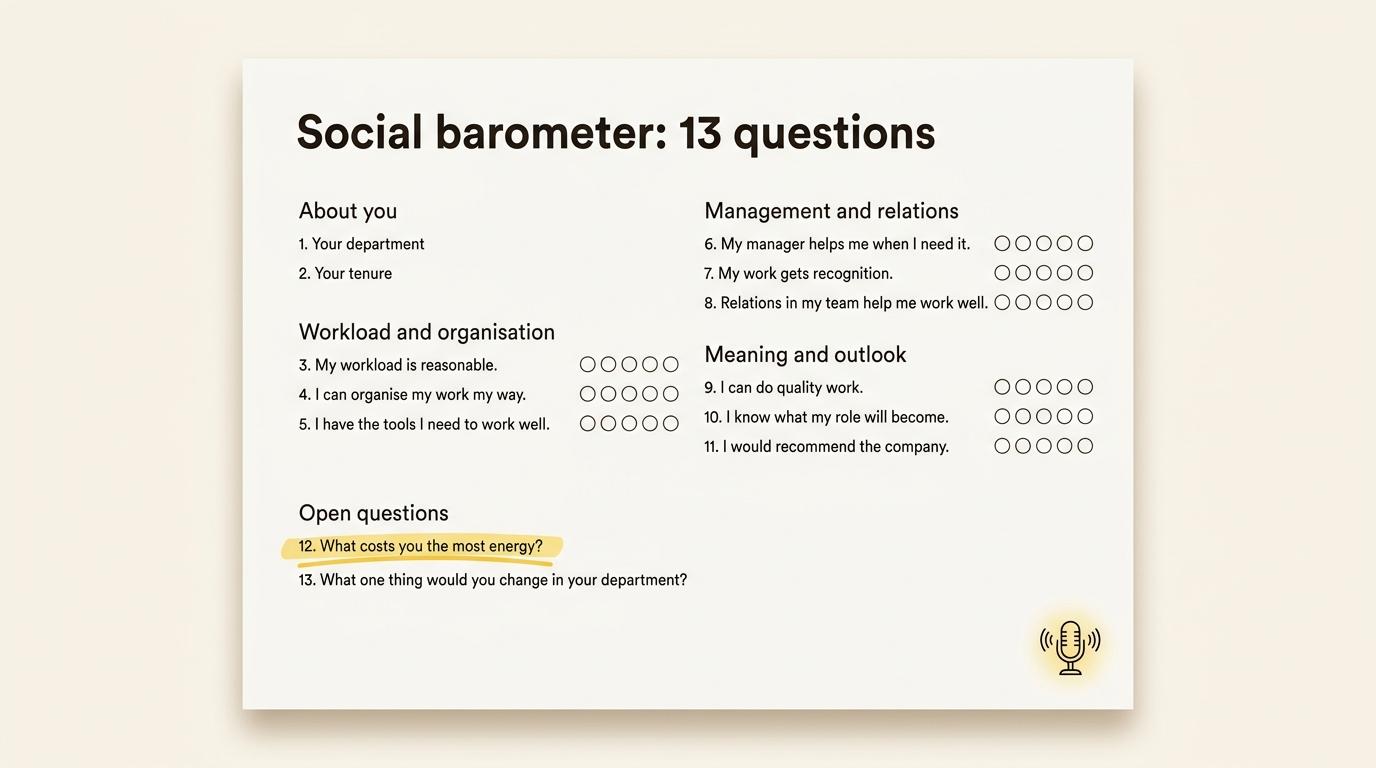
This short questionnaire, to adapt to your company, takes under fifteen minutes. It covers five of the six areas of the Gollac report. If your teams deal with the public, add the statement on emotional demands, “I can do my job without hiding how I feel”. Statements are rated on a five-point scale, from “Strongly disagree” to “Strongly agree”. The note under each block explains the wording.
About you
- Your department (closed list, no group under five people).
- Your tenure: under one year, one to five years, over five years.
Do not ask for age, gender or exact job title. Every profile question shrinks the groups. In a team of eight, three criteria are already enough to recognise someone. Keep only what you will actually cross-tabulate.
Workload and organisation
- My workload is reasonable.
- I can organise my work the way I see fit.
- I have the tools and information I need to do my job well.
Each statement covers one topic. “My workload is reasonable and my goals are clear” asks two questions, so nobody can tell which one the respondent answered.
Management and relations
- My manager helps me when I need it.
- My work gets the recognition it deserves.
- Relations in my team help me do good work.
These three statements target the team and the direct manager, where action is possible. “Senior management listens” yields a score nobody in the team can move.
Meaning and outlook
- I can do quality work.
- I know what my role will look like in two years.
- I would recommend the company to a friend as an employer.
Question 9 picks up value conflicts without using the word. Question 11 is an eNPS (employee Net Promoter Score) question, which many companies track year on year.
Open questions
- What costs you the most time or energy in your work?
- If you could change one thing in your department, what would it be?
Two open questions are enough, since most respondents skip them and those who do answer usually write only a few words. When a survey mixes open and closed questions, concrete open questions like these get better answers than a final “Any other comments?”. If you expect one statement to score low, swap one of these two open questions for the one that goes with that statement in a set of employee survey questions.
Once the questionnaire is live, do not touch the wording. A statement reworded between rounds gives a score you can no longer compare with the previous round. Yet comparing rounds is the whole point of a barometer.
Why annual scores change nothing
Most social barometers end in a slide deck, an action plan and few visible changes. The questionnaire is rarely the problem. The problem is what managers receive: a score.
Managers see that score late. Between the survey closing, the processing and the presentation to the leadership team, two or three months often go by. A manager finds out in March about a problem the team felt in November, whose cause may already have changed.
An average hides the gaps. A 3.2 out of 5 on workload for a whole department can combine one comfortable team and one at breaking point. The finer you slice the results, the smaller the groups get, and the sooner you fall below the anonymity threshold.
A score holds no reason. A manager who reads “Recognition: 2.7” cannot tell whether the problem is pay, a missed promotion, or a client who never thanks anyone. The manager therefore picks the most general action, an offsite or a charter, so next year’s score does not move.
When nothing changes after a round, employees notice, so fewer of them take part in the next one.
Collecting qualitative answers at scale without breaking anonymity
To learn why a score dropped, you need to ask the people concerned and be able to follow up on their answer. With the usual methods, you only get detailed reasons by giving up anonymity or volume.
| Method | Reasons collected | Possible volume | Anonymity |
|---|---|---|---|
| Open question in the barometer | A few words, rarely an example | The whole workforce | Anonymous |
| Focus group run by HR | Rich, but shaped by the group | One or two teams | None |
| One-to-one interviews by a consultancy | Rich and detailed | A few dozen people | Confidential |
| Asynchronous voice interview | A story, followed up when it stays vague | A whole team or department | Confidential |
An AI-led voice interview sits between the open question and the consultancy interview. Each employee opens a link and talks for five to ten minutes when they have a moment. Whenever an answer stays general, the AI follows up, the way an interviewer would. You get one transcript per person, with examples and context, across a whole team within a week.
A voice interview is confidential rather than anonymous, because whoever listens to a recording may recognise a colleague’s voice. For people to speak freely, set these rules before you send the link:
- Ask for neither name nor email on the entry form, so no identity is collected.
- Have someone in HR outside the team’s reporting line listen. Name their role in the invitation.
- Pass themes and paraphrased quotes to the manager, never a raw transcript.
- Only run the interview with a team of at least five people, the same threshold as the barometer.
With Raconte, an AI voice interview tool, you write what the interview should cover, then turn on a reusable share link and post it in the team’s channel. The link can ask for neither name nor email, sit behind an access code, stay open between two dates and close after a set number of answers. For each interview you get the transcript, the audio, a summary and the sentiment of each answer. Raconte delivers interviews one by one and does not produce a report comparing them: to read a whole round, connect an AI assistant to the MCP server and ask it for the recurring themes, or run a thematic analysis by hand. Interviews run in English or French.
Copy this interview brief when the barometer flags a drop on workload:
You are running a short, confidential interview with an employee about their workload. The latest social barometer shows that their team finds the workload too heavy. Your goal is to understand what makes it heavy. Ask them to describe their last busy week and what filled it. Ask which tasks feel pointless or badly shared out. Whenever an answer stays general, ask for a recent example. Never ask them to name a colleague, and do not defend the company. After about seven minutes, ask which change would help them most, then wrap up.
If 80 people in a department of 150 answer, at seven minutes each, the round comes to 560 minutes. The first 60 minutes each month are free. The remaining 500 are billed at $0.12 a minute, so the round costs $60.
How often should you run a social barometer?
A full barometer once a year is enough to follow a trend, and every two years in a stable company. If you run it more often, you wear people out without learning much more, since a social climate moves slowly. What makes the difference is what happens between rounds:
- The barometer runs once a year, always in the same period, away from reorganisations and annual reviews.
- Within a month, HR identifies the lowest-scoring area and the teams where it dropped most.
- Within six weeks, HR sends those teams a five to ten minute interview on that area.
- Within two months, a message to all employees says what came out, what will change, and what was ruled out and why.
- Six months later, HR sends the same teams a second short interview to check whether they feel the change.
graph TD
  A[Annual social barometer] --> B[Identify the lowest area and the teams concerned]
  B --> C[5 to 10 minute voice interview on that area]
  C --> D[HR reads the transcripts]
  D --> E[Message to everyone: what we heard, what changes]
  E --> F[Follow-up interview six months later]
  F --> A
With this rhythm, the next barometer measures the effect of a decision that was made and announced. Stay interviews held twice a year work on the same principle, asking people while you can still act: they look for the reasons people stay before those reasons disappear. For people who joined less than three months ago, a day-30 new hire survey tells you more than the annual barometer.
Before launch, walk your employee representatives through the barometer. In France the works council (CSE) has a say on health and working conditions and knows each department’s sensitive topics. Employees also trust a barometer more when their representatives saw it first.
Where to start
If you have never run a barometer, start from the questionnaire in this article, cut it down to what you will actually cross-tabulate, and set the date of the results message before the survey goes out. If you already have results, pick the lowest-scoring area, write a seven-minute interview from the workload brief, and send it to the team concerned. Read the transcripts before you write the first slide.
With Raconte, the first 60 minutes of interview each month are free, no credit card needed. They cover a first round with a small team. After that, you pay per interview minute.
Frequently asked questions
What is a social barometer?
A social barometer is a recurring internal survey, usually anonymous, that measures what employees think of their working conditions, workload, management and company. Because the questions stay the same from one round to the next, it shows how the social climate changes and in which teams it gets worse. The term comes from France, where it is the usual name for a workplace climate survey.
What is a social barometer for?
It spots the teams where the climate is getting worse, tracks the effect of decisions made since the last round, and feeds the psychosocial risk assessment. It does not say why a score drops, so it works best alongside a way to collect the reasons, such as a short interview with the teams concerned.
What indicators does a social barometer use?
It uses two families. Perception indicators come from the questionnaire and usually cover the six areas of the Gollac report: workload and working time, emotional demands, autonomy, relations at work, value conflicts and job insecurity. Factual indicators come from your HR data: absenteeism, resignations, workplace accidents, concerns raised by representatives. Read them together, team by team.
Is a social barometer mandatory?
No. No law requires a company to run one. In France, employers must protect their employees’ physical and mental health and assess psychosocial risks in a written risk assessment. A barometer is one of the most common ways to feed that assessment.
How many questions should a social barometer have?
Aim for 15 to 40 statements to rate, plus two open questions, for 10 to 15 minutes of answering time. Beyond that, respondents pay less attention to the last questions. Keep only one or two profile questions to protect anonymity in small teams.
How do you keep a social barometer anonymous?
Hide the results of any group with fewer than five respondents, limit profile questions, run the survey through an outside tool or provider, and say before launch who will see what. Never pass raw answers to open questions to the team’s manager. A voice can be recognised, so present a voice interview as confidential rather than anonymous.


