
20 stay interview questions, and when to actually ask them
A stay interview question bank grouped by theme, a form you can copy, the cadence that works, and why the direct manager is often the wrong person to ask.
August 10, 2026
Godefroy
- Three quarters of departures are preventable. The information existed while the person was still on the payroll, and nobody went and asked for it.
- A stay interview is a twenty to thirty minute conversation with someone who is still here, about why they stay and what would make them leave.
- Running the same set of questions at a fixed cadence turns individual answers into a trend you can act on.
- Keep the conversation clear of performance review week, or people answer the reviewer rather than the question.
- The manager accounts for around 70% of the difference in engagement between two teams, which makes them a hard person to be candid with about it.
By the time someone hands in their notice, you are months late. The decision happened slowly, out of sight: a project handed to someone else, a promotion conversation that kept sliding, a quarter without a single piece of feedback. None of it showed up in the engagement survey, because engagement surveys ask about the company and people leave over their Tuesday.
Work Institute, an American firm that studies employee retention, analysed more than 120,000 exit interviews for its 2025 Retention Report and put 75% of departures in the preventable column. Preventable means the information existed while the person was still on the payroll. Nobody went and asked for it.
The stay interview is the conversation that goes and asks.
What a stay interview is, and why it lands before the resignation
A stay interview is a scheduled one-on-one with an employee who is not leaving, dedicated to two questions: why do you stay, and what would make you go. It runs twenty to thirty minutes. It carries no rating, stays out of the HR file and out of the performance review cycle. Richard Finnegan built the practice into a method in his book The Stay Interview, and SHRM has been pushing it into HR playbooks ever since.
It differs from a good weekly one-on-one on two points. It is scheduled as its own conversation, so the agenda cannot get eaten by a sprint review. And it ends with something written down that the manager owes back, which is what stops it turning into a pleasant chat with no consequence.
Gallup found that 51% of people who quit voluntarily had not discussed their job satisfaction or their future with any manager in the three months before they resigned. Three months is a long time. It is enough time to fix a workload problem, unblock a promotion, or move someone off a project they have quietly hated since March.
Stay interview or exit interview
Both are worth running, and they answer different questions.
| Stay interview | Exit interview | |
|---|---|---|
| When | Twice a year, while the person is here | After the resignation |
| The question | What would make you leave | Why did you leave |
| Who benefits | The person in the conversation | The next hire |
| What you can act on | This person’s workload, manager, path | Patterns across many departures |
| Candor | Depends on who is asking | High, once the reference is safe |
| Cost of getting it wrong | You confirm a problem and do nothing | You hear about the problem from someone already gone |
Running only exit interviews means every lesson arrives from people who have already gone. Stay interviews on their own leave out the sentences people say once they have nothing left to protect. The two sets overlap by design, and a good half of the questions below have an exit interview twin.
20 stay interview questions, grouped by theme
Pick ten to twelve for a given conversation. Keep the same set from one round to the next, because the value comes from comparing an answer to the same answer six months earlier.
Why they stay
- What would you miss if you left tomorrow?
- What makes a good day here a good day?
- What keeps you here that has nothing to do with the pay?
- If a recruiter called you this afternoon, what would make you take the call?
- What are you learning here right now?
The work itself
- Which part of your week do you look forward to?
- Which part of your week feels like a waste of your time?
- What do you need to do your job well that you do not have?
- Where are you working around a process instead of working?
- How much of your job today looks like the job you were hired for?
The manager, recognition and the path
- When was the last time your work was recognised in a way that mattered to you?
- What kind of feedback do you get from me, and is it the kind you need?
- What do I do that gets in your way?
- What does the next step look like from where you sit?
- Who here has helped you get better at your job this year?
The leaving signal
- When was the last time you thought about leaving, and what prompted it?
- What would have to change for you to still be here in two years?
- Is there anything about your job you have stopped mentioning because nothing happened?
- If you were me, what would you fix first for this team?
- What have I not asked that I should have?
Question 16 is the one people skip because it feels rude to ask. It is the single most useful question in the list, and SHRM keeps it in its short set for exactly that reason. Asking it out loud gives permission to answer it.
“Everything is fine” is not data. Follow it with a specific: what was the last thing that annoyed you, when did it happen, what did you do about it. A stay interview that produces five polite answers and no examples has told you that the person does not yet trust the format.
Twice a year rather than once
Once a year lands the conversation on the same rhythm as the performance review, and it is too slow for a problem that builds in a quarter. Add two extra conversations in the first year: one at day 30, when the gap between the promised job and the real one is still fresh, and one at day 90, before it hardens into a resignation. At day 30, the same conversation can double as a new hire survey on what surprised them when they joined.
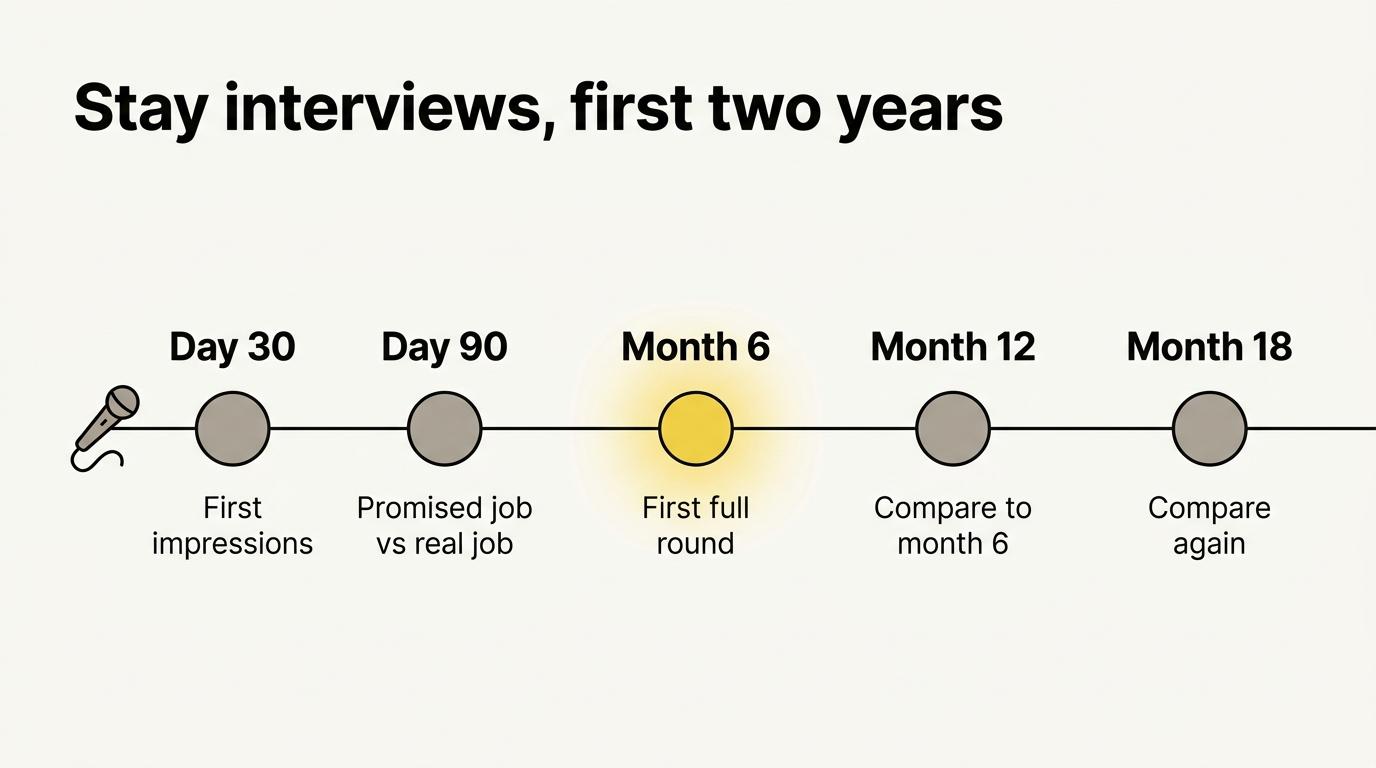
Keep the stay interview out of review week. The moment a stay interview sits next to a rating, people answer the rating. Some companies run them quarterly, which is defensible in a high-turnover operation and exhausting anywhere else.
Who should ask, and the problem with the manager
The standard answer is the direct manager, and it holds up. The manager can act on most of what comes up, and having to answer question 13 in person is good for them.
Still, Gallup’s analysis of 2.7 million employees attributes 70% of the variance in team engagement to the manager. So the single most likely reason someone leaves is sitting in the chair opposite, holding the question list. Asking “what do I do that gets in your way” is a genuinely hard question to answer to someone’s face, in a conversation they will remember at your next salary review.
You can put distance between the two roles in three ways. Have the skip-level manager run one of the two rounds a year, so the manager gets described to someone who is not their peer. Have HR run it for teams where the relationship is already tense. Or take the room out of the equation and let people answer with nobody watching.
A stay interview form you can copy
The written trace matters more than the conversation. The whole form is seven fields on one page.
| Field | What goes in it |
|---|---|
| Person, role, tenure | Plus the date of the previous stay interview |
| Why they stay | Their own words, quoted, not summarised |
| Leaving risk | Low, medium or high, and the sentence that made you pick it |
| Blockers named | The concrete obstacles, one line each |
| What they want next | Skill, scope or role, with their timeline |
| What I commit to | One to three actions, each with an owner and a date |
| Next conversation | The date, set before this one ends |
The written commitment and the date of the next conversation do the work. A stay interview that ends without a commitment teaches the person that talking changes nothing, which is worse than never having asked. One real action beats five vague intentions.
If you would rather run it as a written or spoken prompt than as a live meeting, this version holds the same ground:
You are running a stay interview with someone who currently works at the company and is not leaving. Your goal is to understand what keeps them here, what frustrates them, and what would make them consider leaving. Cover what they would miss if they left, the parts of the week they look forward to and the parts they resent, what they need and do not have, the feedback and recognition they get, and how they see the next step in their career. Ask when they last thought about leaving and what prompted it. Ask for specific recent examples rather than general opinions, and follow up whenever an answer stays vague. Never argue with an answer or defend the company. Close by asking what you should have asked.
Covering forty people without spending forty hours
Forty people, twice a year, thirty minutes each, is forty hours of conversation before anyone schedules anything. The scheduling is the part that kills the practice: three reschedules, a quarter-end, and the second round never happens.
This is why we built Raconte. You write the interview once as a prompt, then you send a link. The person opens it in their browser when it suits them, and talks. The AI listens, follows up when an answer deserves it, and stops when it has what you asked for. Nobody books anything. The ten exit interview tools we compared also work for stay interviews once you change the questions.
Two things change beyond the logistics. Voice keeps the texture a form flattens, the pause before naming a problem, the example that arrives three sentences after the answer. And talking to a machine lowers the social cost of saying something awkward: research published in Computers in Human Behavior found that people disclose more and self-censor less when they know their counterpart is not human. Question 13 gets a real answer when the manager is not in the room to hear it.
You get the transcript, per-message sentiment and a summary a few seconds after each interview ends, which means the manager reads answers instead of taking notes. Across a team, the same question asked twice a year turns into a series you can compare. If your HRIS should receive it, the API and MCP integrations push it there without a manual export.
Getting started
Pick ten questions, decide who asks and when the second round happens, and commit to one written action per conversation. Send the day 30 and day 90 interviews to everyone who joined in the last quarter, because that is where the preventable departures are densest.
The first 60 interview minutes each month are free, no credit card, and the pricing page covers the rest. The getting started guide has your first interview out the door in a few minutes.
Frequently asked questions
What is a stay interview?
A stay interview is a scheduled twenty to thirty minute conversation with an employee who is not leaving, about why they stay and what would make them leave. It carries no rating and sits outside the performance review cycle, and it ends with one or two written commitments from the manager.
What is the difference between a stay interview and an exit interview?
A stay interview happens while the person is still here and asks what would make them leave, so you can act on the answer for that person. An exit interview happens after the resignation and asks why they left, which helps the next hire rather than the person answering. Most companies run only the second one and learn every lesson too late.
How often should you run stay interviews?
Twice a year for everyone, plus a conversation at day 30 and one at day 90 for new joiners. Once a year is too slow for a problem that builds in a quarter, and quarterly only makes sense in a high-turnover operation. Keep them out of the week the performance reviews land.
Who should conduct a stay interview?
Usually the direct manager, because they can act on most of the answers. The limit is that the manager is also the most common reason people leave, which makes some questions hard to answer to their face. Alternating with the skip-level manager, or running the interview asynchronously with nobody in the room, gets you the answers the direct manager cannot collect.
Should you be honest in a stay interview?
From the employee side, be specific rather than sweeping. “The scope of my role shrank when the team split in March” is something a manager can act on, and it does not read as a threat. Broad complaints about the company invite a defensive answer, and staying silent gets recorded as satisfaction.
What do you do with the answers?
Write one to three actions per conversation, each with an owner and a date, and tell the person what happened at the next one. Then read the round as a whole: the same blocker named by four people on the same team is a management problem, even if it reaches you as four separate conversations.

