
Employee engagement surveys: what the score measures, and the reasons it leaves out
What an employee engagement survey measures, why response rates fall, why few people write a comment, and the quarterly voice interview that explains a score.
October 7, 2026
Godefroy
- An engagement survey shows which team scores low and on which theme. It cannot show why, because a rating scale has no room for a reason.
- Response rates fall when people saw nothing change after the last round, much more than when they are surveyed too often.
- Most people skip the comment box at the end of a survey. When someone does write a comment, nobody can go back to its author, who is anonymous.
- A short voice interview every quarter, on the theme the survey flagged, collects the reasons behind the score. Keep the survey for the trend.
- Colleagues can recognise a voice, so a voice interview is confidential rather than anonymous. Say who will listen to the recordings before you send the link.
An employee engagement survey is a recurring questionnaire, usually anonymous, that asks every employee to rate statements about their work, their manager and the company, so you can see which teams are engaged and which are losing interest. Its scores show where engagement dropped and on which theme, but never why. The comment box at the end is supposed to collect the reasons, yet most people skip it. A short voice interview every quarter, on the theme the survey flagged, collects those reasons, as long as people know who will listen to the recordings.
Gallup’s State of the Global Workplace 2026 puts the share of engaged employees worldwide at 20% in 2025, its lowest level since 2020. The figure is 31% in the United States and Canada, the best region, and 12% in Europe, the worst. Most companies try to move that number with a survey once a year, a dashboard, and the same survey the following year.
What an employee engagement survey measures
Engagement is the effort and attention people put into their work beyond what the job strictly requires, along with their intention to stay at the company. Satisfaction is narrower: whether people are content with their working conditions. A satisfied employee can be comfortably disengaged. The reverse happens too: someone furious about their pay can still put everything into the work.
Most engagement surveys follow the same model. Gallup’s Q12, the best known, is twelve statements people agree or disagree with, from “I know what is expected of me at work” to “In the last seven days, I have received recognition or praise for doing good work.” Vendors add their own questions, but the same themes come back in all of them:
- clarity on what the job expects
- the relationship with the manager
- workload and the means to do the job
- recognition
- growth and the next step
- belief in where the company is going
You can copy employee survey questions for most of these themes. Each statement to rate comes with an open question to ask in an interview when its theme scores low.
Many surveys add an eNPS question (“How likely are you to recommend this company as a place to work?”), scored from 0 to 10. French companies often call their annual engagement survey a social barometer and add questions on working conditions and health.
What you get back is a score per theme and per team, compared with the previous round and with an industry benchmark.
| The survey shows | The survey cannot show |
|---|---|
| Which team scores low | What happened on that team |
| Which theme dropped | Which decision or event moved it |
| Whether the drop is new | Whether people think it can be fixed |
| How you compare with a benchmark | What people would change first |
| What share of the team answered | Why the others did not |
A rating scale has no room for a reason, the one thing a manager can act on. A score of 2.8 out of 5 on recognition shows that the team feels unseen. It does not show whether the problem is the manager, leadership, or a promotion round that passed over half the team.
Why response rates collapse after the second round
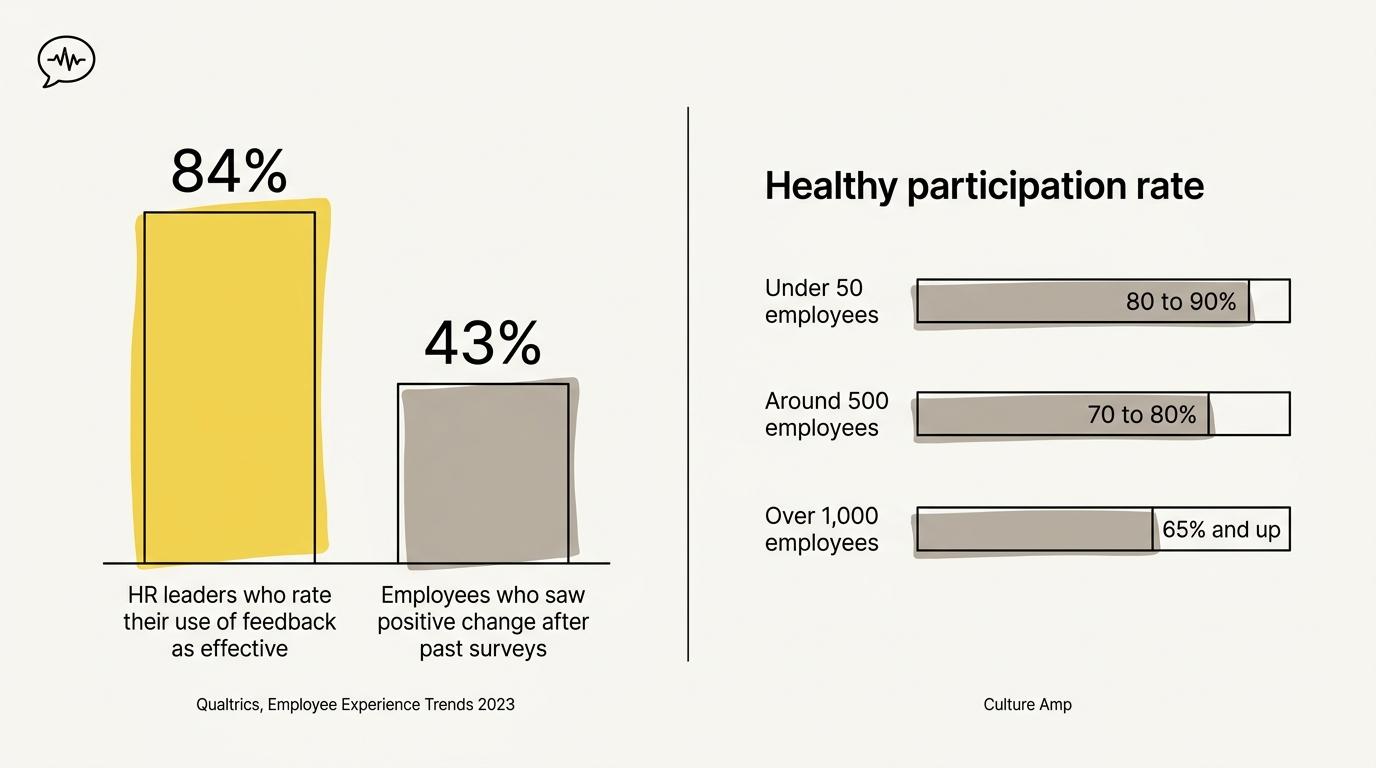
Culture Amp, an employee survey platform, puts a healthy participation rate between 65% and 85%, depending on size: 80% to 90% in a company under 50 people, 70% to 80% around 500, and about 65% as the floor above 1,000. It also treats 100% as a warning sign, since that rate usually comes with comments about being pushed to answer.
When the rate drops, the usual explanation is survey fatigue, meaning too many surveys. The data points to another cause. In Qualtrics’ 2023 Employee Experience Trends study, 84% of HR leaders rated their organisation’s use of employee feedback as effective, while only 43% of employees said they had seen positive change come out of previous surveys. In a Visier survey of 1,000 US employees published in February 2025, “my employer will not act on it” was the second most common reason for holding back an honest answer.
People stop answering when answering changed nothing last time. The first round gets a good rate because people believe in it. In the second round, they check whether they were right to. If you shorten the survey or move it to quarterly, people still get disappointed, only at a different pace, since nothing more gets done with their answers.
To bring participation back, act between rounds and let people see it. Send a message that names what the last survey found, what was decided, and what was dropped and why. It costs one email per round. Most companies still skip it, because the results deck took up all the time.
Why the comment box collects so few reasons
Every engagement survey ends with the same box: “Is there anything else you would like to tell us?” It is supposed to collect the reasons. In practice, it fails in three ways.
Most people skip it. In a 2017 study of 13,346 responses to an online service survey, published in Behaviour & Information Technology, more than 75% of respondents left every open-ended question blank. Even on a panel paid to answer surveys, the Pew Research Center, a US polling institute, finds that people skip far more open questions than closed ones. An employee who has just rated forty statements at the end of a Friday has less patience than a paid panel, so the comments that do come in are short: “management”, “pay”, “nothing to add”.
The comments that do get written are read too late, or never. In a company of a few hundred people, they all arrive in the same week, the week the results deck is due. The survey tool groups them into themes, so managers get a word cloud and three quotes. Nobody reads the comments one by one before deciding anything.
Nobody can follow up on any of them. An anonymous survey has no way to go back to the person who wrote “my manager” and ask what happened. An interviewer asks that question the moment someone says “my manager”. The reply usually gives the reason.
A voice interview every quarter, alongside the survey
Keep the survey. It gives every team a score you can compare from one year to the next, which no interview does. Over three years, that score becomes a trend worth having. Add a second tool, run between rounds, to collect the reasons.
We recommend this rhythm:
- The survey runs once or twice a year and flags the themes and the teams that moved.
- Each quarter, a five to ten minute interview goes out on the one or two themes the survey flagged. If recognition dropped on the support team, that becomes the subject of the interview.
- People answer out loud, whenever they have a moment. When an answer stays vague, the interviewer follows up.
- HR reads the transcripts and writes a message to employees about what came up and what will change.
- The message goes out before the next survey, so the next round measures the effect of a decision.
graph TD
  A[Engagement survey, once or twice a year] --> B[A theme or a team drops]
  B --> C[Quarterly voice interview on that theme]
  C --> D[HR reads the transcripts]
  D --> E[Message to employees: what we heard, what changes]
  E --> A
People say things out loud that they rarely bother to type: an example, the context, the moment the problem started. A follow-up question turns “management” into an account of what happened. Talking to software also makes it easier to say something awkward. Gale Lucas and her colleagues at the USC Institute for Creative Technologies found in 2014 that people disclosed more to a virtual interviewer when they believed it ran on its own than when they believed a person was operating it.
A workload or management problem often builds up over a few months, so an interview every quarter usually catches it before anyone resigns. For the same reason, we suggest running stay interviews twice a year rather than once. A stay interview is a one-on-one where a manager asks one employee what keeps them at the company. The quarterly voice interview covers a whole team and one theme, without the manager taking part.
| Annual survey | Pulse survey | Quarterly voice interview | Stay interview | |
|---|---|---|---|---|
| How often | Once or twice a year | Weekly to monthly | Every quarter | Twice a year |
| Time per employee | 10 to 20 minutes | 1 to 3 minutes | 5 to 10 minutes | 20 to 30 minutes |
| What you get | A score per theme and team | A few scores, fast | A transcript per person, with the reasons | One person’s blockers and leaving risk |
| Follow-up on a vague answer | None | None | The interviewer asks, live | The manager asks |
| Identity | Anonymous above a minimum group size | Anonymous | Confidential, the voice is recorded | Named |
| What it does best | Trend and benchmark | Catching a drop early | Explaining a score | Keeping one person |
Here is an interview prompt you can copy and adapt to the theme your survey flagged:
You are running a short, confidential interview with an employee about recognition on their team. The latest engagement survey showed that people on this team feel their work goes unnoticed. Your goal is to understand why. Ask when they last felt their work was noticed, and by whom. Ask about a recent moment when it was not. Ask what recognition would look like for them, concretely. Whenever an answer stays general, ask for an example. Never ask them to name a colleague. Never defend the company either. After about eight minutes, close by asking which single change would make the biggest difference, then stop.
Raconte, an AI voice interview tool, runs this kind of interview. You write the prompt, turn on a share link for the interview and post it in the team channel. Each person opens it in their browser and talks, while the AI follows up when an answer stays vague. For each interview you get the transcript, the audio, a summary and the sentiment of every answer. Raconte gives you the interviews one by one and builds no report across them. To compare the transcripts of a round, connect an AI assistant through the MCP server, or pull them through the API. Interviews run in English or French.
For a sense of cost, take 200 people, 60% of whom answer, at eight minutes each. That makes 960 minutes per round. With the 60 minutes offered each month, 900 minutes are billed at $0.12 a minute, about $108 a quarter.
Anonymity and trust
People hold back part of their answer when they do not trust the process. In the Visier survey, 37% of employees said they do not believe engagement surveys are ever really anonymous. Almost half (47%) said they often or occasionally feel pressured to withhold feedback. The topics people find hardest to answer candidly are overall job satisfaction (36%), leadership performance (33%) and the relationship with their manager (30%). Those three topics are exactly what an engagement survey is for.
These rules apply to the survey and to the interview alike:
- Say who sees what before anyone answers: which role reads individual answers, and which one only sees themes.
- Hide any group under a minimum size, commonly five people. In a small team, a detail in an answer can still give away its author, whatever the tool.
- Keep raw answers away from the manager of the team that gave them. Let HR read the text and pass only the themes on to the manager.
- Never try to work out who wrote what. One attempt that becomes known is enough for people to stop answering the next round.
A voice interview has one more limit than a survey. Whoever listens to the recordings may recognise a colleague’s voice. So a voice interview is confidential rather than anonymous. With Raconte, you can set the share link to ask for no name and no email, protect it with an access code and open it for a fixed window, so that no identity is collected. The voice is still on the recording. Decide who listens to the recordings, ideally someone in HR outside the team’s reporting line, then say so in the invitation. People speak more freely when they know who is listening.
People who leave need the same reassurance. An exit interview gets candid answers once the person knows who reads the transcript and that their job reference is safe. To pick a tool that runs them, we compared ten exit interview software options by who asks the questions.
Where to start
Before your next survey goes out, run through this list.
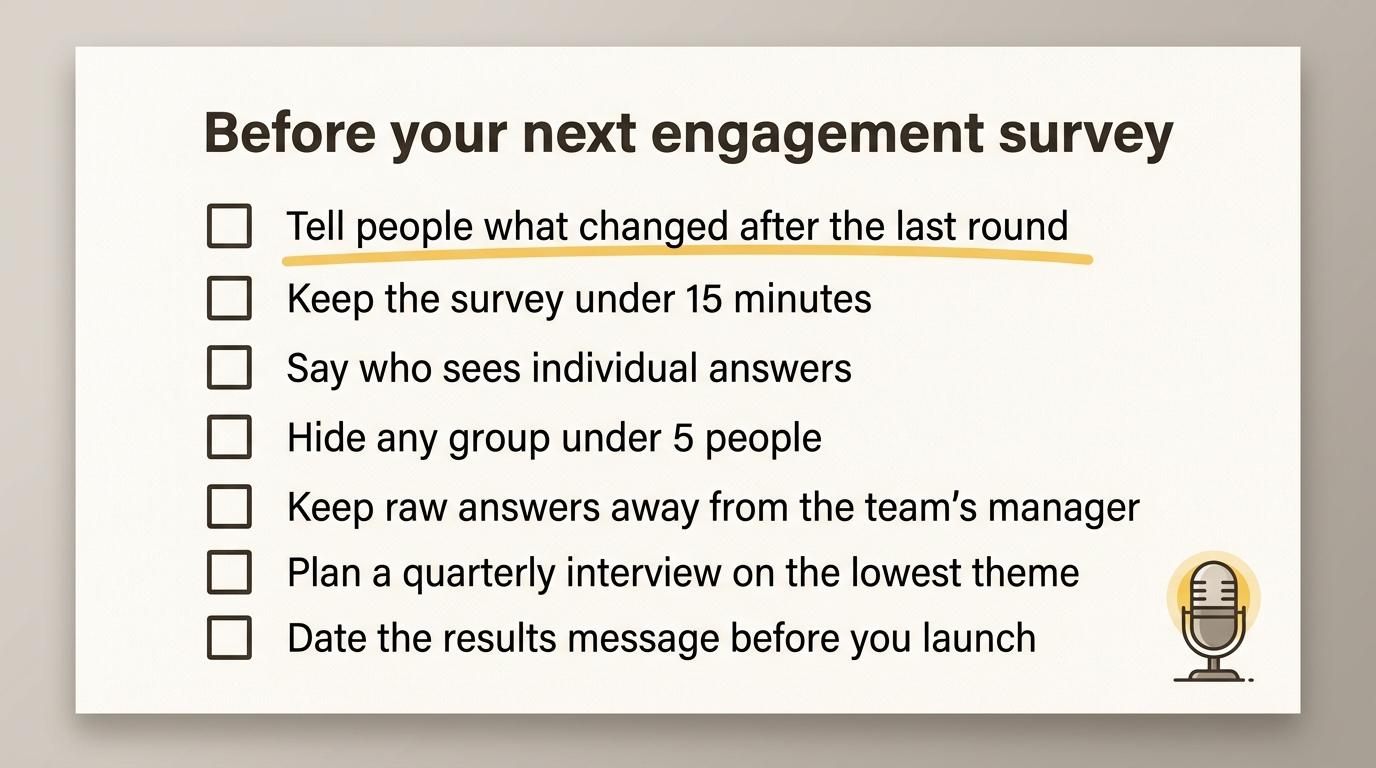
- Tell people what changed after the last round.
- Keep the survey under 15 minutes.
- Say who sees individual answers.
- Hide any group under five people.
- Keep raw answers away from the team’s manager.
- Plan a quarterly interview on the lowest-scoring theme.
- Set the date of the results message before you launch.
If you already have survey results, start with a single theme. Pick the one that scored lowest, write a five to eight minute interview about it with the prompt above, and send it to the team with the lowest score on that theme. Read every transcript before you write a single slide.
With Raconte, the first 60 interview minutes each month are free, with no credit card. That covers a first round on a small team. After that, you pay per minute of interview.
Frequently asked questions
What does an employee engagement survey do?
It measures, team by team, how engaged people are with their work, their manager and the company, usually through rated statements and one or two open questions. When you run it at a fixed rhythm, it shows which teams and which themes are moving. Its scores do not show why engagement dropped, so it works best next to a format that collects reasons, such as a short interview.
What are good questions for an employee engagement survey?
Cover the themes that come back in every model: clarity on the job, the manager, workload and resources, recognition, growth, and belief in the company’s direction. Phrase each as a statement to rate, such as “I know what is expected of me at work”. Keep the same wording from one round to the next so you can compare. Add one open question at most, because people answer a short survey with one open question more readily than a long one with five.
What are the 5 C's of employee engagement?
The 5 C’s are care, connect, coach, contribute and congratulate. In this framework, managers drive engagement by caring about their people’s wellbeing, building connections in the team, coaching rather than directing, showing how each person’s work contributes, and recognising good work. The framework has no single author, so each HR firm describes it a little differently. It is a management checklist rather than a survey method.
How often should you run an employee engagement survey?
A full survey once or twice a year is enough to follow a trend. Run it more often and people stop answering, unless they see action between rounds. Between two full surveys, a short pulse survey catches a drop early. Then a quarterly interview on the theme that dropped explains it.
What is a good response rate for an employee engagement survey?
Between 65% and 85% in most companies, according to Culture Amp: 80% to 90% under 50 employees, 70% to 80% around 500, and about 65% above 1,000. A rate of 100% is a warning sign, since it usually means people were pushed to answer. A rate that falls from one round to the next usually means people saw nothing change after the previous one.
How much does an employee engagement survey cost?
Dedicated engagement platforms usually charge per employee: Leapsome, for example, lists its engagement module at €4 per employee a month. A form tool costs little for a small company, but leaves the analysis to you. A voice interview with Raconte is billed by the minute of conversation, so an eight-minute interview costs about $1 once the 60 free minutes of the month are used.
Should an employee engagement survey be anonymous?
Yes, in most cases, because people soften their answers about their manager and leadership when their name is attached. Anonymity only holds if you hide groups below a minimum size, commonly five people, and keep raw answers away from the team’s own manager. Even then, 37% of employees in a 2025 Visier survey did not believe surveys are ever really anonymous, so say who sees what before people answer.


