
20 screening interview questions, and the follow-ups that make them work
Ask phone screening questions with the follow-up that makes each one work, run the call in fifteen minutes, skip the risky ones and copy the template.
October 28, 2026
Godefroy
Updated on November 17, 2026
- A screening interview is a ten to fifteen minute conversation with every candidate who clears your CV filter. It checks pay expectations, availability, must-have skills and real motivation before anyone books the full interview.
- Ask about pay, notice period and the right to work in the first four minutes of a phone screen. If one of them rules the candidate out, you can thank them and end the call there.
- A question is worth what its follow-up gets. "Tell me about your background" filters nothing until you ask why they left, and what they did next.
- Asking every candidate the same questions, in the same order, is what makes a screen comparable across a batch. It is also the most valid selection method ever measured, ahead of every test.
- Keep age, family, health and origin out of the question set. In France the law allows only questions that assess the candidate's ability to do the job. In the US, questions about protected traits are treated as evidence of discrimination.
- Letting a tool decide who advances is bad practice, one the EU is now regulating. AI can run the first conversation and summarize it. The decision stays with a human.
A screening interview is a ten to fifteen minute conversation, most often a phone call, with every candidate who clears your CV filter. It checks the practical knock-out criteria before anyone books the real interview: pay expectations, availability, must-have skills, work authorization, and whether the motivation goes beyond “I saw your ad”. The question lists are everywhere. What they skip is the part that filters, which is what you ask when the first answer comes back. This post gives you twenty questions with the follow-up for each, the seven that work best on a phone call and how to run that call, the questions that get employers in trouble, and a template to run the whole first filter without living on the phone.
The math is what pushes teams toward screens done badly. Forty applications came in, twenty are worth a look, fifteen minutes each. That is a full working day spent on calls where eight candidates tell you in the first two minutes that the salary does not fit. A good screen is where that day goes to die: one structured exchange per candidate, the same questions for everyone, read against a grid, and only the people who clear it moving to the full conversation.
What a screening interview is for
A screen has two jobs. The first is to eliminate early on the criteria that would kill the hire anyway: a salary gap the budget cannot close, a notice period the deadline cannot absorb, a missing must-have skill. The second is to check motivation, because a candidate who is passively browsing job boards wastes a full interview slot just as thoroughly as one who cannot do the work.
A screen also does a third job people forget: it is the candidate’s first real contact with your company. Six of your twenty will talk to a competitor the same week. A screen that respects their time is recruiting, even for the people you reject. Which means a fast, clear “no” is part of the tool, not a courtesy.
The structure is what separates a screen from a chat. Paul Sackett, an industrial-organizational psychologist at the University of Minnesota, and his colleagues re-analysed four decades of selection research in the Journal of Applied Psychology in 2022, correcting a statistical bias that had inflated older estimates. The structured interview came out first among all selection methods measured, predicting job performance at .42. The unstructured interview landed at .19. An improvised phone call costs the same time and predicts far less.
So: same questions, same order, every candidate, and a grid you wrote before sending anything. The twenty questions are built for that. Once someone clears the screen, the long conversation deserves the same care. Our guide covers how to build the full conversation.
The 20 screening interview questions to ask
Pick five to eight for the role, the same ones for every candidate in the batch, and keep the wording identical from one candidate to the next. The follow-up is where each question does its actual work: a first answer is rehearsed, a follow-up answer is not.
Background and trajectory
- Walk me through your career in two minutes. If you get a list of job titles, ask what made them leave each role and what they looked for in the next one. A good answer names decisions, not employers.
- Which role in your career is closest to this one, and what did a good week look like in it? Follow up on the parts of that week this role will not have. You are checking whether they know what they are applying for.
- What are you working on right now that this role would interrupt? The follow-up writes itself: how do they feel about leaving it unfinished? An engaged person answers differently from a checked-out one.
Motivation
- Why this role in particular? What made you apply today? When the answer is generic (“your company seems great”), ask what the second choice on their list would be, and why. A candidate who has none has not chosen you, they have landed on you.
- What do you know about us, and what would you want to know before accepting an offer? Follow up on whatever they say they know. You learn in one minute whether the research went past the homepage.
- What would make you turn down an offer for this role? People answer this one honestly more often than you would expect. It surfaces the real constraints early: commute, on-call hours, the title, the money.
- What are you looking for in your next role that you do not have today? The follow-up is the oldest one in the trade: “give me an example of when that was missing”. Generic answers stay generic in a full interview too.
Key skills
- Tell me about a specific piece of work you did that used [key skill]. Ask what their own part was, precisely. Someone on a team of eight who says “we rebuilt the pipeline” needs one more question: which part did you rebuild?
- What part of this job would be new for you? Follow up with how they learned the last new thing. You are measuring the learning curve you would be paying for.
- How do you rate yourself on [skill], and what would someone clearly better than you do differently? The self-rating tells you little. The second half tells you whether they have seen the next level up close.
- Tell me about a time a project you were on went wrong. What did you do? Follow up on what they would change now. The useful signal is ownership rather than the story itself.
Compensation
- What are your compensation expectations for this role? Ask it as expectations for this role, never as “what do you earn today”. If the number is off, follow up with the range you can actually offer, in the same call. A good share of the mismatches ends here, with nobody having wasted a full interview.
- Besides salary, what matters to you in the offer? Remote time, title, on-call load, learning budget. Follow up on whichever one they pick first, because that is the one that will decide.
Availability and logistics
- When could you start, and what is your notice period? The follow-up matters when the answer is vague: is the notice period contractual or negotiable? Some people can buy out their notice.
- Where are you based, and what would the commute or the remote arrangement look like for this role? Ask what their actual working setup is today. Someone optimistically planning a two-hour commute in week one will be job hunting again in six months.
- Do you have the right to work in [country] for this position? This one you may ask, in most jurisdictions, and should ask early. Work authorization is a knock-out criterion like any other.
Closing
- Is there anything about the role as described that does not fit you? Give the honest answer room to land. The follow-up is “how would you handle that part”.
- What would you want to ask me before the next step? The questions a candidate asks are data too. A question about the team’s roadmap and a question about whether the schedule is flexible are two different applications.
Two conditional questions
- Are you in other hiring processes right now? Where does the furthest one stand? Ask what would decide it if two offers landed the same week. A candidate already holding an offer changes your own timeline.
- This role involves [condition: on-call weeks, travel, on-site days]. How does that fit your week right now? Get concrete about what the condition means in a normal month. A mismatch found at the screen costs one conversation. After the hire, the same mismatch costs a replacement.
Keep the habit of open questions through the whole list: “how”, “what”, “tell me about”, and the follow-up on whatever stays general. Closed questions in a screen give you yes-or-no answers you could have collected in a form.
The questions to avoid
Age, family situation, pregnancy, health, origin, religion, union membership: keep them out of the question set, and out of the small talk before and after.
In France, Article L1221-6 of the Code du travail draws the line: an employer may only request information that assesses the candidate’s capacity to occupy the position or their professional aptitude. The public service documentation lists what falls outside it: health, family situation, pregnancy, union activity, religion, housing, leisure. A candidate refused for one of the 25 criteria listed in the Labour Code can take the employer to the labour tribunal. A question asked “for information only” still counts.
In the US, no federal statute bans the question itself, but the EEOC’s position is that questions about protected characteristics are never needed to assess ability, so asking them is treated as evidence of intent to discriminate. Several states go further and ban the inquiry outright: New York prohibits pre-employment questions about age, marital status and arrest record, Wisconsin does the same for marital status and age. Salary history questions are off-limits in a growing list of states and cities, California and New York included. Age may be asked in one form only, verifying a legal minimum, as in “are you over 18”.
The safe rephrasing rule is the same in both countries. Ask about the ability to do the job, never about the person’s situation: “this role requires being on call one weekend in four, does that work for you” rather than “do you have children”. None of this is legal advice. It is the boundary the twenty questions already respect.
Phone screening questions: 7 of the 20 work on a call
On a phone screen you have fifteen minutes and no face to read, so the questions that work best get a short answer you can test with one follow-up. Seven of the twenty fit that bill and make a complete phone screen on their own. They are listed in the order you ask them:
- the compensation expectations (question 12)
- the notice period and start date (question 14)
- the right to work in the country (question 16)
- why this role in particular (question 4)
- what would make them turn down an offer (question 6)
- one specific piece of work that used the must-have skill (question 8)
- what they want to ask you before the next step (question 18)
Questions 2, 10 and 11 work less well on the phone. Each needs a long answer that, with its follow-up, takes about five minutes, a third of the call. Keep them for the full interview, or for a format where the candidate answers without a recruiter watching the clock. Question 1 stays usable as long as you hold it to the two minutes it asks for.
How to run a 15-minute phone screen
Order matters more on a live call than in any other format. You can end a phone call early, so the questions that can end it go first.
- Before the call, send a 15-minute invitation that says who will call and from which number. Open your reading grid just before you dial.
- In the first minute, say who you are, how long the call lasts and when they will hear back.
- From minute 1 to minute 4, ask the knock-out questions: pay, notice period, right to work (questions 12, 14 and 16). When the pay or the start date does not fit, tell the candidate what you can offer. If that changes nothing, or if they lack the right to work, thank them and end the call there.
- From minute 4 to minute 12, ask about motivation and the must-have skill (questions 4, 6 and 8), with a follow-up on every general answer.
- In the last three minutes, take their questions (question 18) and give them the date of the next step.
- Right after you hang up, take five minutes to fill in the grid: one line per question, with the candidate’s own words rather than your impression of them.
A 15-minute call plus five minutes of notes comes to twenty minutes per candidate, so you can run three phone screens an hour.
Phone screen, one-way video, or asynchronous voice interview
The questions are the content. The format decides what they cost you and how candidates experience them.
The phone screen is the default. A recruiter calls, follows up naturally, and adapts. It works, but it is expensive: fifteen to thirty minutes per candidate, plus the scheduling messages, plus the write-up. A live call only gets through five to eight questions with real follow-ups in that time. Twenty candidates is the working day you were trying to save.
The one-way video interview (the candidate records answers to fixed questions on camera, no one on the other side) removes the scheduling but also the conversation. No follow-up, so a vague answer stays vague, and the exercise lands badly on a fair share of candidates. Ottilie Tilston, a researcher at the University of Lausanne, and her colleagues published a study in Human Resource Management in 2024 covering 27,809 real applicants across 11 countries. Reactions improved with more preparation time and with the option to rerecord, and got worse with every extra question. Applicants over 31 reacted especially badly to long question sets. Some candidates did prefer the format, mostly because it lowers anxiety and gives time to think, but the design still decides how it lands.
The asynchronous voice interview is the trade both formats point at: no scheduling, and follow-ups that happen. The candidate opens a link whenever they have a moment and talks. The questions adapt to what they said, the way a phone screen does, minus the calendar. This is what we built Raconte for: you write the interview once and send one link or email invitations to the whole batch. The AI runs the same conversation with each candidate, asking your questions and following up where an answer deserves it. You get the full transcript, the audio, a summary and the sentiment of each answer.
| Phone screen | One-way video | Async voice interview | |
|---|---|---|---|
| Your time per candidate | 15 to 30 minutes plus scheduling | Nothing per candidate | Nothing per candidate |
| Scheduling | Back-and-forth on calendars | None | None |
| Follow-ups | Yes, depends on the recruiter | None, fixed list | Yes, on every answer |
| Candidate experience | Familiar, can feel like an interrogation | Talking to a camera with no reaction | Talking, no camera, no appointment |
| Comparability | Varies with each recruiter’s improvisation | Strong, identical questions | Strong, same questions with adaptive follow-ups |
| Main bias | The recruiter’s mood and style | Comfort on camera, camera and connection quality | Willingness to speak at length |
Running a pre-screening at scale
Four rules hold a batch of screens together, whatever the format.
Write the reading grid before sending anything. Decide in advance what “clears” and what “does not” look like on each criterion, and how much a missing nice-to-have weighs against a strong must-have. A grid written after the first answers is just the first candidate’s impression wearing a costume.
Send the same questions to everyone. Comparative judgement only works on identical inputs. The interview’s predictive validity comes from the same requirement, per Sackett’s 2022 re-analysis.
Give a response window and honour it. “Answer within five days, hear back within two” is a promise candidates can plan around. The candidates you reject quickly remember it. Some of them apply again for a better-fitting role. The ones you ghost remember that too.
Be transparent about the tools you use. In France, Article L1221-8 of the Code du travail requires recruitment methods to be relevant and communicated to the candidate. The EU AI Act pushes the same direction: it classifies the AI systems used to screen and rank candidates as high-risk, which brings human oversight, documentation and information obligations phasing in through 2027. It has banned emotion recognition in hiring since February 2025. A candidate should never discover mid-conversation that they are talking to a machine.
Reading the answers fairly
A screen produces a decision. How fair it is depends on the process behind it.
Read against the grid, question by question, before you form an overall impression. The overall impression is where affinity bias lives: the candidate who went to your school, who reminds you of you, who was easy to talk to. The grid does not remove the taste, it contains it.
Put a second reader on the borderline cases. Two people reading independently and comparing notes is the cheapest fairness mechanism there is. It takes twenty minutes.
Let the machine summarize, never decide. Raconte gives you the transcript, the sentiment of each answer and a summary of the conversation, and no candidate score, on purpose. The tool makes twenty conversations readable in an evening. Which one moves forward is a human call, made with the grid in front of you. The people you screen today become the employees you will want to interview when they leave, or better, before they ever think about it. They will remember how the hiring process treated them.
A pre-screening template you can copy
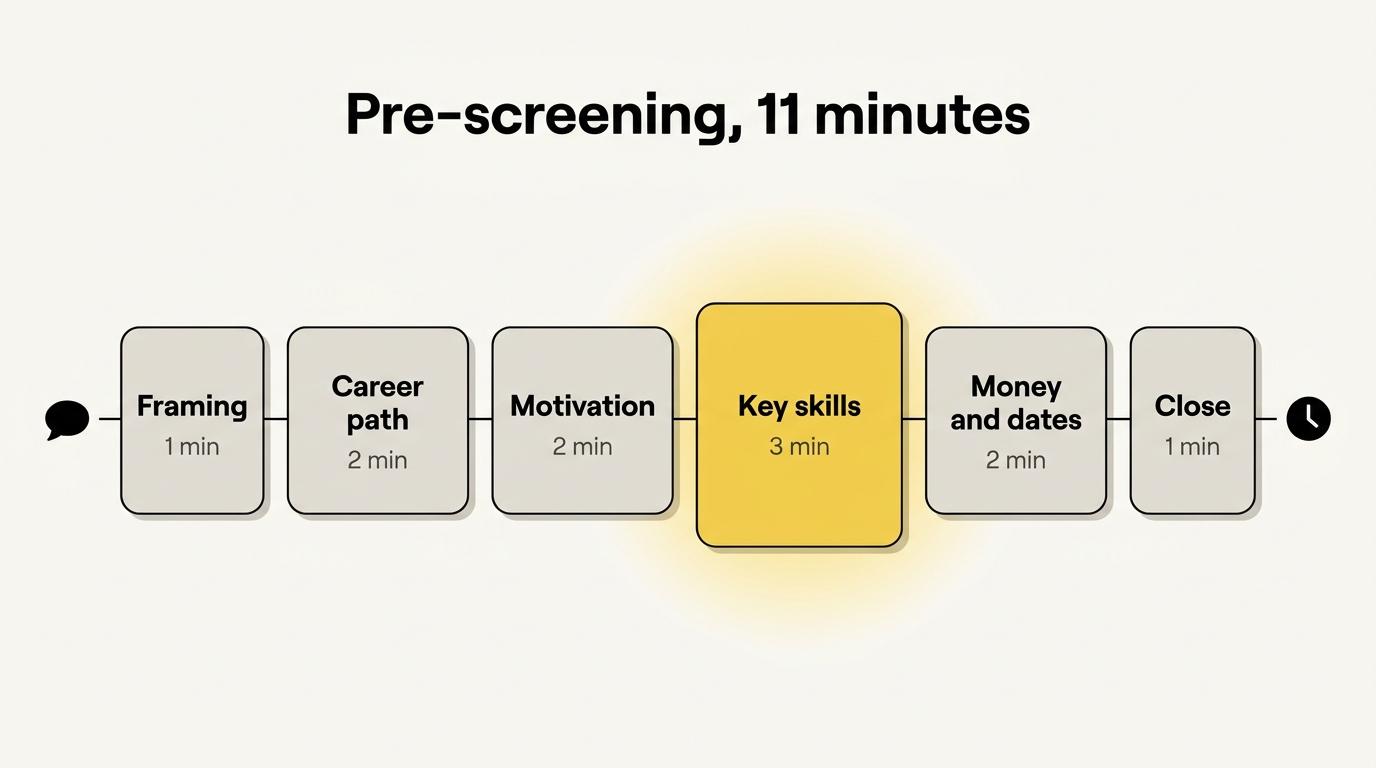
The template runs six blocks in eleven minutes and adapts to any role. It is the structure of the product’s “Candidate pre-screening” model, which you can duplicate and edit per role. The blocks draw on questions 1 to 18, the core of the set. Questions 19 and 20 are conditional: the first when the good candidates move fast, the second when the role carries a specific constraint. Eleven minutes holds five to eight questions with their follow-ups, so each block lists more questions than it asks. Choose from each pool once per role, before sending anything.
| Block | Time | What you are after |
|---|---|---|
| Framing | 1 min | Who you are, what the conversation covers, what happens next, and when |
| Career path | 2 min | The two-minute walkthrough and one follow-up on a decision (questions 1 to 3) |
| Motivation | 2 min | Why this role, what would make them decline (questions 4 to 7) |
| Key skills | 3 min | One concrete story per must-have skill (questions 8 to 11) |
| Money and dates | 2 min | Expectations, notice period, work authorization (questions 12 to 16) |
| Close | 1 min | What does not fit, their questions (questions 17 and 18) |
The prompt version, if you run it as an asynchronous voice interview:
Run a pre-screening for a [job title] role. Ask, in this order: their career in one minute, why they applied for this role, one concrete piece of work that used [key skill], their level on [key skills], their compensation expectations, their notice period and availability, and whether they hold the right to work in [country]. Follow up whenever an answer stays general, and ask for the example behind every claim. Stay neutral, never argue with a candidate, never ask about age, family situation, health or origin. Close by inviting their questions.
Paste it, adapt the bracketed parts, send it to the batch. Candidates answer when it suits them. You read twenty conversations in the time one phone day would have taken.
Getting started
Copy the grid, pick your five to eight questions, decide your response window, and send your first batch. The whole thing costs you an evening of setup and never a scheduling email again. The first 60 interview minutes each month are free, no credit card. The pricing page has the rest. When your new hires settle in, a newcomer survey closes the loop the screen opened.
Frequently asked questions
How long should a screening interview last?
A screening interview lasts ten to fifteen minutes. That covers five to eight questions with real follow-ups. Beyond twenty minutes you are running a first-round interview without meaning to. The comparability across your batch starts to drift.
How many questions should a screening interview have?
A screening interview uses five to eight questions, the same ones for every candidate in the batch. Fewer and you are collecting trivia, more and you are running the full interview early. The follow-ups do the filtering, so budget the time for them rather than for extra questions.
Is a one-way video interview legal and fair?
One-way video interviews are legal, with obligations: in the EU, candidates must be told what the process is. The AI Act also classifies candidate-ranking tools as high-risk, with emotion recognition in hiring banned since February 2025. Fair is a design question. The 2024 Human Resource Management study of 27,809 applicants found reactions improve with preparation time and a rerecord option, and worsen with every extra question. A long fixed question list in front of a camera is the worst-performing design measured.
Can AI screen candidates?
An AI can run the first conversation, transcribe it and summarize it, which removes the scheduling and the note-taking without touching the decision. The decision itself stays with a human, both because a first exchange read as a signal tells you more than any score, and because EU rules point the same way: the AI Act requires human oversight of the high-risk AI systems used in hiring. The GDPR limits decisions made solely by a machine.


