
A Typeform alternative for answers that need more than a box
Tally, Google Forms or a voice interview: which Typeform alternative fits, depending on whether you need a short answer or the story behind it.
September 28, 2026
Godefroy
- Pick a Typeform alternative by the answer you collect. For short, structured answers, Tally and Google Forms do the same job as Typeform for free.
- A form reaches its limit when the useful answer is a story, such as why a customer left or where onboarding went wrong: people skip the open box or type a few words.
- Typeform's free plan stops at 10 responses a month across all forms. Its AI follow-up question starts with the Talent plan, at $169 a month.
- A voice interview asks the question out loud and follows up when the answer stays vague. Raconte bills it by the minute of speech, with 60 minutes free every month.
- Many teams keep a form for the score and add a voice interview for the people whose score needs explaining.
The right Typeform alternative depends on what your form collects. If you need short, structured answers (a sign-up, an order, a score out of 10), Tally and Google Forms do the same job for free, while Typeform stays the most polished option if you pay for it. When the useful answer is a story, such as why a customer cancelled or where the first week went wrong, every form builder hits the same limit: people skip the open box or type a few words. The alternative for that case is a voice interview, where the person talks and an AI asks the follow-up questions. We build Raconte, a voice interview tool, so keep that in mind as you read. This post compares the four options with prices checked in September 2026, and says where Typeform is the right choice.
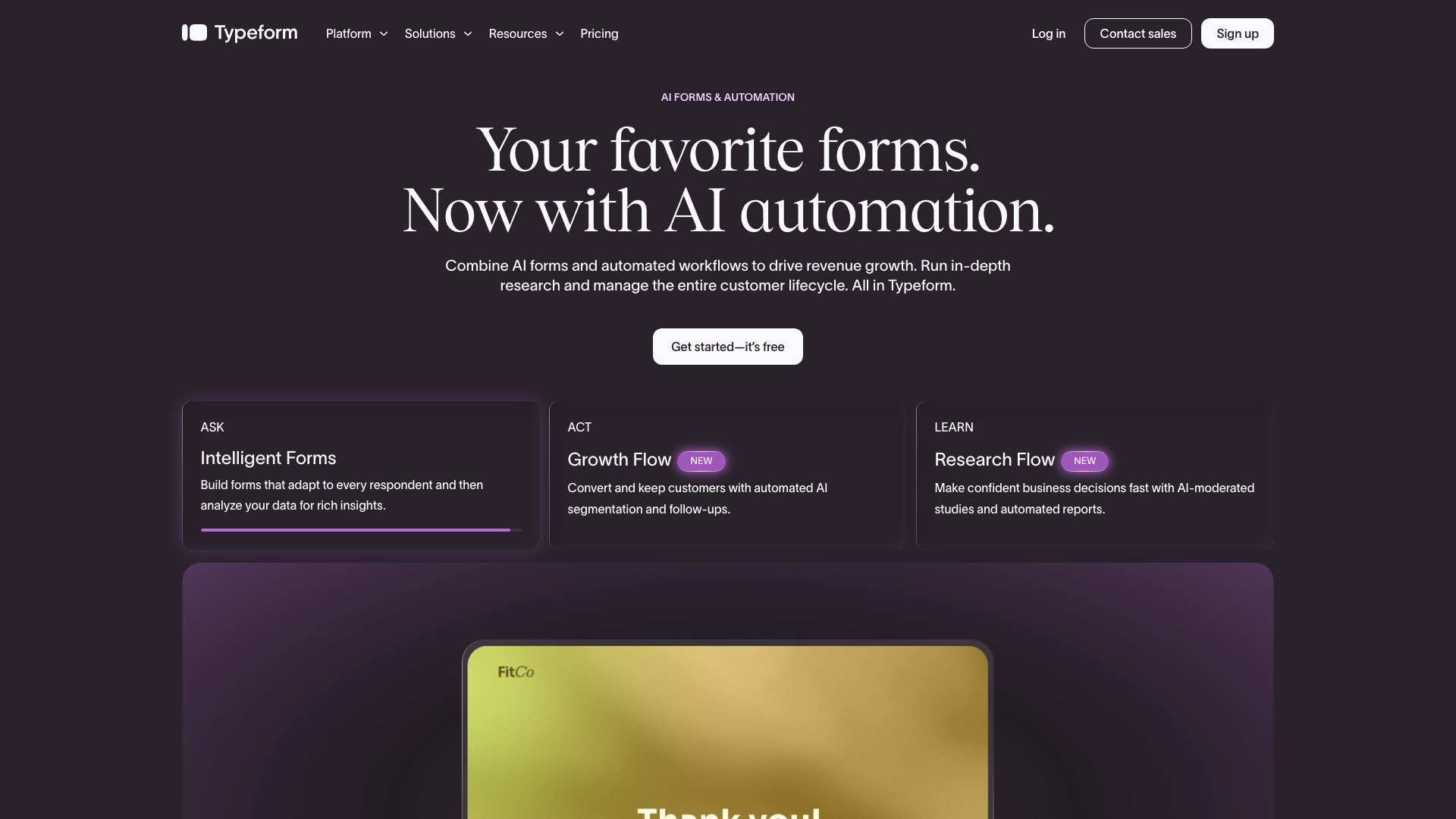
Typeform earned its place. The Barcelona company made the one-question-at-a-time form popular and still makes the best one: its forms look good on a phone, logic jumps take a few clicks to set up, and the integrations cover most marketing stacks. Reviewers on G2 keep naming the design and the ease of building branching forms as the reasons they stay. Typeform also launched Research Flow in June 2026. This separate product, sold through Typeform’s sales team, runs AI-moderated studies in text, voice or video. If you run lead forms, quizzes or applications, stay on Typeform: it is a solid tool for them.
Why teams look for a Typeform alternative
Four complaints come up again and again. Three are about Typeform’s plans and prices. The other one, the open question that comes back empty, affects every form builder.
The response cap closes your forms
Typeform counts responses per account, across all your forms, and resets the count every month. The free plan allows 10 responses a month, Basic 100, Plus 1,000 and Business 10,000. Once the account reaches its cap, the forms stop accepting answers until the next month, so a campaign that goes better than planned stops collecting halfway through.
The price climbs with volume
Basic costs $39 a month on monthly billing, Plus $79 and Business $129. Annual billing brings them down to $28, $56 and $91 a month. G2 reviewers complain about price more often than anything else, though the response cap bothers them more than the headline price: a team that needs 1,001 responses a month pays for the next plan up.
The open question comes back empty
People skip free-text boxes more than any other kind of question. The Pew Research Center measured 18% nonresponse on open-ended questions against 1% to 2% on closed ones, on a paid panel of people used to answering surveys. The answers that do come in are short: “too expensive”, “confusing”, “fine”. A standard form cannot ask what “too expensive” was compared with.
Follow-up questions cost extra
Typeform does offer a fix for short open answers, on its higher plans. Its Clarify with AI question generates up to two written follow-up questions after an open answer. It comes with the Talent, Growth and Enterprise plans, from $169 a month on Talent. Research Flow also covers voice and video, but it has no public price: you go through a demo with the sales team. Typeform says in its launch announcement that participants in these AI-moderated studies give 4.5 times more feedback per question than with traditional approaches. So Typeform itself has reached the same conclusion as us: people say more in a conversation than in a box.
How a voice interview works differently
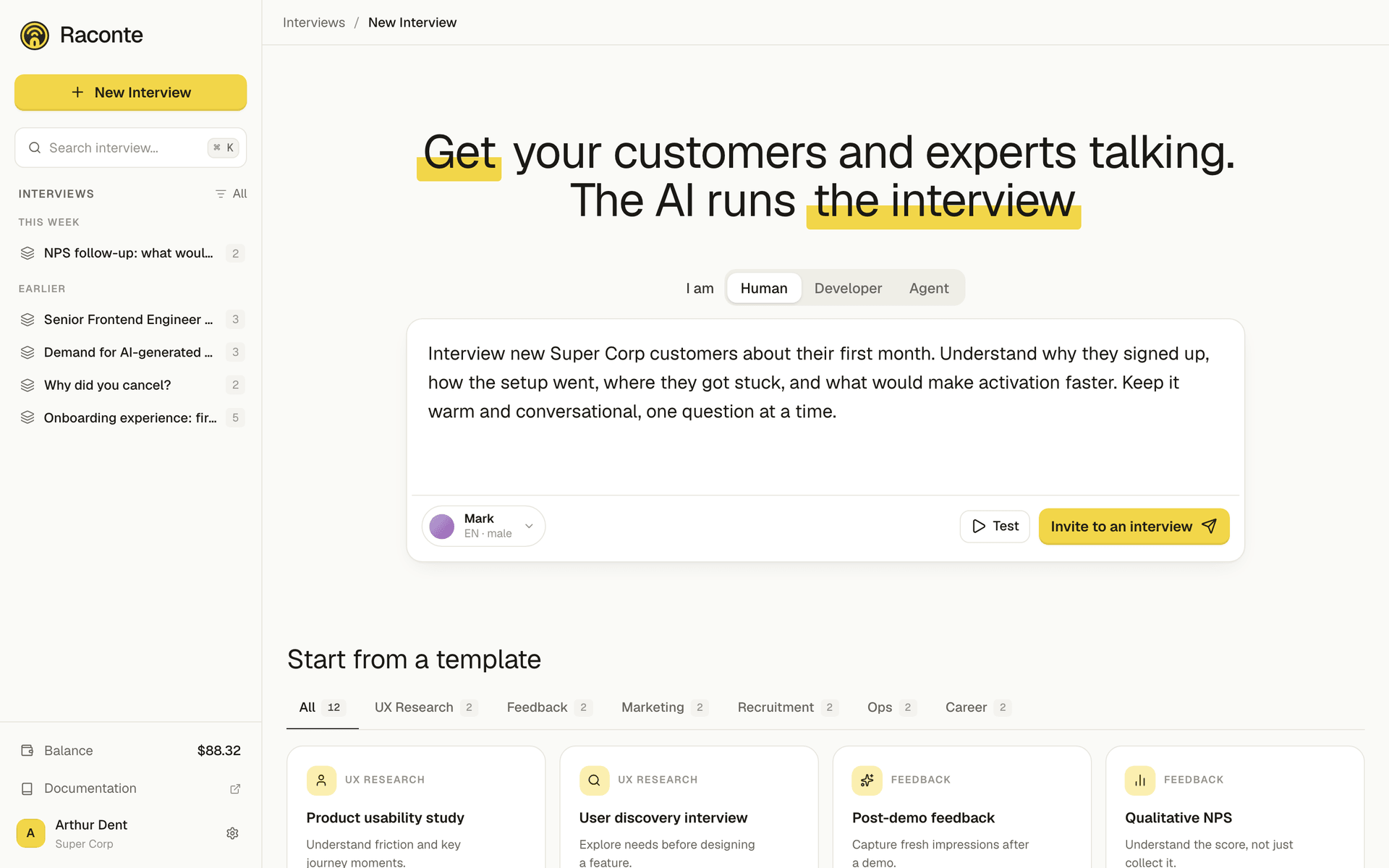
Raconte starts from the conversation rather than from the form. You describe what you want to learn, each person gets a link, and an AI runs a spoken interview with them in their browser.
The AI picks its next question from what the person just said
You write a brief instead of a list of fields: “this customer cancelled last week, find out what made them start looking elsewhere”. Raconte drafts the title, the introduction and the opening question, which you can edit. The AI then follows up when an answer stays vague, the way an interviewer would (“too expensive compared with what?”). People also say more out loud than they type: Jan Karem Höhne, a survey methodologist, and his co-authors measured about 55 words per spoken answer against 21 per typed answer to the same open questions.
The person answers from a link, whenever it suits them
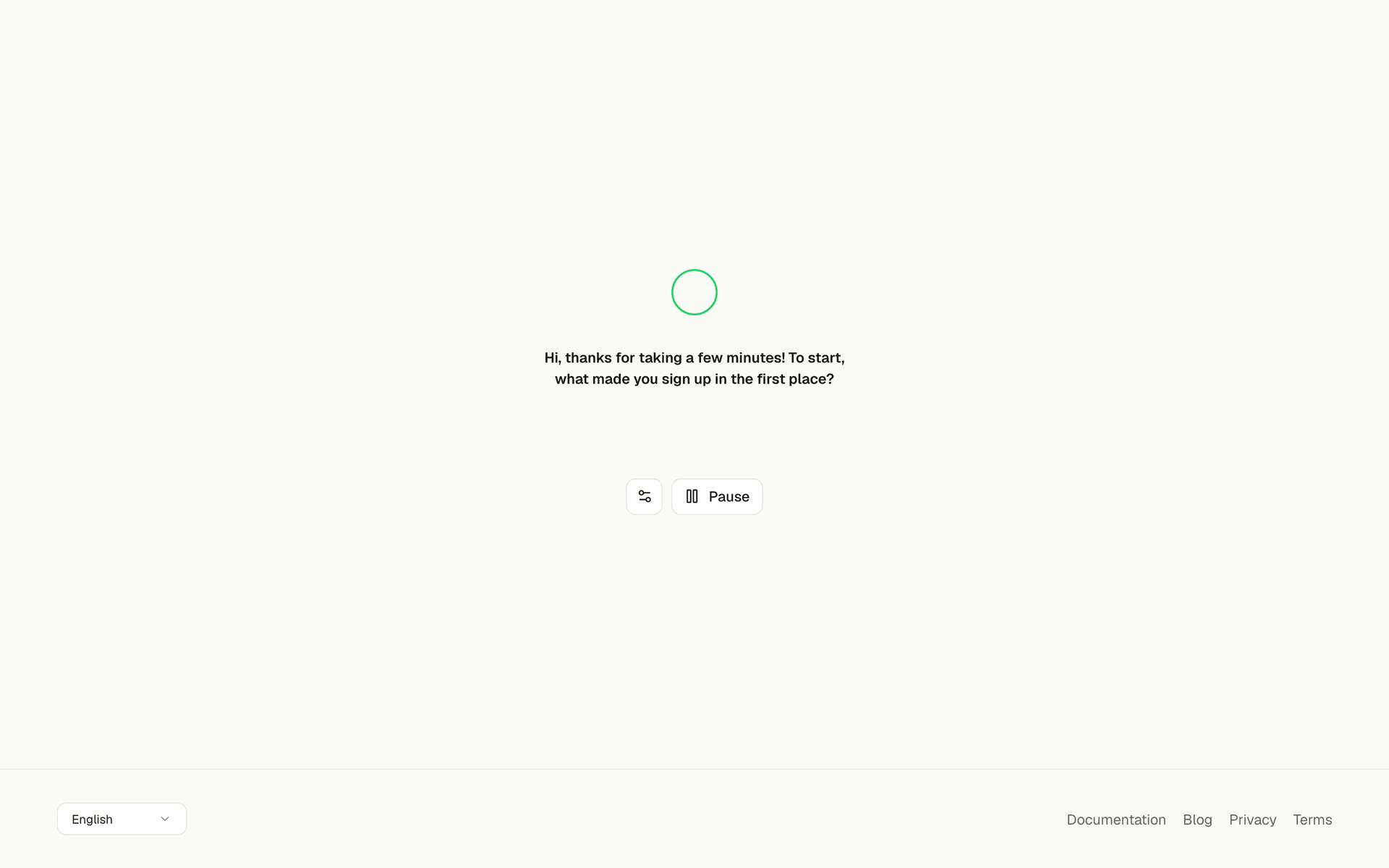
The person opens the link in their browser and starts the interview without creating an account, installing an app or booking a time slot. They can pause, rephrase or go back to an earlier point. 82% of Raconte invitees finish their interview, which lasts 16 minutes on average. You can send one link per person by email, or turn on a reusable share link that anyone can open, with a cap on the number of responses and dates when it opens and closes.
You pay for the minutes people speak
Raconte bills active speech, at $0.12 a minute (€0.10 if you pay in euros). Silences are free, even a long pause while someone thinks. The first 60 minutes every month are free, with no credit card. Then you top up a wallet from $12 and use it when you need it, with no subscription. A study that draws more participants than planned keeps running as long as the wallet has credit, since you pay by the minute rather than by the response.
The transcript is ready when the interview ends
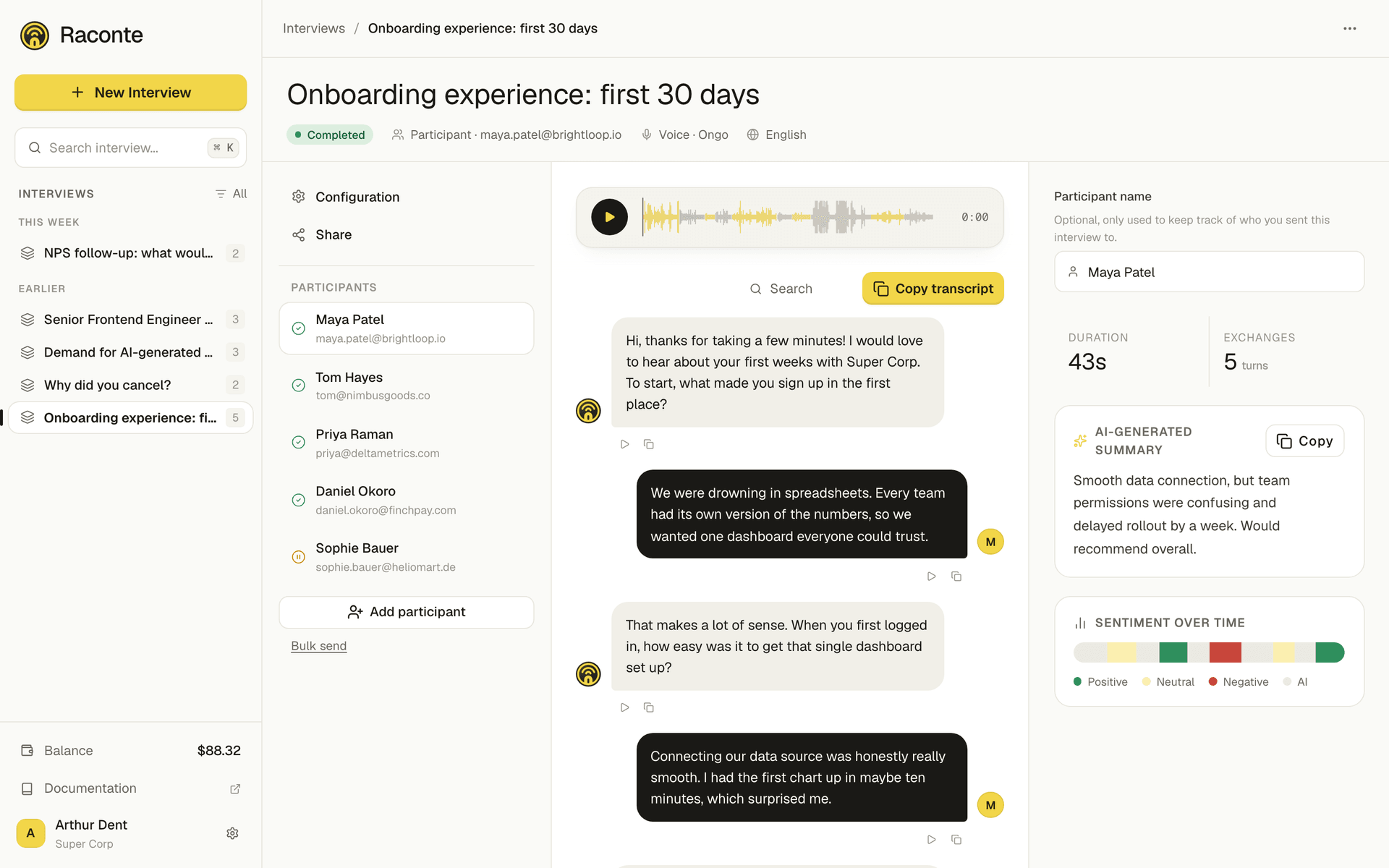
Each interview comes with the full transcript, the audio synced to it word by word, a summary and the sentiment of every message. Read them in the app, or pull them into your own tools through the REST API, the MCP server for AI agents, and webhooks that fire when an interview starts and ends. n8n, Make and Zapier can trigger interviews and collect transcripts through the same API.
Your data stays in France
Raconte stores its data and recordings in France. The models that conduct and analyse the interviews run on servers in France too, so nothing is transferred outside the European Union. Briefs, transcripts and recordings stay yours: nobody trains a third-party model on them.
Typeform vs Tally vs Google Forms vs Raconte
The table compares the four tools on what matters when you pick one. Everything in it was checked in September 2026. Typeform, Tally and Google Forms are form builders, so some rows only apply to them.
| Typeform | Tally | Google Forms | Raconte | |
|---|---|---|---|---|
| What the person does | Clicks and types, one question at a time | Clicks and types | Clicks and types | Talks |
| Free plan | 10 responses a month | Unlimited forms and responses, within fair use | Unlimited, with a Google account | 60 interview minutes a month |
| Paid plans | $39 to $129 a month, or $28 to $91 billed yearly | Pro €20 a month, Business €65 a month | Included in Google Workspace | $0.12 per minute of speech, no subscription |
| Conditional logic | Yes, visual and easy to set up | Yes, on the free plan | Basic, by section | Replaced by the AI’s follow-up questions |
| Follow-up on an open answer | Up to two written questions (Talent plan and above) | No | No | Spoken, whenever an answer stays vague |
| Closed questions and scales | Yes | Yes | Yes | You can ask them, but a form handles them better |
| Payments and file uploads | Yes | Yes | File uploads only | No |
| Design and branding | The most polished of the four | Clean, custom domain on Pro | Plain | Your brand on the Enterprise plan (white-label) |
| What comes back | A row per response | A row per response | A row in Google Sheets | Transcript, audio, summary, sentiment per message |
| Developer access | API and webhooks | API and webhooks | Forms API | REST API, MCP server, webhooks, CLI, SDK |
| Where it fits best | Branded lead forms, quizzes, applications | The same uses, for free | Internal and school forms | Churn, onboarding and customer feedback interviews |
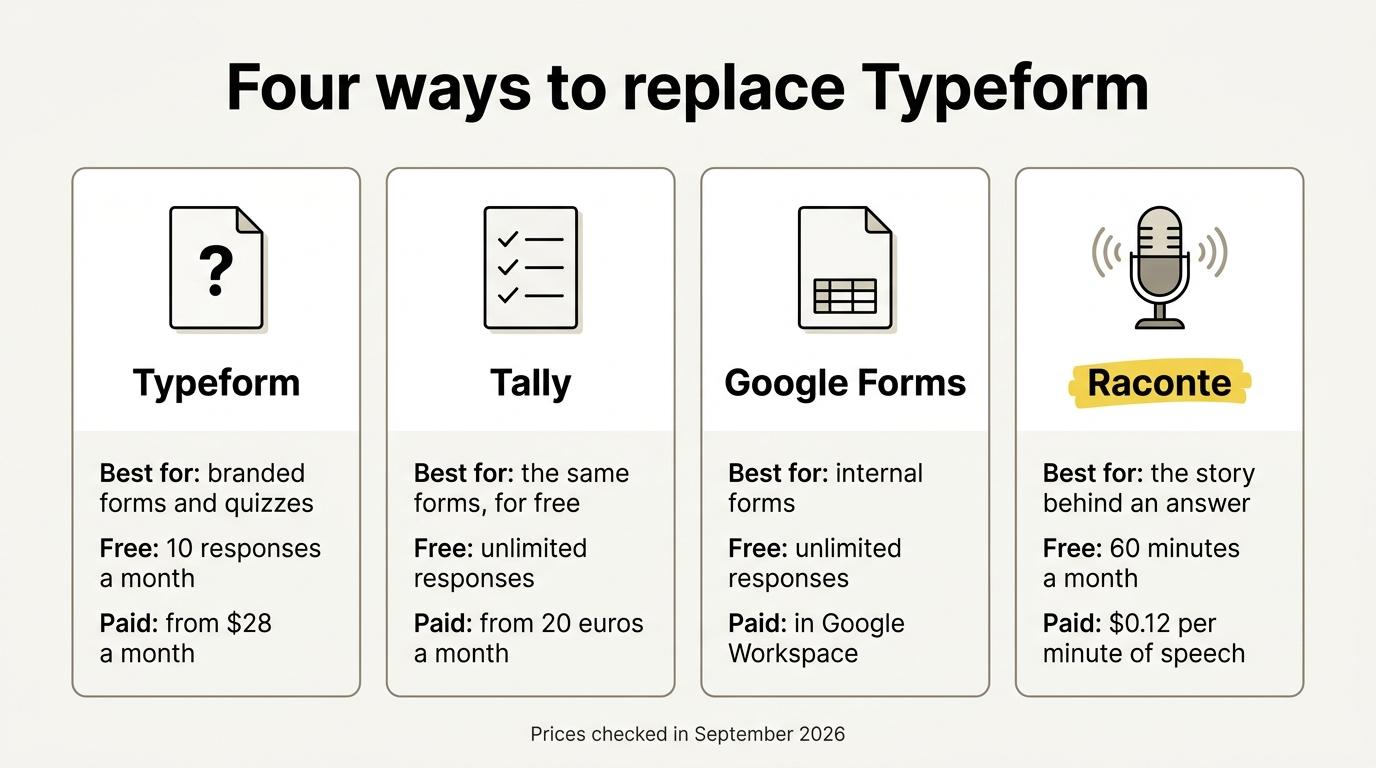
How much each option costs
Typeform charges by the number of responses, Tally and Google Forms charge little or nothing, and Raconte charges by the minute of speech. To compare the three models, price the same study on each.
| Typeform plan | Monthly billing | Yearly billing, per month | Responses a month |
|---|---|---|---|
| Free | $0 | $0 | 10 |
| Basic | $39 | $28 | 100 |
| Plus | $79 | $56 | 1,000 |
| Business | $129 | $91 | 10,000 |
| Talent (with Clarify with AI) | $169 | $119 | 3,000 |
Take a churn study where you want to hear 30 customers who cancelled last quarter.
- On Typeform, 30 responses fit in the Basic plan at $39 for the month. The open question comes without a follow-up, unless you move to Talent at $169.
- On Tally or Google Forms, the same form costs nothing, with the same empty boxes.
- On Raconte, 30 interviews with about ten minutes of speech each add up to 300 billed minutes, which is around $36. The first 60 minutes of the month are free, so the bill comes to about $29.
Now take the opposite case: a two-minute satisfaction form sent to 1,000 customers a month. Typeform Plus covers it for $79. On Raconte, 1,000 two-minute interviews would cost around $240 for answers a score already gives you. Keep the form for that. Pay by the minute when each answer is worth listening to.
Typeform and Raconte both price their Enterprise plans on quote. Raconte’s Enterprise plan adds volume discounts, SSO, white-label and an SLA.
Which one to choose
If you are choosing your first tool, start from the answer you need rather than from the tool.
- You need a branded lead form, an application or a quiz with payments. Take Typeform, whose design and logic are worth the price.
- You need the same kind of form without paying per response. Take Tally, whose free plan includes unlimited responses and conditional logic.
- You collect answers inside a company or a school that already runs on Google. Google Forms does the job and saves the answers to Google Sheets.
- You want to host the form yourself. A self-hosted instance of Formbricks, OpnForm or HeyForm (all three are open source, under the AGPLv3) has no response cap.
- You need to know why a customer left, how their first week went, or what “too expensive” means to them. Take Raconte, whose AI follows up out loud whenever an answer stays vague.
If you need an NPS program or a question shown inside your product rather than a form, look at customer feedback tools grouped by the moment they ask.
If you already use Typeform, you rarely need to leave it. Keep your forms for the scores, the sign-ups and the payments. Add a voice interview for the people whose answer needs explaining.
graph TD
  A["What does the useful answer look like?"] --> B{"A choice, a number or a sign-up?"}
  B -->|"Yes"| C{"Do you need branding, payments or advanced logic?"}
  C -->|"Yes"| D["Typeform"]
  C -->|"No"| E{"Does your team already work in Google?"}
  E -->|"Yes"| F["Google Forms"]
  E -->|"No"| G["Tally, or an open source form you host yourself"]
  B -->|"No, it is a story"| H{"Do you also need a score you can track?"}
  H -->|"Yes"| I["A form for the score, then a Raconte interview for the people who need to explain it"]
  H -->|"No"| J["A Raconte interview on its own"]
What switching to Raconte involves
Starting from scratch
You write a brief of a few lines: who you are talking to, what you want to learn, the topics to cover. Raconte drafts the introduction and the opening question from it. You choose the language of the interview, English or French. Test the interview on two or three colleagues first, read their transcripts, and adjust the brief wherever the AI strayed from what you wanted to learn. Then send the invitations by email, in bulk from a list, or post the share link.
Raconte has no payment step and no file upload. It has no conditional logic either, because the AI picks the next question itself. An invitation carries only a name and an email, with no equivalent of Typeform’s hidden fields. If you need to know which plan a person was on, keep it in your own list.
Moving an existing Typeform study
Paste your open questions into the brief as the topics to cover: the AI turns them into a conversation. Leave the closed questions, the scores and the multiple choices in Typeform, or move them to Tally if the price was what made you look around.
You can keep both tools side by side. Put the interview link on the ending screen of your form, or let your automation send it: when a low score comes in, n8n, Make or a script creates a Raconte invitation through the API and emails the link. Once the interview ends, a webhook sends the transcript back to your team. Your Typeform forms stay as they are, so you can try an interview on one study before deciding anything else.
Frequently asked questions
What is the best alternative to Typeform?
It depends on what you collect. Tally is the closest alternative if you want the same kind of form without the response cap: its free plan includes unlimited responses and conditional logic. Google Forms suits internal forms in a company that already uses Google. A voice interview tool such as Raconte fits better than a form when you need the reason behind an answer rather than the answer itself, because the AI follows up out loud whenever an answer stays vague.
Is there a free version of Typeform?
Yes, Typeform has a free plan, limited to 10 responses a month across all your forms. The first paid plan, Basic, costs $39 a month, or $28 a month billed yearly, for 100 responses. If you need more responses for free, Tally and Google Forms have no monthly response cap on their free plans.
Why is my Typeform closed?
Usually because the account reached its monthly response limit. Typeform counts responses across all the forms of an account. Once the plan’s cap is reached, the forms stop accepting answers until the count resets the following month. A form can also close because its owner set a response limit or a closing date in its settings.
Is Tally or Typeform better?
Tally suits you better if you want to avoid paying per response, since its free plan includes unlimited forms, responses and conditional logic. Typeform suits you better if design and branding come first, or if you need its integrations and its AI features. Both collect the same kind of written answers, so neither helps when people leave the open question empty.
Is Jotform or Typeform better?
Jotform suits long, complex forms with many field types. Its free plan allows 5 forms and 100 submissions a month. Typeform suits short forms that need to look good and feel conversational. For open feedback, both run into the same limit as every form: people type far fewer words than they would say out loud.
Is there an open source alternative to Typeform?
Yes, several. Formbricks, OpnForm and HeyForm are open source form builders under the AGPLv3 licence. Formbricks and OpnForm keep some enterprise features under a separate licence. If you host them yourself with Docker, there is no response cap. You then run the servers, the updates and the backups yourself.
Should I start with Typeform or with Raconte?
Start with a form if what you need is a number you can track, a sign-up or a payment. Start with Raconte if you already have the number and want to know why it moved, or if the question you want to ask is “take me through what happened”. Many teams end up using both: a form for everyone, then an interview for the people whose score needs explaining.
Keep the form, add the conversation
Typeform, Tally and Google Forms are good at the same thing: collecting short answers from a lot of people. Pick Typeform for the design, Tally for the price, Google Forms for a team that already works in Google. When the answer you are missing is a story, move from a form to a voice interview rather than to another form builder. Raconte runs those interviews for you. The first 60 interview minutes every month are free, with no card required, then each minute of speech is billed at $0.12.


